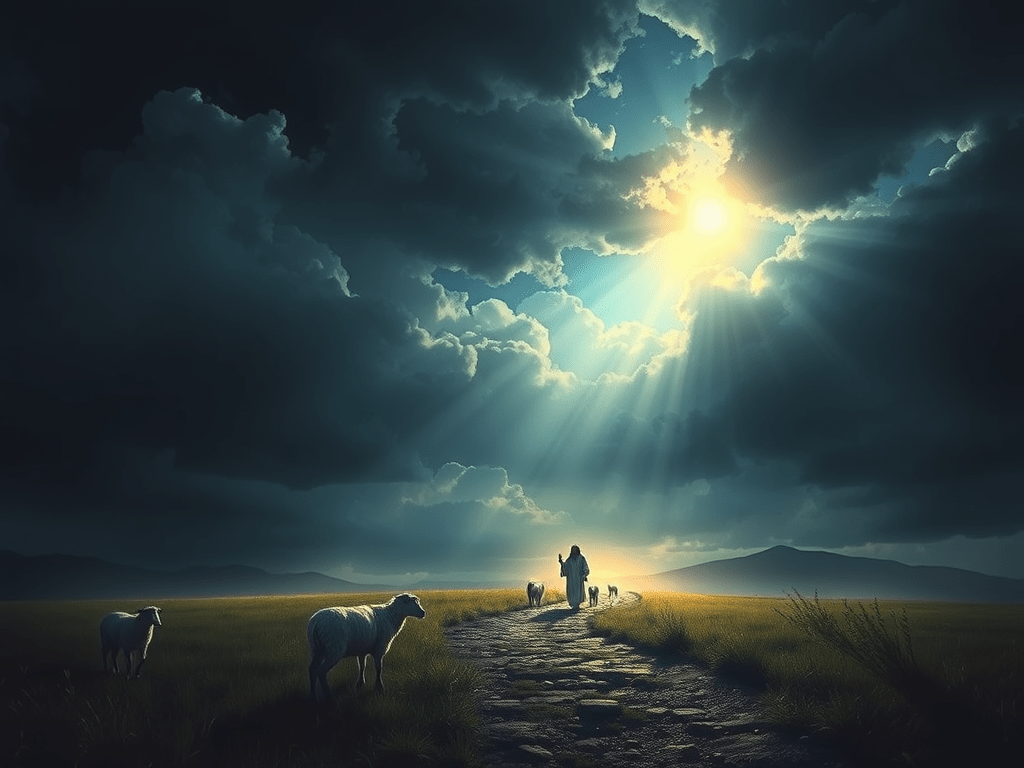
I was reading James Howe’s sermon on Acts 1:7, and I wanted to share with you some imagery from it you can use during a meditation time. In Acts 1:7, Jesus says to His disciples, “It is not for you to know the times and the seasons, which the Father hath put in his own power.” Howe explains this verse at length in the full sermon. I wanted to quickly share some imagery from the sermon with you.
1. Alternate between thinking about God’s attributes and our capacities as humans:
Howe says, “We ought to admire here the divine wisdom and mercy in conjunction, upon this occasion; that he doth not let us have any more knowledge than what will suit with our power in such things. What a dreadful concurrence would it be in us between infinite knowledge and finite power!”
One way we are supposed to meditate is to alternate between thinking about our own limitations as humans and God’s unlimitedness. It helps us to see that He is that fountain from whom all blessings flow. It increases our faith because as we meditate on how God has infinite knowledge and power and we have limited knowledge and power, we begin to see not only that we can trust Him, but also that we need to trust Him.
This goes along with the imagery from Hannah Whitall Smith’s book God of All Comfort, that we are sheep in need of a shepherd.
2. Let God be eyes to us:
Later in his sermon, Howe says that we are blind as to what will happen tomorrow – we cannot know the future – and we must trust God to be eyes to us. He says, “And so though we be blind and cannot see the product of to-morrow; know not what a day will bring forth; we shall have him to be eyes to us. He will be eyes to the blind, if they will but trust in him; as when a blind person is led by another he useth that person’s eyes, who leads him. Let him lead us on from day to day, time to time and season to season. We cannot see with our own eyes, but is it not better for us that we have better eyes to see with? For we have one to see for us, who seeth infinitely better than we.”
So envision yourself in the dark and unable to see where you are going. You need God to guide your steps forward. When you envision that, you can see how it is necessary for you to trust in God in order to follow Him. We must trust where He is leading us before we will take that first step. Take note of how you feel when you envision God guiding you in the dark. Are you trusting in Him? Are you used to following His guidance? I find when I practice with that imagery, I still feel hesitation at times and I’m just not used to waiting in that sense for God’s guidance. That’s why we need to spend time meditating on our condition in this world and see that we really are sheep in need of a shepherd…sheep that could not see the way without God. We must wait for His guidance.
3. A restriction that stands between us and tomorrow:
There was another image in the sermon of a filter or insulation between our thoughts about today and our thoughts about tomorrow. Howe says about us not knowing the times and seasons of things, “There is a great deal of compassion in this: that since it belongs to our state as creatures to be able to do but little, to be mere dependencies, impotent things, that therefore we should not have a fore-knowledge of what it would be afflictive to us to foreknow. We are therefore put under a restriction that comes so close to us, as to stand betwixt us and to-morrow. “Take no thought for the morrow; sufficient for the day is the evil thereof.” We are not to range with afflicting thoughts so far as to the next day. Thou wilt have enough in this day to trouble thee with, never let thy solicitude be conversant about the accessions of time. We foolish creatures should fetch the troubles of all our days into every day, if we could foreknow what is to come. Take then no thought for to-morrow! it is enough for you that you have One to think of you, and care for you. And it will make most for your advantage to be looked upon by him every day; who will make your strength to be sufficient for each day when it comes.”
When I read that, I saw in my mind the imagery of a calendar. On a calendar, there is a line between each day, marking off one day from the next. I started seeing imagery of that line being a filter or insulation of some type that would keep my mind thinking about today and not ranging into tomorrow. I saw myself standing in one block of the calendar, or one single day. And instead of looking forward to the next day, I was looking up to God and praying about the events of the current day.
One important point that Howe makes in the sermon is when he says, “We are barred up as to future time; but we are bid to know the present time, and what God calls for at our hands therein.” Earlier in the sermon, Howe explains that Jesus answered His disciples question about wanting to know the times and seasons by reminding them, “Your work and business must be to be witness bearers to me, to my name and truth; to be my agents to carry on the business and design of that spiritual kingdom, which I am intent to establish, and promote, and spread through the whole world. And in order thereunto, you shall have a power come upon you which you shall little understand till you feel it, and which shall furnish you for this great work. ‘You shall receive power after that the Holy Ghost is come upon you: and ye shall be witnesses unto me, both in Jerusalem, and in all Judea, and in Samaria, and unto the uttermost parts of the earth.’ (Acts 1:8)” And later in the sermon Howe says, “The present time points out such and such work that we should be intent upon. We cannot indeed know these reserved times and seasons; let us then know the times, that are left open to our view. As now this present time is come, but do we know what ought to be the work of this time? God hath ordered for us this time, this season to be waiting for him, humbling ourselves before him.” In the imagery, I see myself standing in the block of the calendar that is today, asking God what is the work of today?
So the imagery I found in this sermon that we can use during meditation time is:
- Envision a concept in your mind of God’s infinite power and knowledge and a concept of human beings’ finite, or limited, knowledge and power. And then alternate between thinking about the two. You could look up to God in heaven and think of His attributes, and then return your attention to yourself and notice the limitations of human beings in comparison to God.
- Envision letting God be your eyes as He guides you on a dark pathway.
- Envision a restriction for your thoughts between today and tomorrow.
Here is a link to the full sermon: John Howe: Whole Works of the Rev. John Howe, M.A. with a Memoir of the Author. Vol. VI. – Christian Classics Ethereal Library
 Learning to Live by Faith
Leave a comment