-
“He Wore a Crown of Thorns” by William M. Runyan

Hymnal Page Scan: The New National Baptist Hymnal (21st Century Edition) 114. ‘Twas God’s own Son who came to earth | Hymnary.org
Audio Recording:
1 ‘Twas God’s own Son who came to earth,
Who chose to know a lowly birth;
But, tho’ a King of matchless worth,
He wore a crown of thorns.Refrain:
He wore a crown of thorns that I
might wear a crown of glory!
He laid His heav’nly splendors by
to bring me love’s sweet story.
In poverty He walked life’s way,
In Olive’s garden bowed to pray;
He wore a crown of thorns that I
might wear a crown of glory!2 Wonderful Counsellor was He,
Matchless His grace; how could it be
That at the last, He wore for me
That bitter crown of thorns? [Refrain]3 Kind were the deeds that crowned each day,
Gracious the words His lips would say,
While He pursued the fateful way
To wear that crown of thorns. [Refrain]4 Never again His brow shall know
Piercings of agony and woe
But ’twas for us that, here below,
He wore the crown of thorns. [Refrain] -
Christmas Hymn: “For God So Loved the World” by Eliza E. Hewitt

Hymnal Page Scan: For God So Loved the World
Audio Recording:
1. A story sweet and wondrous,
Like heav’nly music swells;
In chimings clear to all who will hear,
Ring out the Gospel bells.Refrain
For God so loved the world
That He gave His only begotten Son,
That whosoever believeth in Him,
Whosoever believeth in Him
Should not perish,
Should not perish,
But have everlasting life.2. When, grieving, brokenhearted,
Because of sin and shame,
We find a joy earth cannot destroy,
Believing on His name. [Refrain]3. This love beyond all measure
Of earth or sea or sky,
Could only show its full overflow,
When Jesus came to die. [Refrain]4. Come, brother, come to Jesus;
His Word was meant for you;
His grace receive, His promise believe,
And sing His praise anew. [Refrain] -
Christmas Hymn: “Like the Sound of Many Waters” by Fanny Crosby

Hymnal Page Scan: Gems of Song: for the Sunday School page 250 | Hymnary.org
Audio Recording:
1. Like the sound of many waters
Rolling on through ages long;
In a tide of rapture breaking—
Hark! the mighty choral song!Refrain
Hallelujah! Hallelujah!
Let the heav’nly portals ring!
Christ is born, the Prince of glory!
Christ the Lord, our mighty King!2. Lo! the Morning Star appeareth,
O’er the world, His beams are cast;
He the Alpha and Omega,
He the Great, the First, the Last. [Refrain]3. Clap your hands with exultation!
Sing aloud, rejoice with mirth,
Peace her silver wing hath folded:
Lo! she comes to dwell on earth! [Refrain]4. Savior, not with costly treasure
Do we gather at Thy throne,
All we have, our hearts we give Thee,
Consecrate them Thine alone. [Refrain] -
Imagery from John Howe’s Sermon on Acts 1:7
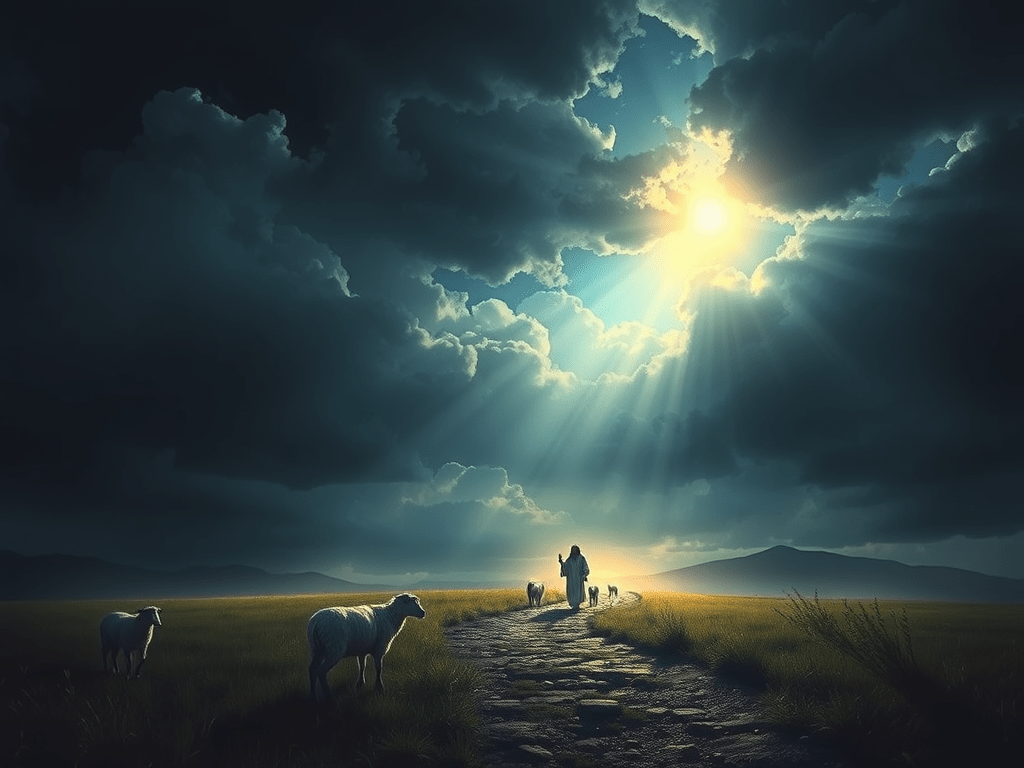
I was reading James Howe’s sermon on Acts 1:7, and I wanted to share with you some imagery from it you can use during a meditation time. In Acts 1:7, Jesus says to His disciples, “It is not for you to know the times and the seasons, which the Father hath put in his own power.” Howe explains this verse at length in the full sermon. I wanted to quickly share some imagery from the sermon with you.
1. Alternate between thinking about God’s attributes and our capacities as humans:
Howe says, “We ought to admire here the divine wisdom and mercy in conjunction, upon this occasion; that he doth not let us have any more knowledge than what will suit with our power in such things. What a dreadful concurrence would it be in us between infinite knowledge and finite power!”
One way we are supposed to meditate is to alternate between thinking about our own limitations as humans and God’s unlimitedness. It helps us to see that He is that fountain from whom all blessings flow. It increases our faith because as we meditate on how God has infinite knowledge and power and we have limited knowledge and power, we begin to see not only that we can trust Him, but also that we need to trust Him.
This goes along with the imagery from Hannah Whitall Smith’s book God of All Comfort, that we are sheep in need of a shepherd.
2. Let God be eyes to us:
Later in his sermon, Howe says that we are blind as to what will happen tomorrow – we cannot know the future – and we must trust God to be eyes to us. He says, “And so though we be blind and cannot see the product of to-morrow; know not what a day will bring forth; we shall have him to be eyes to us. He will be eyes to the blind, if they will but trust in him; as when a blind person is led by another he useth that person’s eyes, who leads him. Let him lead us on from day to day, time to time and season to season. We cannot see with our own eyes, but is it not better for us that we have better eyes to see with? For we have one to see for us, who seeth infinitely better than we.”
So envision yourself in the dark and unable to see where you are going. You need God to guide your steps forward. When you envision that, you can see how it is necessary for you to trust in God in order to follow Him. We must trust where He is leading us before we will take that first step. Take note of how you feel when you envision God guiding you in the dark. Are you trusting in Him? Are you used to following His guidance? I find when I practice with that imagery, I still feel hesitation at times and I’m just not used to waiting in that sense for God’s guidance. That’s why we need to spend time meditating on our condition in this world and see that we really are sheep in need of a shepherd…sheep that could not see the way without God. We must wait for His guidance.
3. A restriction that stands between us and tomorrow:
There was another image in the sermon of a filter or insulation between our thoughts about today and our thoughts about tomorrow. Howe says about us not knowing the times and seasons of things, “There is a great deal of compassion in this: that since it belongs to our state as creatures to be able to do but little, to be mere dependencies, impotent things, that therefore we should not have a fore-knowledge of what it would be afflictive to us to foreknow. We are therefore put under a restriction that comes so close to us, as to stand betwixt us and to-morrow. “Take no thought for the morrow; sufficient for the day is the evil thereof.” We are not to range with afflicting thoughts so far as to the next day. Thou wilt have enough in this day to trouble thee with, never let thy solicitude be conversant about the accessions of time. We foolish creatures should fetch the troubles of all our days into every day, if we could foreknow what is to come. Take then no thought for to-morrow! it is enough for you that you have One to think of you, and care for you. And it will make most for your advantage to be looked upon by him every day; who will make your strength to be sufficient for each day when it comes.”
When I read that, I saw in my mind the imagery of a calendar. On a calendar, there is a line between each day, marking off one day from the next. I started seeing imagery of that line being a filter or insulation of some type that would keep my mind thinking about today and not ranging into tomorrow. I saw myself standing in one block of the calendar, or one single day. And instead of looking forward to the next day, I was looking up to God and praying about the events of the current day.
One important point that Howe makes in the sermon is when he says, “We are barred up as to future time; but we are bid to know the present time, and what God calls for at our hands therein.” Earlier in the sermon, Howe explains that Jesus answered His disciples question about wanting to know the times and seasons by reminding them, “Your work and business must be to be witness bearers to me, to my name and truth; to be my agents to carry on the business and design of that spiritual kingdom, which I am intent to establish, and promote, and spread through the whole world. And in order thereunto, you shall have a power come upon you which you shall little understand till you feel it, and which shall furnish you for this great work. ‘You shall receive power after that the Holy Ghost is come upon you: and ye shall be witnesses unto me, both in Jerusalem, and in all Judea, and in Samaria, and unto the uttermost parts of the earth.’ (Acts 1:8)” And later in the sermon Howe says, “The present time points out such and such work that we should be intent upon. We cannot indeed know these reserved times and seasons; let us then know the times, that are left open to our view. As now this present time is come, but do we know what ought to be the work of this time? God hath ordered for us this time, this season to be waiting for him, humbling ourselves before him.” In the imagery, I see myself standing in the block of the calendar that is today, asking God what is the work of today?
So the imagery I found in this sermon that we can use during meditation time is:
- Envision a concept in your mind of God’s infinite power and knowledge and a concept of human beings’ finite, or limited, knowledge and power. And then alternate between thinking about the two. You could look up to God in heaven and think of His attributes, and then return your attention to yourself and notice the limitations of human beings in comparison to God.
- Envision letting God be your eyes as He guides you on a dark pathway.
- Envision a restriction for your thoughts between today and tomorrow.
Here is a link to the full sermon: John Howe: Whole Works of the Rev. John Howe, M.A. with a Memoir of the Author. Vol. VI. – Christian Classics Ethereal Library
-
How I Started Studying the Bible
I wanted to write to let you know about how I started studying the Bible. I grew up going to church. In Sunday School we would learn memory verses and I had a little book that had verses from Proverbs in it that I would read. I also had a Children’s Bible that I would read through at night before I went to bed.
When I was in about the 6th grade, my mom bought a One-Year Bible. I hadn’t seen one before. I asked if I could look at it, and it was a Bible that was printed in a format of daily devotionals. This was around the year 1994, and it wasn’t long after that before I started hearing people talking about the end of the world. There were people saying that the world was going to end in the year 2000 and there was a lot of stress about Y2K – a fear that computers were going to stop working when they had to change from 99 to 00 for the year 2000.
I was only about 12 years old at the time, and I don’t know if I had heard before that Jesus was going to be returning. If I had heard about it, it was only mentioned in a way where I did not understand how serious it would be – although it is not supposed to be terrifying to us. At Youth Group, I saw some sensationalized videos of the rapture where people were disappearing and it was very scary. I started developing a lot of stress about it. One night I was having a panic attack during a thunderstorm because I had heard someone at school say that Jesus was going to return during a thunderstorm. I knew that Jesus was probably not returning at that moment, but I realized then how much the stress of it was affecting me. My mom asked me what was wrong, and I explained that I was distressed because people were saying that Jesus was returning and I didn’t know if what they were saying was true or not. She said that Jesus was going to return, but that she didn’t know much about how it would happen. She thought the things I was hearing were sensationalized, though.
So now I knew it was true that Jesus was returning, but what about everything else that was being said? Was it in the Bible? I remember that particular feeling of uncertainty I felt when I didn’t know if those things were true or not. How would I know if something someone said was in the Bible really was in there or not if I had never read the Bible myself? God reminded me of that One-Year Bible, and I could feel that He was leading me to start reading through the Bible.
Sometime soon after that thunderstorm, my mom took me to the bookstore after school. I went to the Bible section and got a book that said it was about Revelation. I went home and went out and sat down on the deck with my border collie, and started reading through Revelation and the study guide. I knew I wasn’t understanding everything I was reading, but I felt God’s presence there with me as I was reading through His word. I felt a sense of peace. Whatever was going to happen over the next few years, God was going to be there with us. I also noticed that Revelation didn’t say anything specific about the world ending in the year 2000. As I kept reading, I wasn’t sure if the study guide I had bought about Revelation was accurate or not. The Bible I was reading in was an NIV Zondervan Study Bible, so I started reading through those study notes.
After I finished reading Revelation, I wanted to keep reading through the Bible daily. So I started reading through the One-Year Bible. Not long after I started reading through it, I read Matthew 24:36, in which Jesus says about the time when the world will end, “But about that day or hour no one knows, not even the angels in heaven, nor the Son, but only the Father.” I felt a lot of comfort from that verse and was able to stop having as much stress about the world ending. I really enjoyed feeling God’s presence with me as I read through the Bible, so after I got home from school, I would go outside with my border collie and would read through my daily devotional in the One-Year Bible.
When I was 16 years old, I started getting sick. I had to homeschool my last 2 years of high school and was not able to finish college. It took 11 years to get the diagnosis of Eosinophilic Esophagitis and Gastroparesis. During those years, I kept doing my daily quiet time. I used the NIV Zondervan Study Bible that I used to read Revelation in 1994, and read through the study notes for the whole Bible. That took many years. And after I had finished that, I started reading the Matthew Henry commentary and other commentaries and books. I would try to be sure to have quiet time for 30 minutes to 1 hour a day. And a lot of times I would play several hymns also. It made such a difference in my life to have a daily quiet time, so I’m trying to build a resource here on this website for people to use during their quiet times. There will be posts people can read for a devotional time and hymns for people to listen to.
After I got the diagnoses of EoE and Gastroparesis, I was still having a lot of symptoms. In 2012, I was diagnosed with Mind Body Syndrome and started working with a counselor who used a holistic approach. I wrote in my post How to Use Imagery from Hymns in Christian Meditation – Learning to Live by Faith about how she used guided imagery and meditation. So it was in 2012 that I learned to meditate using guided imagery, hypnosis, and mindfulness techniques. During that time, God brought to my mind all of the imagery He has given us throughout the Bible. So I started incorporating Biblical imagery into my meditation time and found it to be a very powerful experience. I’ve recently started writing posts on here about Christian meditation and look forward to continuing to share with you what I have learned. I hope you will find it to be healing and helpful.
So I started reading the Bible to find out what it said about Jesus’ return, and I have learned about it over the years and hope to post about it on here in the future. There are many beautiful hymns that are about Jesus’ second coming. We cannot know when Jesus will return, but as Christians we are supposed to be living with the expectant hope of meeting our Savior face to face, whether that happens after experiencing death at the end of earthly life or whether that happens if we get to experience Jesus’ return during our lifetime. That is how Christians have lived since His ascension – waiting to see Jesus. And we do not need to fear death or Jesus’ second coming because we have received a pardon for our sins and are reconciled to God through Christ.
So again, I’m looking forward to posting about Christian meditation and about what I am learning in my daily quiet times. And I am still hoping to get the website design changed to where there is a menu so that the devotionals will be posted on one page and the hymn recordings will be posted on another page.
-
Christian Meditation: God, the Almighty King

In my previous post, I wrote about how God created the earth as a habitation for man. In this post, we will see how God lovingly rules over His creation as the Almighty King. When I was growing up, I think the descriptions of God I was most familiar with were of Him as a loving Father or a friend. I had heard and read about Him being the King, but I don’t know that I spent as much time thinking of Him that way. It is important to know that God is our Father and friend. But it is also very important to remember that He is the Almighty King because we must remember all of His attributes. Yes, He is gentle, loving, kind, holy, righteous, good, but He is also omnipotent, omniscient, and infinite. In Matthew Henry’s commentary on the Lord’s Prayer, he explains that God is our Father but that we must remember He is our Father in heaven. God is infinitely above us. And that is what we are supposed to be in awe of and rejoicing in. The great, Almighty God is our loving father and friend! We have a gentle, loving, merciful, righteous King! We can find great comfort in meditating on God’s almighty power because it gives us the assurance that He truly has the power to save our souls from hell. And we can say along with Paul in 2 Tim. 1:12, “For I know whom I have believed, and am persuaded that he is able to keep that which I have committed unto him against that day.” The great God of the universe, who is Lord of all, has promised us eternal life with Him in heaven through faith in Jesus Christ, His Son. And we can trust in that promise.
In terms of meditation, try to take time to form imagery of these concepts in your mind. Envision God on His throne in heaven, lovingly ruling over His creation. You can read Revelation 4 and meditate on the imagery that is used there. Rev. 4:2-3 says, “2 At once I was in the Spirit, and there before me was a throne in heaven with someone sitting on it. 3 And the one who sat there had the appearance of jasper and ruby. A rainbow that shone like an emerald encircled the throne.” The entire chapter contains imagery you can use.
As you are envisioning God on His throne, take time to contemplate that this great God, the Lord of heaven and earth, wants to be in covenant with you. God created earth as a habitation for man and God wants to be in a close relationship with us. He does not want to be at a distance from us. The covenant language of the Old Testament can be seen in Jeremiah 30:22 in which God says, “So you will be my people, and I will be your God. ” This is what God desires for us. He wants to be our God to guide and care for us. The covenant that is in the Old Testament is the same covenant that is in the New Testament. So, there is one covenant and two different administrations of the same covenant (which I hope to write a post about at another time). In the New Testament, 2 Cor. 6:18 echoes the covenant language of the Old Testament and shows the close relationship that God wants to have with His people: “I will be a Father to you, and you will be my sons and daughters, says the Lord Almighty.”
When you become a Christian, you are adopted by God as his child. You become a child of the King and an heir of His Kingdom. In John Gill’s book Doctrinal Divinity, he explains that there are verses in the book of Hebrews that show us that the word “testament” is used for the Old Testament and New Testament in the same way we use the words “will and testament” for a person who has an earthly estate. That person writes out a will or testament to tell their heirs what they will be inheriting from his estate. Gill says we should view the Bible in the same way because in it, God explains the terms of His covenant with us, declares that we are adopted as His children, and promises to us that we will inherit the Kingdom of Heaven.
As you are meditating, spend time envisioning God, the Almighty King, sitting on His throne in Heaven, lovingly ruling over His creation. Take time to rejoice that this gracious, loving, righteous King is also our Father – He has adopted us as His children and we are in a covenant relationship with Him. He will be our God, and we will be His people for all of eternity because He has given us as our inheritance a place in His heavenly kingdom. Here is a link to the hymn “Come, Thou Almighty King” by Anonymous author – Learning to Live by Faith. You can sing this to God as you are meditating and rejoicing that He is our King. After spending time in meditation, you will find that you mind stays more focused on God throughout the day and you will grow closer and closer in your walk with Him.
-
“Come, Thou Almighty King” by Anonymous author

Hymnal Page Scan: Psalms and Hymns to the Living God page 221 | Hymnary.org
Audio Recording:
1 Come, Thou Almighty King,
help us Thy name to sing;
help us to praise:
Father, all glorious,
o’er all victorious,
come, and reign over us,
Ancient of Days.2 Come, Thou Incarnate Word,
gird on Thy mighty sword,
our pray’r attend:
come, and Thy people bless,
and give Thy Word success:
Spirit of holiness,
on us descend.3 Come, Holy Comforter,
Thy sacred witness bear
in this glad hour:
Thou who almighty art,
now rule in every heart,
and ne’er from us depart,
Spirit of pow’r.4 To Thee, great One in Three,
eternal praises be
hence, evermore.
His sov’reign majesty
may we in glory see,
and to eternity
love and adore! -
Christian Meditation: The Beauty of Nature

Meditating on nature is one very powerful way to connect to God, and that’s because the earth is God’s creation. The creation reveals the mind and nature of its Creator. Psalm 19:1-4 (NIV) says,
“The heavens declare the glory of God; the skies proclaim the work of his hands. 2Day after day they pour forth speech;
night after night they reveal knowledge. 3They have no speech, they use no words; no sound is heard from them. 4Yet their voice b goes out into all the earth, their words to the ends of the world.”
How does the creation reveal God to us? How does it “proclaim the work of his hands?” Well, if you went into a museum and saw a beautiful painting, you would stop and admire it. You would want to know more about who painted it. And as you studied the painting, the qualities of it would reveal a lot about the character of the artist who painted it. So, in the same way that a painting is the work of an artist’s hands, the earth is the work of God’s hands. Therefore, “the skies proclaim the work of his hands” (v.1) and point us to the one who formed them.
I wish I had learned to see the earth this way when I was little. I don’t remember what I thought when I looked around, or if I ever took time to think of the earth this way. So, we will imagine we are seeing the earth for the first time. What do you see when you look around? Try to see it through the lens that God created the earth as a habitation for mankind, a place for us to live. He made light for us to see – the sun by day, and the moon and the stars by night. He separated the waters from the dry land. He caused the land to produce vegetation so that we would have food. And He filled the waters and the land with living creatures – fish, animals, and birds. So He got everything ready for man, prepared a place for him to live where he would have everything he needed for a pleasant life, and then he created man.
When we see the creation through this lens, it reveals God’s loving-kindness and tender regard for us. He is our Heavenly Father, and He created a beautiful habitation for us to live in. When we look around there is still much beauty in the world today, but it is important to remember that we never saw the world in the perfect condition it was in when Adam and Eve were placed in the Garden of Eden. We have only seen the creation in a fallen state in which it is subject to decay and death. In the Garden of Eden, everything was perfect. The grass did not wither, trees did not grow old, and flowers did not droop and die. Life was pleasant and free from any difficulties. When Adam and Eve sinned and fell, sin and death entered into the world (Rom. 5:12). After the Fall, life was attended with many hardships. It was harder to grow food and people’s bodies were vulnerable to illness and fatigue. So, plant life and animal life suffered because of the sin that was brought in as a result of Adam and Eve’s disobedience.
Let me take a minute to write about meditation so you can see the point I’m trying to make. In meditation, you take time to scan your body and the world around you and mindfully notice what is going on. You are answering the questions: where are you? how are you feeling? what do you see around you? As Christians, we answer those questions by saying that we are children of God, living in a world God created in which currently we are suffering under the weight of the effects of sin, and we are longing for the restoration that awaits us in heaven. That is how we approach meditation. We are taking time to contemplate who God is, who we are, where we are now on earth, and where we are going to be one day in heaven. We are trying to connect to a sense of God’s presence with us and especially His Holy Spirit who dwells within us. So when I am scanning my body in meditation, I take time to notice any symptoms I am having within the general context that my body is suffering the effects of sin in a fallen world. As Christians, the guilt of our own sins has been taken away, but we still live in bodies and in a world that suffers the corrupting, or decaying effects of sin. We will still go through an aging process, and we will still have to face death. But our hope lies in the fact that we have eternal life, and that at the end of our earthly life we will be fully restored and live in perfect peace and rest in heaven. The suffering we are experiencing now is temporary, but our restored state will be eternal. That is what Paul meant in 2 Cor. 4:18 when he said, “So we fix our eyes not on what is seen, but on what is unseen, since what is seen is temporary, but what is unseen is eternal.” And in Romans 8:18-25, Paul says,
“18 I consider that our present sufferings are not worth comparing with the glory that will be revealed in us. 19 For the creation waits in eager expectation for the children of God to be revealed. 20 For the creation was subjected to frustration, not by its own choice, but by the will of the one who subjected it, in hope 21 that[h] the creation itself will be liberated from its bondage to decay and brought into the freedom and glory of the children of God.
22 We know that the whole creation has been groaning as in the pains of childbirth right up to the present time. 23 Not only so, but we ourselves, who have the firstfruits of the Spirit, groan inwardly as we wait eagerly for our adoption to sonship, the redemption of our bodies. 24 For in this hope we were saved. But hope that is seen is no hope at all. Who hopes for what they already have? 25 But if we hope for what we do not yet have, we wait for it patiently.”
As you are meditating, take time to notice this groaning that is taking place both in people and in the entire creation. Then remember that we have hope of restoration and take time to connect to that longing feeling…the longing for life in heaven. So, connect to the groaning and then connect to that longing feeling…that feeling of waiting patiently for the future glory of heaven. You will find that taking 15 minutes to meditate on these things will help you have a greater awareness of God’s presence as you go throughout the day. You will start to see the world through a new lens…through the eyes of faith. And you will be able to connect more to that feeling of hope as we wait for the glory that is yet to be revealed – remembering that the beauty of God’s creation here on earth is only a glimpse of the beauty that awaits us in our eternal home.
-
Part 1 of Notes on Ezekiel Hopkins’ The Excellency of Heavenly Treasures

Matthew 6:19-23
“Do not lay up for yourselves treasures on earth, where moth and rust destroy and where thieves break in and steal; but lay up for yourselves treasures in Heaven, where neither moth nor rust destroys and where thieves do not break in and steal. For where your treasure is, there your heart will be also!
“The lamp of the body is the eye. If therefore your eye is good, your whole body will be full of light. But if your eye is bad, your whole body will be full of darkness. If therefore the light that is in you is darkness, how great is that darkness!”Introduction
Ezekiel Hopkins begins by stating that every person – whether he has an abundance of possessions or few possessions – has something he counts precious as his soul’s treasure. In dangerous and difficult times, it is everyone’s first and chief care to make sure their treasure is safe from corruption and violence. They want to put their treasure somewhere safe. But what are we supposed to count as our treasure? And where do we store it in order for it to be safe?
In Matthew 6:19-23, Jesus shows us that there are 2 places a person can store his treasure, or 2 Common Treasuries: earth and heaven. Any treasure has to belong to one of these; you must deposit it in either earth or heaven. Hopkins explains next the difference between earthly treasure and heavenly treasure.
What is earthly treasure?
Jesus tells us what types of treasure are stored in Earth’s Treasury in 1 John 2:16, “For everything in the world—the lust of the flesh, the lust of the eyes, and the pride of life—comes not from the Father but from the world.” So there are:
- The lust of the flesh: pleasures, suiting the evil propensities of the flesh
- The lust of the eye: riches, for the greediness of the eye; riches are considered to fulfill the lust of the eye because the enjoyment of its owners is the beholding of the riches with their eyes, and
- The pride of life: honor and dignity, that airy, good thing, that puffs up
Worldly pleasures, riches, and worldly honor and dignity are earthly treasures.
Hopkins explains that Jesus teaches in Matthew 6:19 that earthly treasures are not lasting and certain; moths and rust corrupt them, and thieves can break in and steal them. Jesus then tells them that there is another treasury in heaven, where you can store your treasure in “a sure and safe place, where no corruption infects, nor does any violence intrude: therefore, lay up your treasure there: lay up your treasure in Heaven.”
Hopkins will explain a little later in this chapter what heavenly treasure is. Right now, Hopkins explains that in these words of Jesus we are given a command, or exhortation: Lay up your treasure in heaven. And the enforcement of this command is from several considerations.
1) Because your treasure will be secure when it is laid up in Heaven.
There it is completely safe – nothing can destroy it and no one can steal it. It is out of reach of the corruptions of earth. For all threats to a person’s treasure proceed from either:
a. Inward principles of corruption.
Hopkins says, “Thus it is with all Earthly Treasures. They are, of themselves, fading and perishing. Riches perish with the using: they rot out and wear away, while we are using them. All earthly manna, the sweet and luscious things of this world, breed worms that eat upon and devour them. All the riches and treasures of the world have rust, that attends on them, and consumes both them and their beauty and substance.
But spiritual manna never turns into worms: treasure, laid up in Heaven, is never eaten with rust. No, says Christ, there rust does not corrupt: that is, they are free and safe from all inward decays and perishing, from their own inward principle and nature.”
Threats to a person’s treasure also proceed from
b. Outward accidents that might consume them. And this happens either
- “Insensibly, through a secret blasting curse of God, wasting them by little by little, and unperceived decays; so that, while we hold them in our hands and look upon them, then they perish!” And this is here compared to the way a moth eats something. A moth does not make a sudden tear in a garment; but slowly over time, by unseen degrees, the moth eats away at a garment until it is destroyed. And that’s how it often happens with earthly treasures – if they are not torn away from us, yet they are “moth-eaten” comforts; the moth gets into them and destroys them imperceivably. Or,
- By sudden violence. And this is here compared to thieves breaking in and stealing earthly treasure. Hopkins says, “An unexpected turn of providence does, at once, many times snatch away all that men here prize and set their hearts on: and then, where is their treasure?” Hopkins says, “But, treasures laid up in Heaven are secured, both from insensible decays, and also from sudden violence; secured, both from the corruption of the moth, and from the stealing of the thief. It is rich and sure treasure, that is laid up there.“
Hopkins says that now, during your life on earth, is the time to lay up your treasure in heaven. When you get to heaven, your heavenly treasure chest will be opened before your eyes and you will see that there is more treasure there than you could imagine. Hopkins says you will wonder and question with yourself, “Is this glory mine, and that glory mine? Is this throne and that brightness, this diamond and those stars, this robe and that sunbeam, all this precious and inconceivable treasure, are they mine? I cannot remember that ever I laid up so much and such precious treasure: my faith sometimes pried through a crevice into this treasure, and it told me that there were great and glorious things stored up, and it told me also that they belonged to me; but, O my dim-sighted eyes, that could not reveal to me the one half of that glory, wherein I am now lost and swallowed up!” Hopkins says that, “Thus a Christian will then admire how he came by so much treasure, when he comes to the possession and enjoyment of it …Though a Christian knows not how much he has, yet he shall lose none: it is safe, being laid up in Heaven: every star is as a seal set upon the treasure-door, that none may break in and violate it.”
So the first consideration as to why we should store up our treasure in heaven is because it will only be safe there. The second consideration is
2) Because by laying up Treasure in Heaven, you lay up your Hearts in Heaven also: for, where your treasure is, says Christ, there will your hearts be also; and where your hearts are, there are you.
Hopkins asks, “Would you send all your thoughts and all your desires, as spies into the Land of Promise, to discover the riches, and beauty of it? Then lay up your treasure there.” By doing so, you will center all your thoughts and set all your affections on heaven; and, although now you are on earth and walk on earth, yet your heart and mind will be set on Heaven, if your treasure is there.
Hopkins says, “It is impossible that you and your treasure should be at a distance. If your treasure is on earth, your minds will be [on earth] also. But, if your treasure is laid up in Heaven, it will attract and draw up your hearts unto it; and make them heavenly hearts, as itself is a heavenly treasure.”
The third consideration is
3) You will be laying up treasure for yourself – “Lay up for yourselves treasures in Heaven.”
Hopkins says that while you can indeed store up treasures on earth, you can not be certain that you are storing them up for yourself. On earth, people sweat and toil to build estates, but they don’t know who will enjoy and possess them. He says, “[People] labor all their days to purchase a few uncertain riches; while, usually, by that time they purpose to reap the fruit of them, death comes and snatches away their souls; and the greatest use they can make of them is, only to bequeath them unto others.” Only the person who is rich towards God lays up treasure for himself. Hopkins says, “A Christian is his own heir; and, what he himself has gotten, he himself shall eternally enjoy and possess.”
So to summarize this beginning part of the book, every person has something they value as their treasure. There are 2 Treasuries that you can deposit your treasure in: earth and heaven. Jesus commands us to store up our treasures in heaven. Jesus gives 3 considerations as to why we should store up our treasure in heaven 1) Because your treasure will only be safe in heaven, 2) Because by laying up Treasure in Heaven, you lay up your Hearts in Heaven also, and 3) it is only in heaven that you can lay up treasure for yourself with certainty.
In the next part of the book, Hopkins explains what treasure is and what it means to lay it up in heaven. And he will explain the doctrine that states that Heavenly and spiritual things are, and ought to be, of the greatest value with every true Christian. We will pick up there in my next post.
Links: Hopkins Heavenly Treasures
-
“The Lord Our Shepherd” Part 2 of Chapter 4 Summary of God of All Comfort

This post will be Part 2 of the Chapter 4 summary. Here is a link to Part 1 in case you have not had a chance to read it yet: “The Lord Our Shepherd” Part 1 of Ch. 4 Summary of God of All Comfort – Learning to Live by Faith. We will pick up from where we left off last time.
In the next part of the chapter, Hannah Whitall Smith compares 2 flocks of sheep: one flock fat and strong and in good condition, and the other poor and lean and diseased. It is important to remember that when she is making these comparisons in this chapter between sheep and people, she is only referencing our spiritual condition not our physical condition.
There is a very powerful sermon series by Dr. Martyn Lloyd-Jones called Spiritual Depression. I started reading through it without really knowing what it was, and he was talking about how people in a sad condition do not bring glory to God. I have chronic health conditions, and it hit my ears wrong initially because I had thought the sermons were going to be about depression in the sense that we normally hear the word – like depression and anxiety – so I thought he was saying that someone with clinical depression did not glorify God. But the sermon series was highly recommended, so I kept reading and realized he was talking about something different. He was talking about being in a depressed state spiritually, where you are not finding joy in your walk with God. He was actually making the same point that Smith makes here, that if an unbeliever looks and sees that Christians are not enjoying following God, the unbeliever probably will not be drawn towards following God either. We must remember that we are ambassadors for Christ. We go into the world as His representatives. We are supposed to tell them the glorious good news of the gospel and then be living in such a way that others will be drawn to Jesus by seeing the kind of relationship we have with Him. But if we are in a sad spiritual condition, if we are not finding joy in following God, that does not make Him look like a good shepherd. Smith says that we are supposed to show the world that Jesus is a shepherd they can trust. But in order to do that, we must first trust Him ourselves. And so throughout this chapter she continues to show us reasons why we can trust Him.
I just wanted to take a minute to clarify that in case anyone else with chronic health conditions is reading through this book. As Smith has said before, sometimes God works through afflictions and suffering. So if someone is suffering from a health problem that affects their physical condition, they can still bring great glory to God by continuing to follow Him and continuing to find joy in Him in the midst of their suffering. Smith is only talking about how a weakened spiritual condition does not bring honor to God.
In this next part of the chapter, Smith says, “I beg of you to answer this question honestly in your own soul. Have you had a comfortable religious life or an uncomfortable one? If [you have had an uncomfortable one], how can you reconcile it with the statement that the Lord is your Shepherd, and therefore you shall not want? You say He is your Shepherd, and yet you complain that you do want. Who has made the mistake? You or the Lord?” She says that sometimes people will answer, “Oh, no, I do not blame the Lord, but I am so weak and so foolish, and so ignorant, that I am not worthy of His care.” But Smith explains that the fact that sheep are weak and helpless is the very reason why they need a shepherd in the first place. So, in other words, it’s not a reason why they are not worthy of a shepherd but the reason why they need a shepherd.
So try to picture a sheep that is walking by itself looking over and seeing a tender, loving shepherd with plenty of food who is offering to take care of it. Would the sheep say, “Oh, no…I couldn’t follow you! I’m not worthy of your care!” or would the sheep be excited the shepherd had found it and then eagerly follow that shepherd? A sheep would eagerly follow. Smith uses the word “silly” in the sense of “lacking in judgment” and says, “Silly as sheep are, we know well no sheep could be so silly as to talk in this way [of saying they are unworthy of a shepherd]. And here comes the difference. We are so much wiser than sheep, in our own estimation, that we think the sort of trust sheep exercise will not do for us; and, in our superior intelligence, we presume to take matters into our own hands, and so shut ourselves out from the Shepherd’s care.”
One thing I have learned from reading the older commentaries that I reference in my posts is that we are supposed to rejoice that God is saving us out of this fallen world. We are born into this world in a sinful condition, totally unable to save ourselves. But God sent His own Son to be our Mediator. Jesus obeyed the law perfectly in our place, and He died on the cross in our place and bore the punishment for our sins. Through Him we are reconciled to God. And Jesus promises to be with us always, even to the end of the age, lovingly guiding us on our journey through this world until we reach our home in heaven. When we are saved, we are brought into the sheepfold of God. As our shepherd, Jesus watches over our souls and gives us our spiritual food and drink. He also cares for us in terms of earthly resources. And He has a loving plan for our lives…a pathway for us to follow Him in that leads all the way home to heaven.
In this chapter, Smith references the verses where Jesus says, “And this is the Father’s will which hath sent me, that of all which he hath given me I should lose nothing, but should raise it up again at the last day. And this is the will of him that sent me, that every one which seeth the Son, and believeth on him, may have everlasting life: and I will raise him up at the last day.” (John 6:39-40 KJV) And again He said, “The good shepherd giveth his life for the sheep.” (John 10:11) And still again: “My sheep hear my voice, and I know them and they follow me, and I give unto them eternal life; and they shall never perish, neither shall any man pluck them out of my hand.” (John 10:27-28)
We are to see ourselves as a sheep, wandering through this world of darkness. We look up and see Jesus with His arms outstretched to us, longing to be a shepherd to us, longing to guide us through each step on our journey. We must not refuse His comfort and His help. We must go to Him for safety and care.
Smith says that one thing we can do to help us trust that Jesus truly is a good shepherd is to write out a list of all the qualities a good shepherd would have and then to spend time thinking about how Jesus does all of those things for us. If there are areas of your life that you are struggling to see how Jesus is helping you, spend time in prayer asking Him to help you feel His presence there with you. Smith says that we should “say the words over to [ourselves] with all the will power you can muster, ‘The Lord is my Shepherd. He is. He is. No matter what I feel, He says He is, and He is. I am going to believe it, come what may.’ Then repeat the words with a different emphasis each time:
The Lord is my Shepherd.
The Lord is my Shepherd.
The Lord is my Shepherd.
The Lord is my Shepherd.
Realize to yourself what your ideal Shepherd would be, all that you would require from anyone filling such a position of trust and of responsibility, and then know that an ideal far beyond yours, and a conception of the duties of such a position higher than any you ever dreamed of, were in the mind of our Lord when He said, ‘I am the good shepherd’.”
Smith says that when we look at the example of an actual sheep with a shepherd, we all understand what the responsibility is of the shepherd to the sheep – we see what their roles are. The shepherd cares for and tends to the sheep, and the sheep follows the shepherd. But Smith says that the moment we transfer the analogy of shepherd and sheep to our religion – to Jesus as the shepherd and us as the sheep – “we at once shift all the responsibility off the Shepherd’s shoulders, and lay it upon the sheep; and demand of the poor human sheep the wisdom, and care, and power to provide, that can only belong to the divine Shepherd and be met by Him; and of course the poor human sheep fail, and their religious lives become thoroughly uncomfortable, and even sometimes most miserable.”
The point she is making throughout the chapter is that we must not take things into our own hands and try to care for ourselves, and we also must not refuse the tender care of our good shepherd. We must learn to trust and rely on Jesus for everything. We must see that Jesus is reaching out to us, wanting to help us, and we must trust in His goodness and accept His kindness to us.
Smith says that, “There is absolutely only one thing that can hinder Him, and that is, if the sheep will not trust Him and refuse to let Him take care of them. If they stand off at a distance, and look at the food He has provided, and long for it, and cry for it, but refuse to eat it, He cannot satisfy their hunger. If they linger outside the shelter He has made, and are afraid to go in and enjoy it because they feel too distrustful or too unworthy, He cannot protect them. No sheep is so silly as to act in this way, but we human beings, who are so much wiser than sheep, do it continually. No sheep, could it talk, would say to the shepherd: “I long for the food you have provided, and for the shelter and peace of your fold, and I wish I might dare to enjoy them; but, alas! I feel too unworthy. I am too weak and foolish; I do not feel grateful enough; I am afraid I do not feel quite hungry enough, or enough in earnest about wanting it. I dare not presume to think you mean all these good things for me.”
She says to try seeing yourself how Jesus sees you. “Consider your condition as He considers it. See Him coming out to seek you in your far-off wandering. See His tender, yearning love, His unutterable longing to save you. Believe His own description of Himself, and take Him at His own sweet word.”
Then Smith quotes the hymn “There’s a Wideness in God’s Mercy” by Frederick Faber:
If our faith were but more simple,
We would take Him at His word;
And our lives would be all gladness
In the sunshine of our Lord.Smith says, “Ah, yes, this is the trouble. Our faith is not simple enough to take Him at His word, but we must needs add all sorts of ‘buts’ and ‘ifs’ of our own; and obscure the sunshine of His love with clouds of our own imagining. If we but only knew the things which belong to our peace, how quickly we would throw aside every ‘if’ and ‘but’ of unbelief, and how rapturously we would plunge ourselves headlong into an unquestioning faith in all that He has told us of His almighty and never-failing love and care!”
Here is a link to an audio recording of “There’s a Wideness in God’s Mercy” by Frederick Faber: “There’s a Wideness in God’s Mercy” by Frederick Faber – Learning to Live by Faith. As you sing through this hymn, spend time meditating on God’s great love towards us as we learn to view Him as a tender, gentle shepherd rather than a stern judge. Verses 4 and 5 say:
For the love of God is broader
than the measure of our mind,
and the heart of the Eternal
is most wonderfully kind.But we make his love too narrow
by false limits of our own;
and we magnify his strictness
with a zeal he would not own.We’ll pick up here in Part 3 of the Chapter 4 summary in my next post.
Links: Hannah Whitall Smith: God of All Comfort – Christian Classics Ethereal Library
-
Subscribe
Subscribed
Already have a WordPress.com account? Log in now.
 Learning to Live by Faith