-
Animated AI Images of Emotional Threats that can Trigger a State-change into Defensive Modes

In my previous post, I shared a group of images I made with the WordPress AI image generator that showed a stick figure successfully escaping a physical threat. A tiger was chasing the stick figure, the stick figure hid behind a tree until the tiger was gone, and then the stick figure ran to safety. I shared those images first because I thought it was important to get a good idea in our heads of what fight/flight and freeze look like when they happen in response to a physical threat. I think it’s easier to understand what happening in our bodies when we feel surges of mobilizing or immobilizing neurochemicals in response to a physical threat that we might actually be able to fight or run from or hide from than it is to understand why an emotional threat triggers a state change to fight/flight and freeze. So I’m going to be writing about that over the next several posts. First, I will share with you the set of animated images I made with the WordPress AI image generator. Then in separate posts I will write about why emotional threats trigger a state-change.
This set of AI animated images is of a girl who is going through a day of school. Remember that what helped me understand better what the colors on the Polyvagal Chart mean was what Stephen Porges wrote in his article “The polyvagal theory: New insights into adaptive reactions of the autonomic nervous system” that “The human nervous system, similar to that of other mammals, evolved not solely to survive in safe environments but also to promote survival in dangerous and life-threatening contexts.” So this means the human nervous system developed different settings to help us survive in safe environments as well as dangerous and life-threatening environments. It helped me see that’s what your system is trying to do…it’s trying to survive…it’s saying, “my circumstances seem to change in these certain ways…so I will develop modes/defensive states for those specific environments.” We wouldn’t be able to stay in those settings all the times without having negative health effects, so it developed them as different modes we can shift into for limited times and then shift back to our normal settings. It also really helped when he said, “Functionally, visceral states color our perception of objects and others.” That helped me see that when you are in yellow, everything around you can start to register as dangerous…which only increases the stress…which increases activation. And that is how your nervous system can get stuck on the Squiggle of Trauma…where it can’t find safety…and can’t find resolution to the threat.
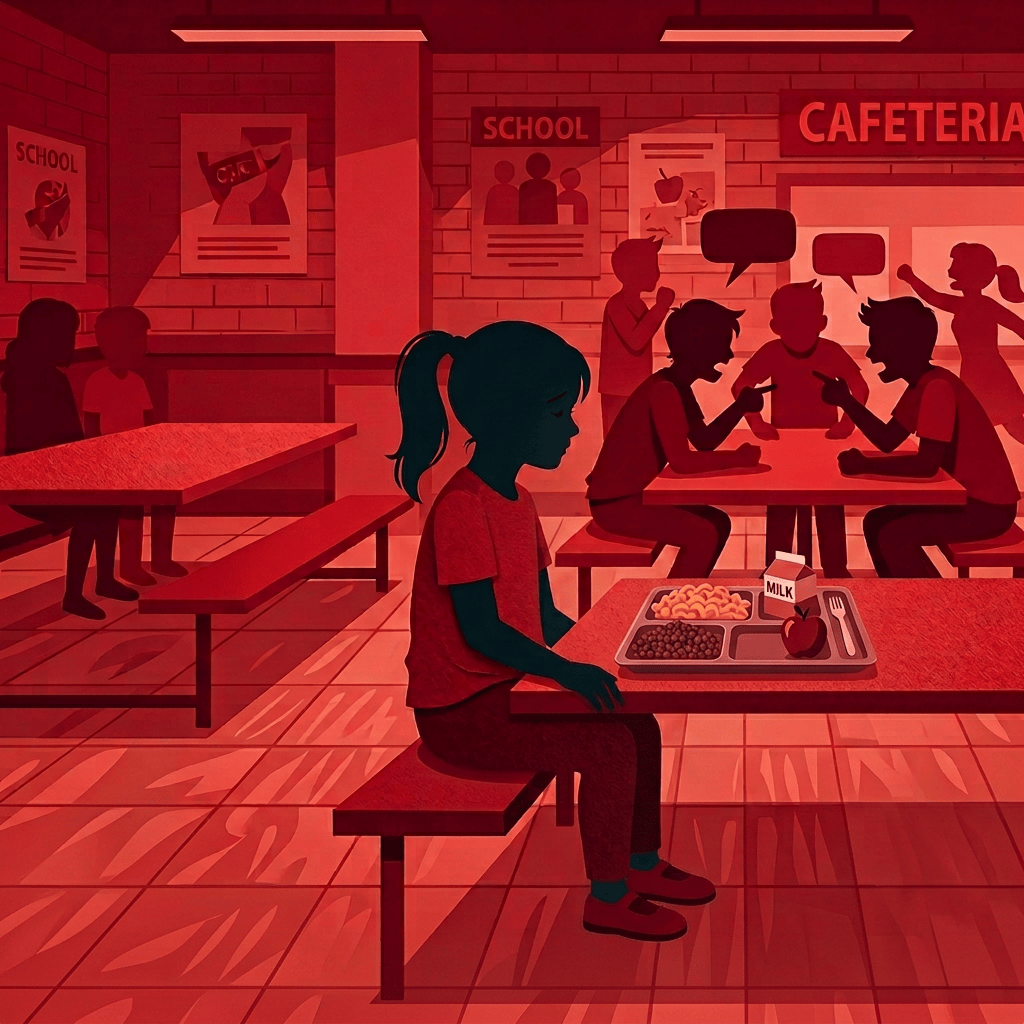
These animated images will help us see how it looks when this student’s nervous system is functioning properly and shifting easily between states. The colors of her environment reflect which physiological state she is in – Safety (Green), Danger (Yellow): Fight/Flight, and Life-threat (Red): Freeze. Here are the images:
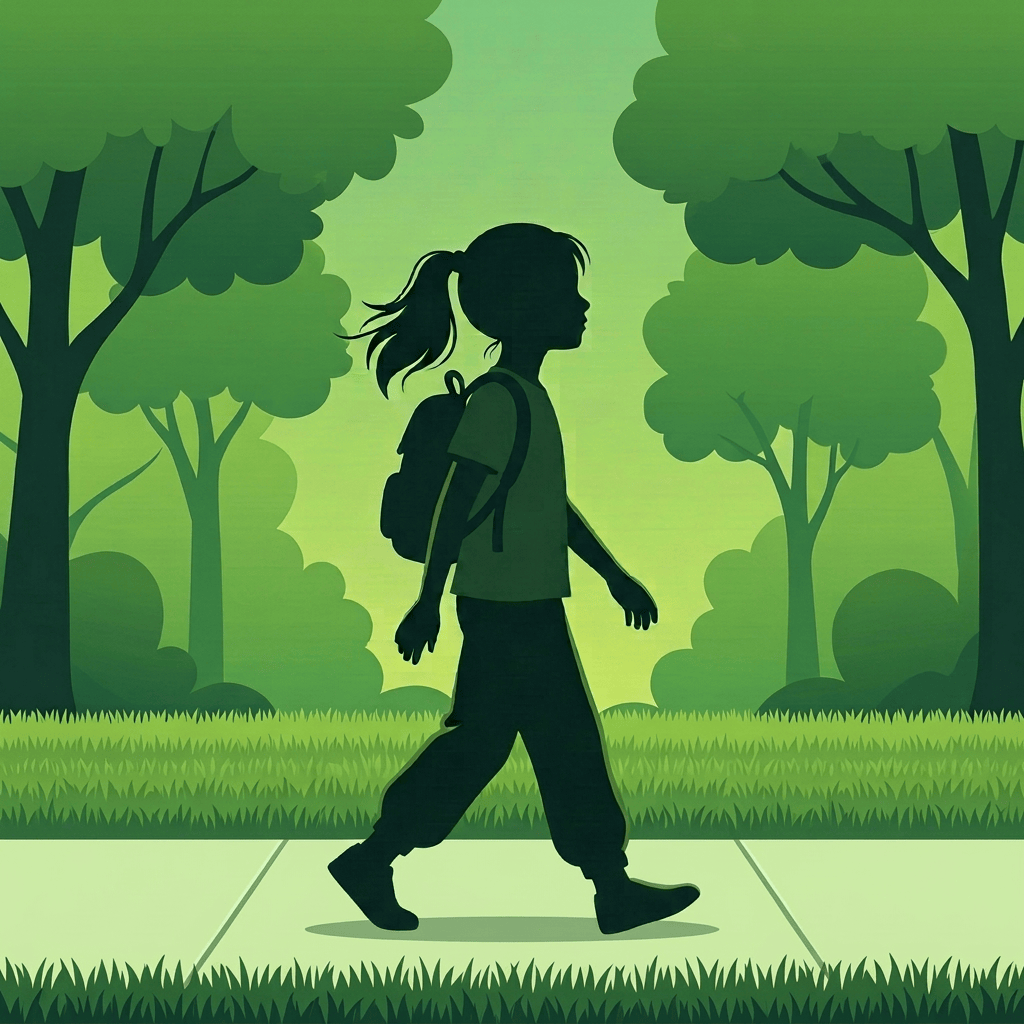
She starts the day by walking to school. She is feeling safe and balanced.
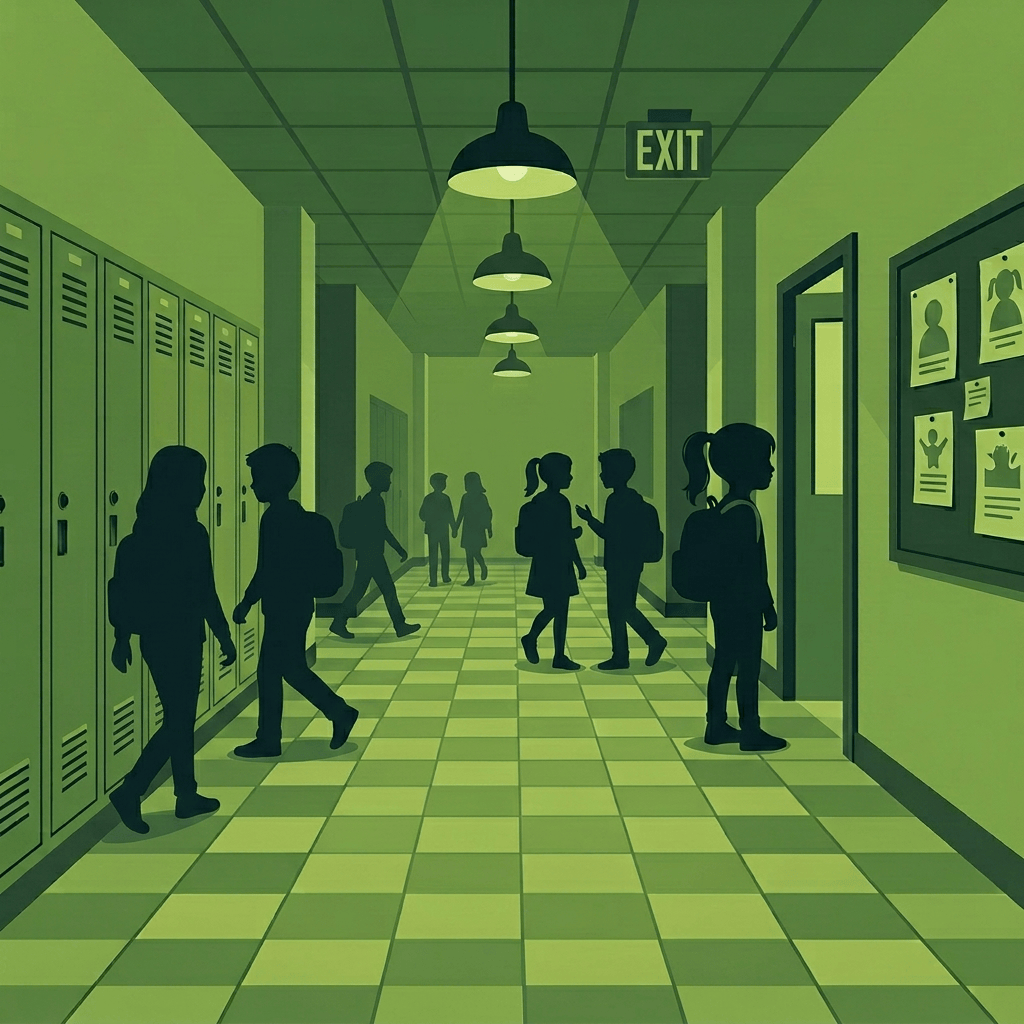
She is still feeling safe when she is walking into class.
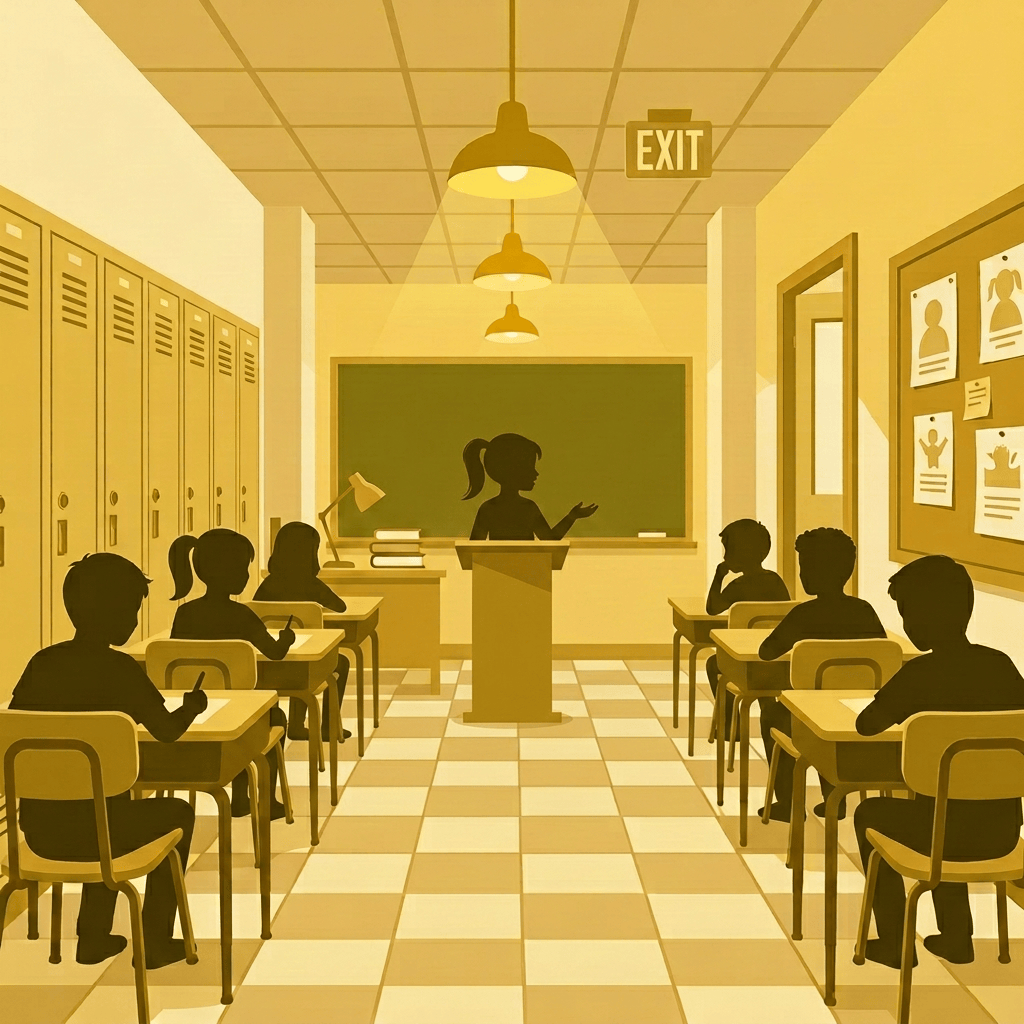
She is supposed to give a speech in front of the class. Her nervous system perceives this as a threat, which causes her to shift states into Fight/Flight. But she is able to channel the energy effectively and uses the surge of adrenaline to enhance her focus and quicken her reflexes so that she can read the responses of her classmates and adapt quickly, which enables her to make an interesting and engaging speech that her classmates respond to positively.
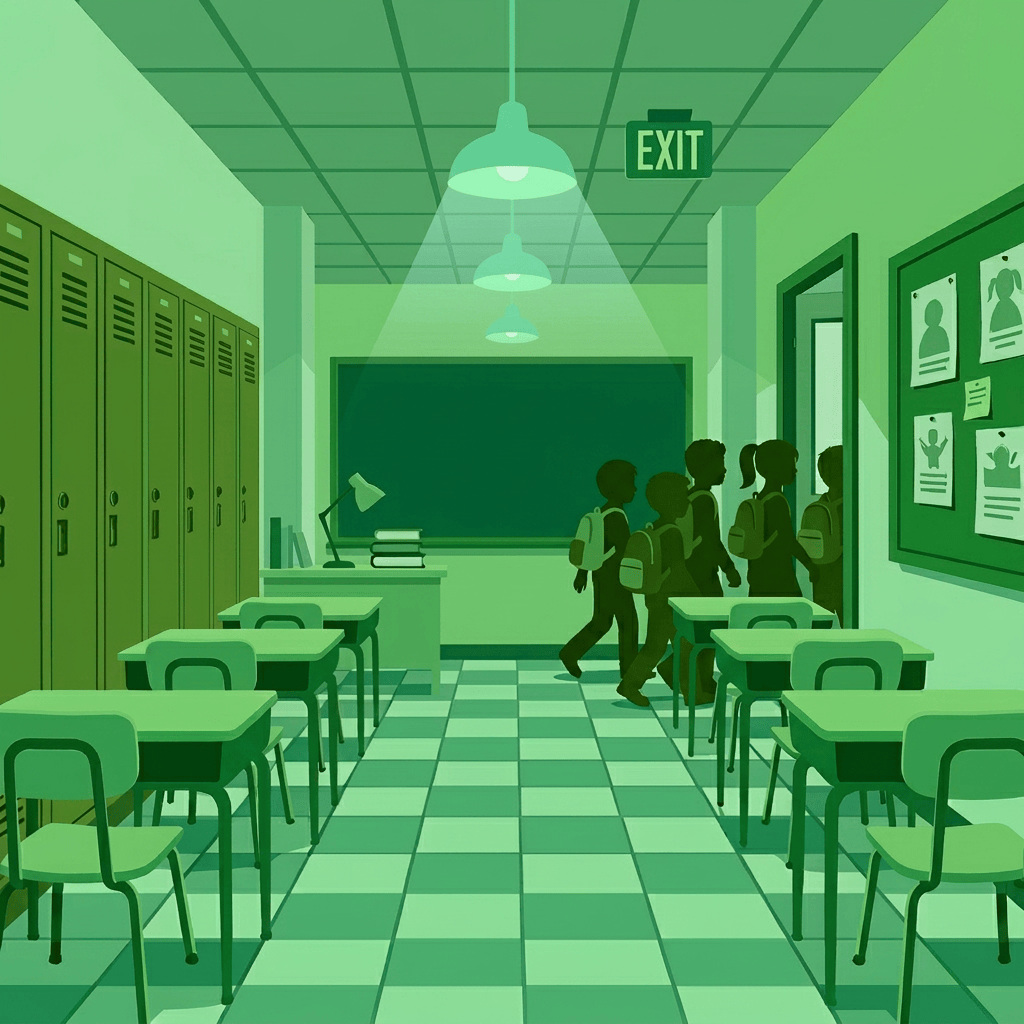
She is feeling safe again by the time class is over. She will try to walk off any remaining adrenaline in between classes. I noticed that the image generator put an Exit sign in the classroom. I thought about removing it but I thought it was interesting to have it there because sometimes it can help us to regulate our nervous systems if we remember that we will only be in the classroom for about an hour and that there is an exit if you need to step outside for a minute.
When she is sitting in the cafeteria at lunch, she hears loud voices that sound angry. She notices that a group of students is having an argument at a lunch table close to hers. She feels a surge of adrenaline and shifts states into Fight/Flight.
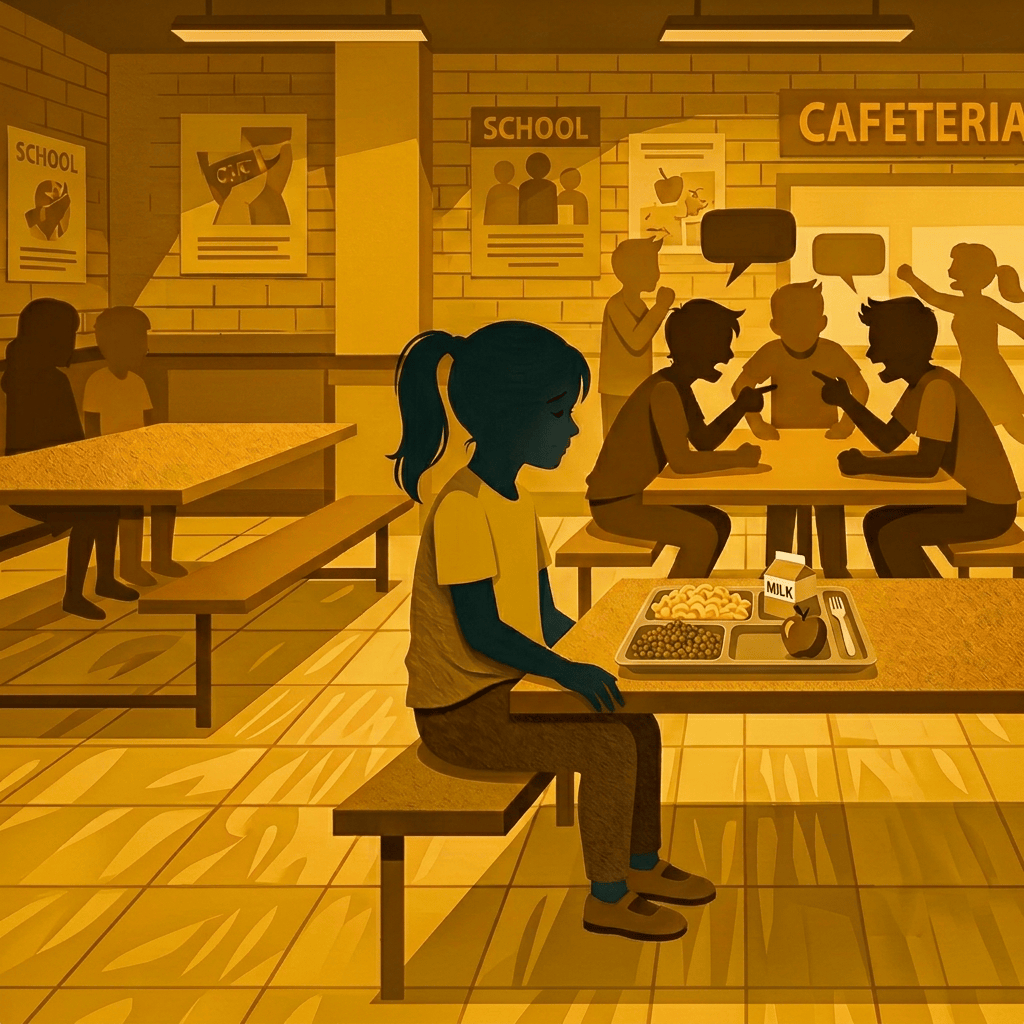
She realizes the fighting and fleeing are not options in this situation, so she shifts physiological states into Freeze. She is able to utilize the surge of immobilizing neuro-chemicals properly to help her remain still and not attract any attention to herself, which prevents her from being drawn into the fight. The numbing of her emotional distress helps her to not panic outwardly. While she looks still on the outside, her brain continues to scan the environment…waiting for signs that the fight is over.
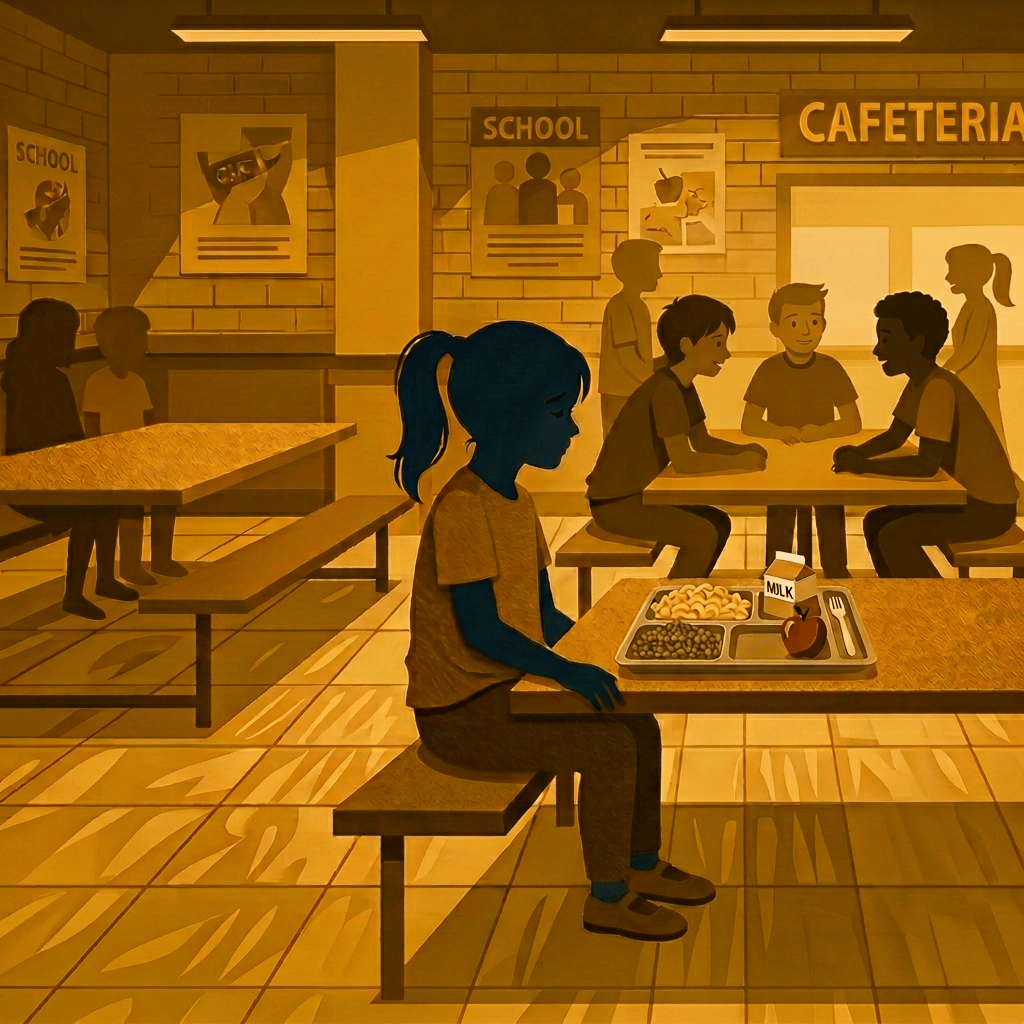
After a few minutes, she no longer hears the angry voices. The quiet continues…so she glances over and sees that the students are now talking in regular voices and eating their lunches. The tension has been resolved. She shifts back into SNS as she begins to unfreeze.
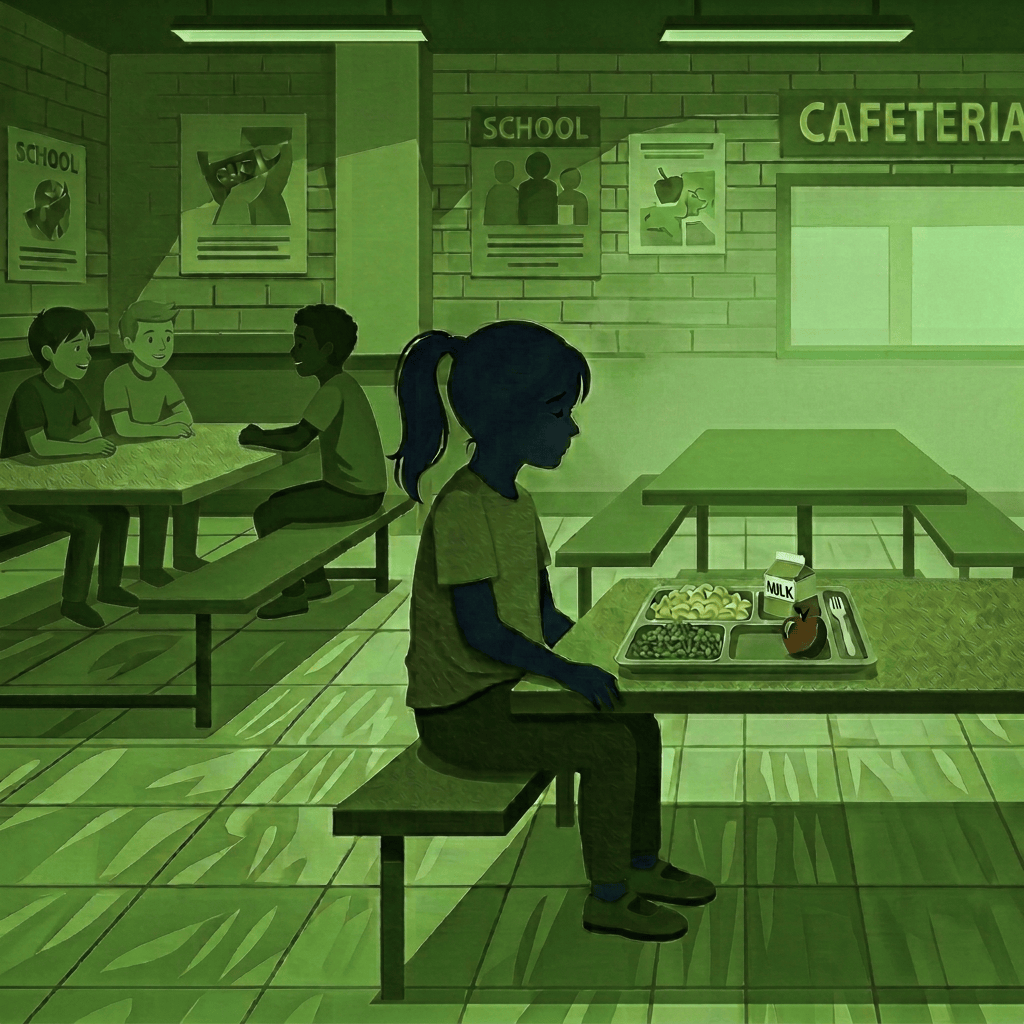
The students who had been fighting stand up and walk out of the cafeteria. She breathes a sigh of relief and stretches her arms and legs a little. She feels safe again and goes on with eating her lunch.
The rest of her classes go well and she is feeling safe on the car ride home. She is thinking through what she will do to relax once she gets to her house.
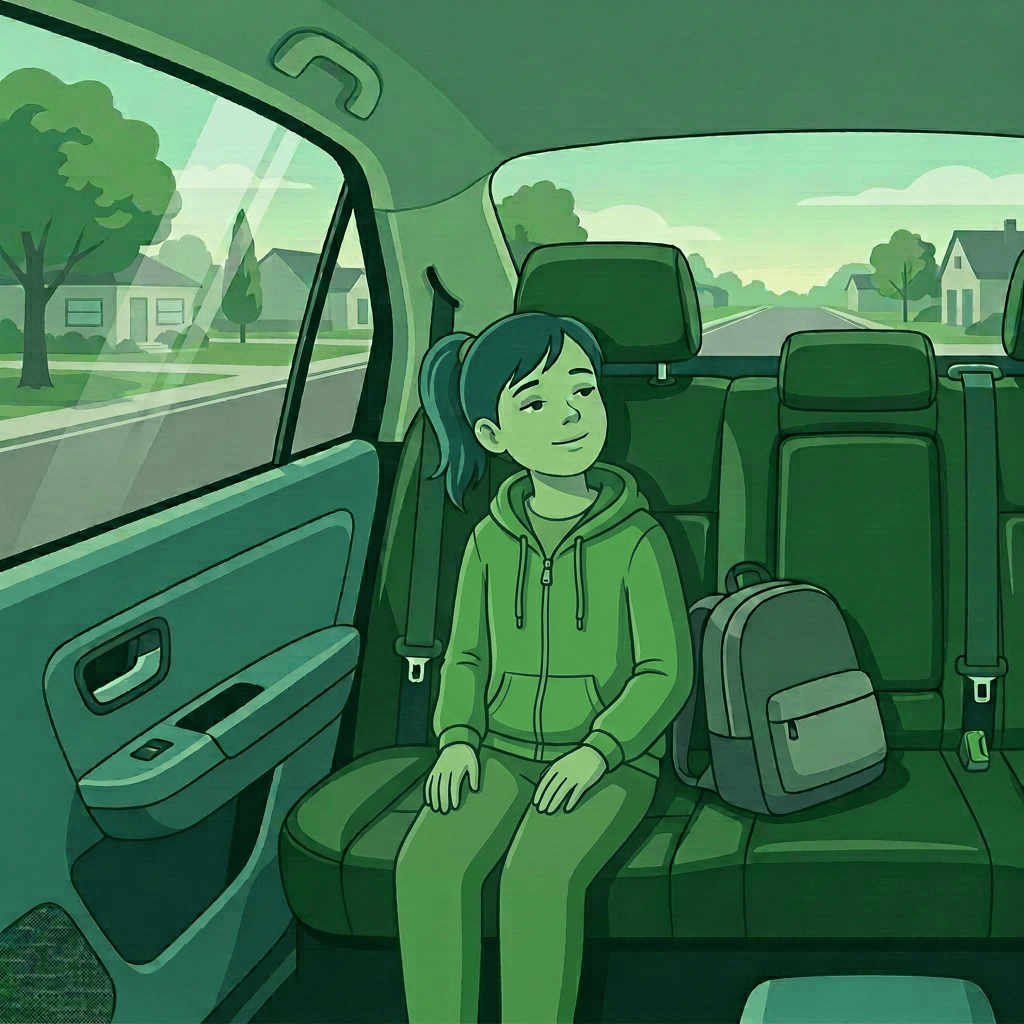
When she gets home, she goes for a nice walk.
It’s such a pretty day…and she might still have some stress energy she needs to release from her day at school…so she goes for a calm jog.

She meditates. (To meditate, she would actually be in a blended state of Ventral Vagal and Dorsal Vagal — Immobilization. I’m still learning about blended states. But she would need to feel safe in order to be able to meditate.)
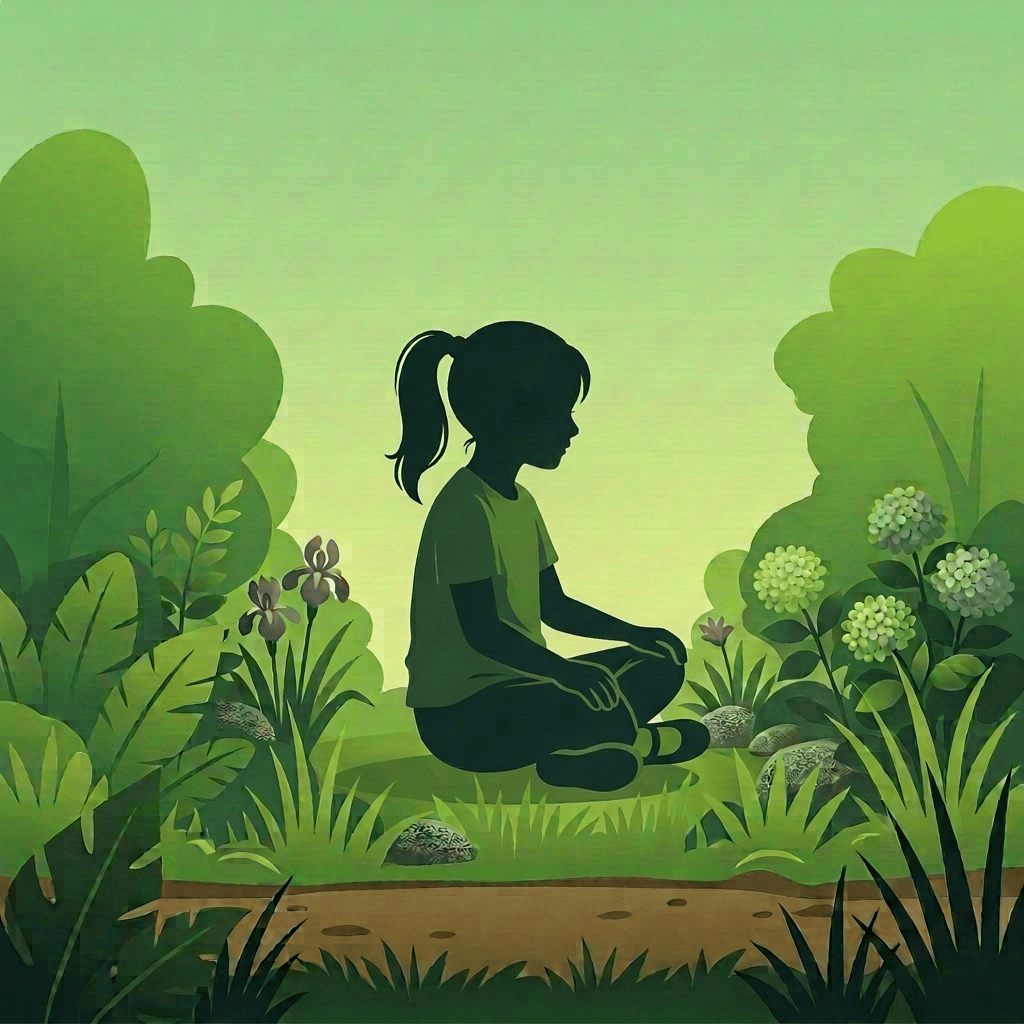
And then she takes time to pray. (To pray, she would also be in a blended state of VV and DV.)
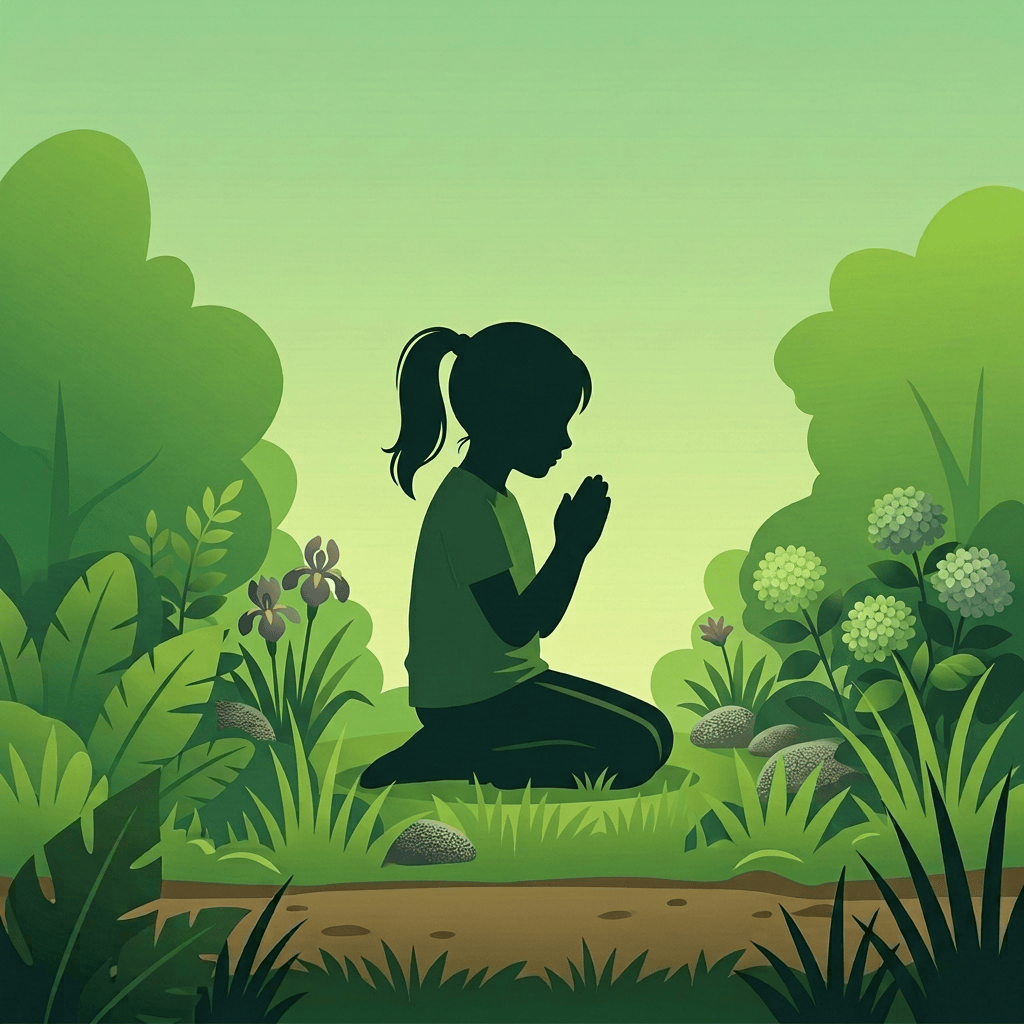
She has a nice dinner.
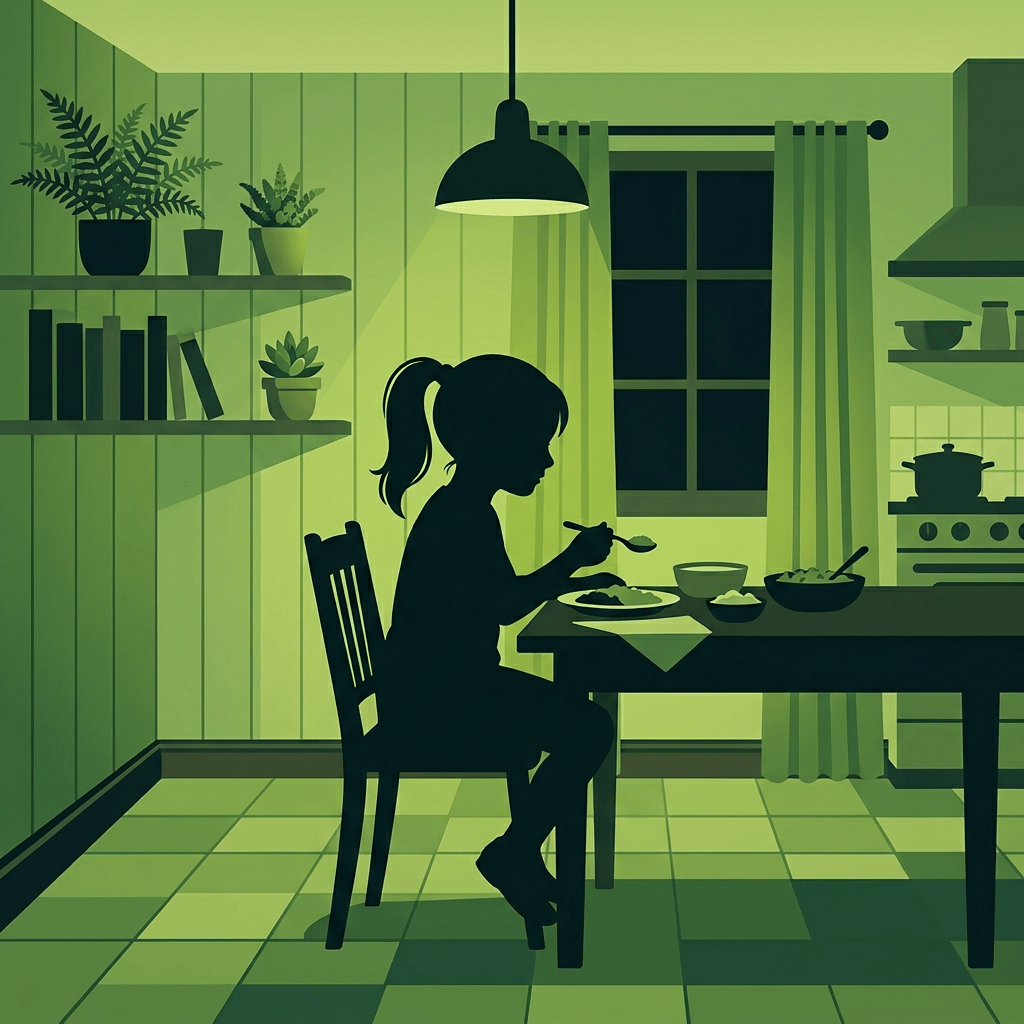
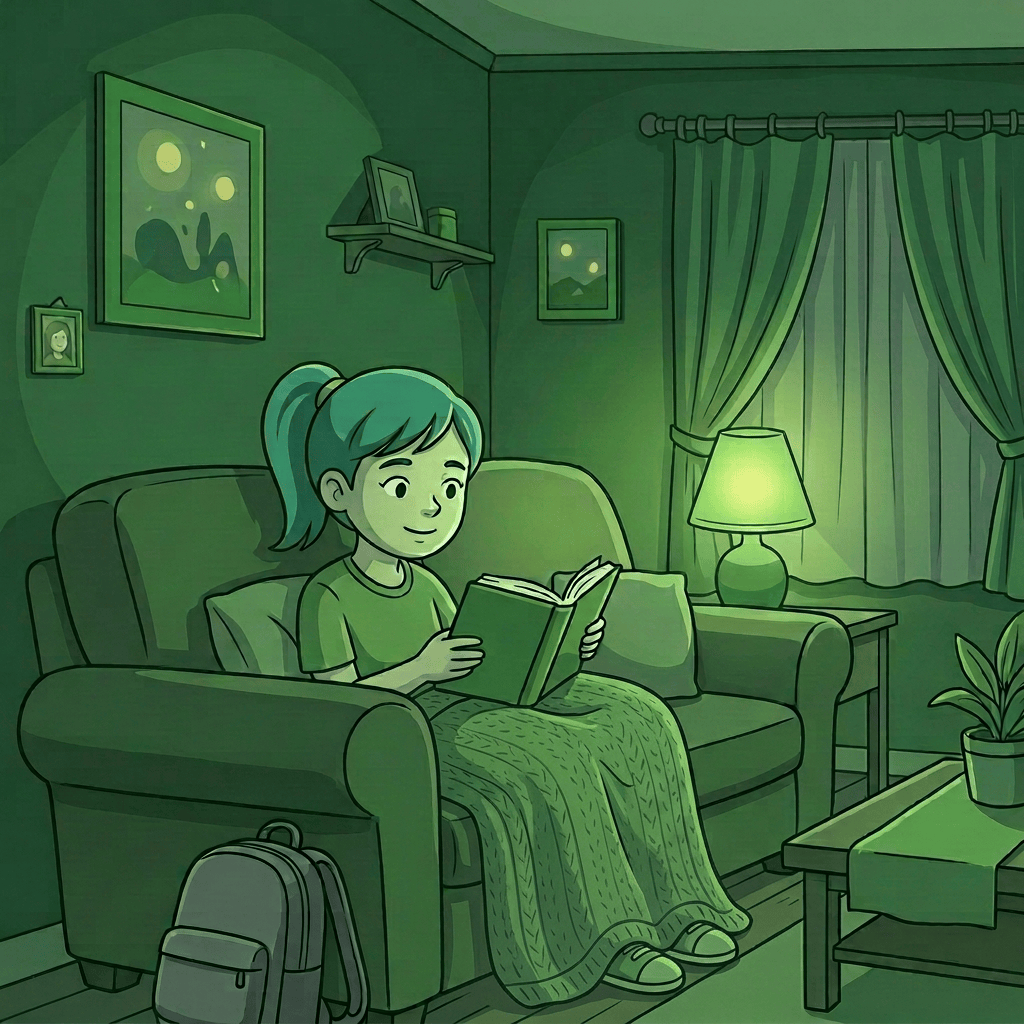
She reads a book before bed to relax. (Blended state: VV and DV)
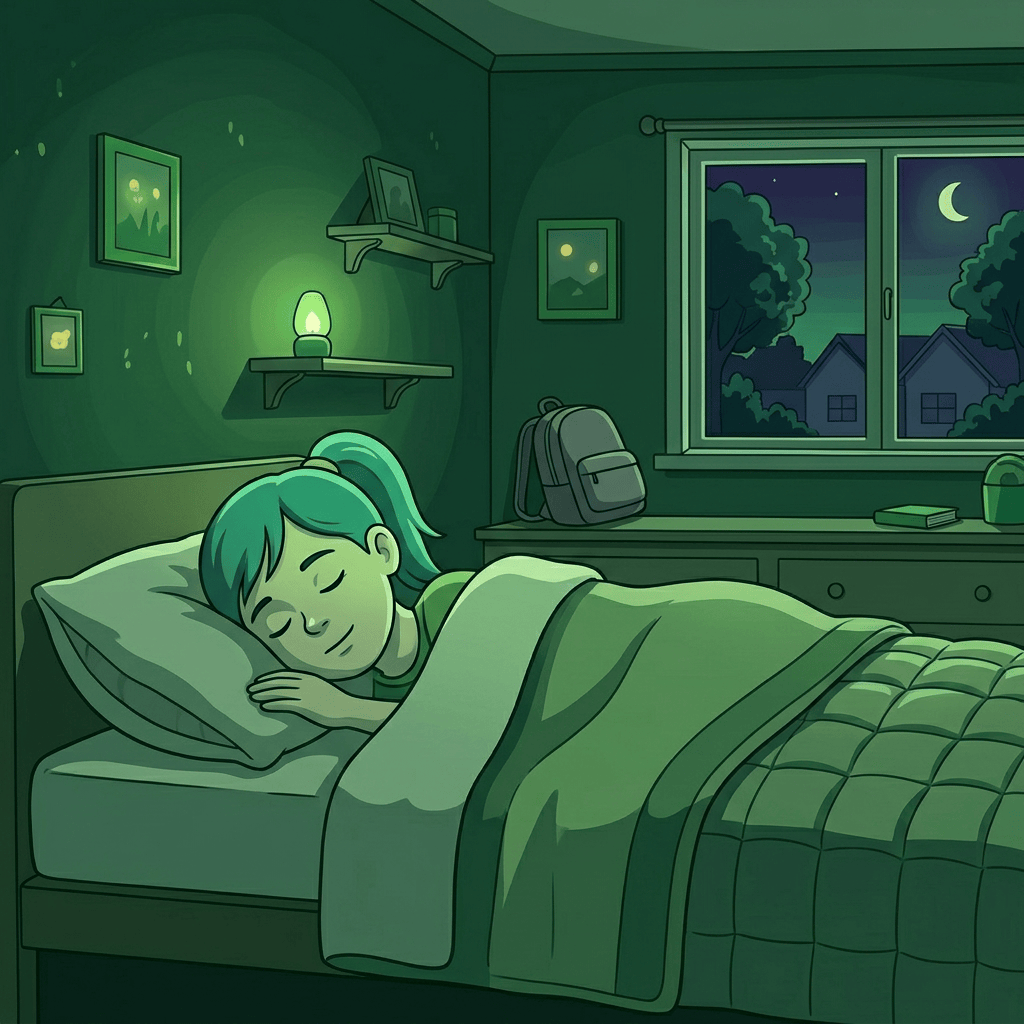
Then she goes to bed feeling safe. (Blended state: VV and DV)
I hope you found these images helpful. You can see that the girl in these images is living on the Squiggle of Life. She is able to shift between states easily and find safety again like in this AI image from my previous post:

The Squiggle of Life: Able to find safety Again, what is helpful to me about these images is how it helps me see that our physiological states color our perception of our environment. If you have been stuck on the Squiggle of Trauma for a long time…going between yellow and red…unable to find safety…then this is how intensely your perception of your environment can be affected when you sense a threat. EVERYTHING feels dangerous. EVERYTHING registers as unsafe. I’m going to be writing in future posts about how learning to see cues of safety in our environment can help us deactivate from defensive modes and spend more time in Ventral Vagal.
I will stop here for today. And in my next post I will write more about why a situation like giving a speech in front of the class caused her to change physiological states.
-
Animated AI Images for Fight/Flight Freeze, the Squiggle of Trauma and the Squiggle of Life, and resolving a physical threat of being chased by a tiger by successfully escaping

I want to pick up where I left off in my previous post about the Polyvagal Theory that had 3 pictures in it for Safety, Fight/Flight, and Freeze. Those pictures helped me see that what is going on is an interaction between your nervous system and your environment…when your nervous system senses something that signals danger, you shift states to prepare to address the threat. Seeing the colors change in the background in the pictures connected with my mind because I think we have all had experiences where something happens and it’s like the background changes to yellow/danger and everything feels different.
I wanted to try making images that would help me get clarity about how the physiological states can only change in a certain sequence. In terms of the Polyvagal Chart, they can only go from green to yellow to red and then red to yellow to green. So you can’t get back to green without going through the yellow.
For these images I just used stick figures so we can concentrate on the color changes/state changes. First, let’s just look at what the different states are. Then we will look at them in sequence. Here are the 3 states:
Safety (Ventral Vagal)
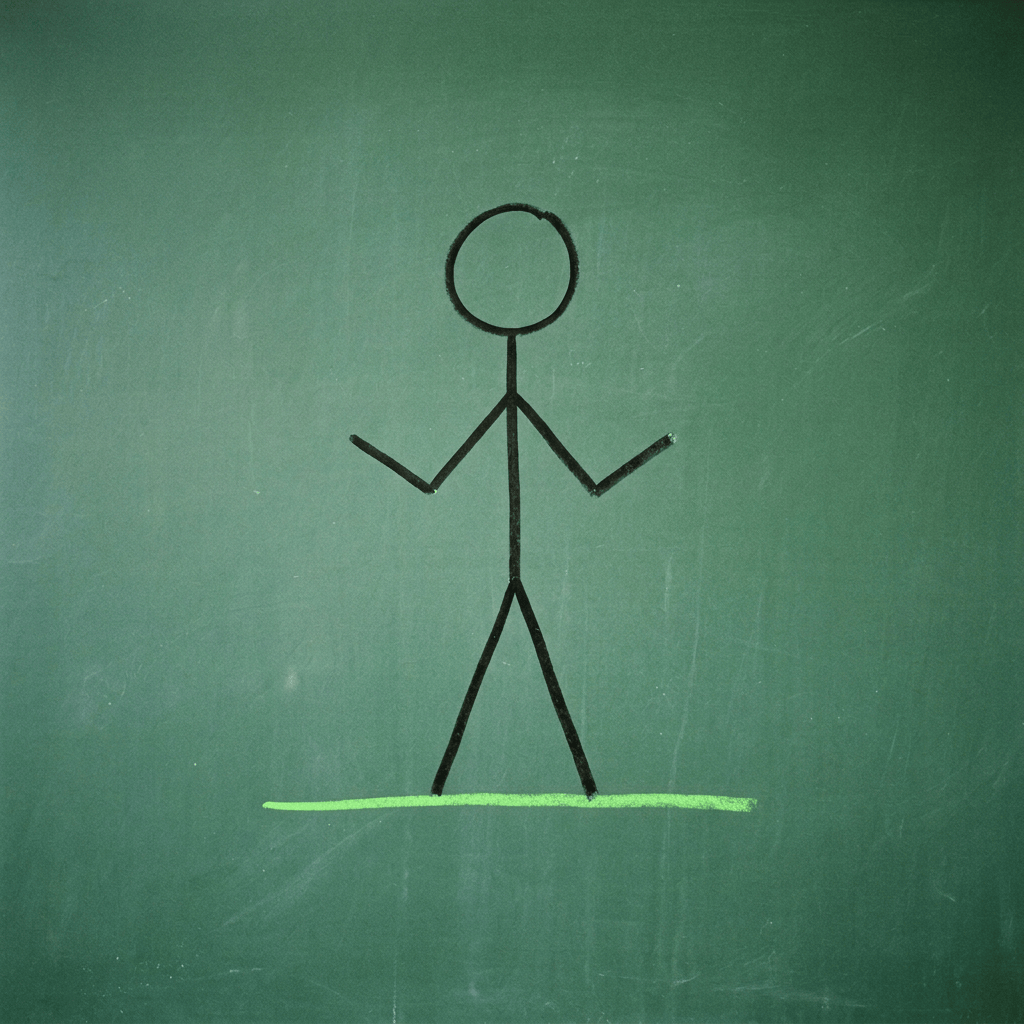
Danger (SNS): Fight/Flight
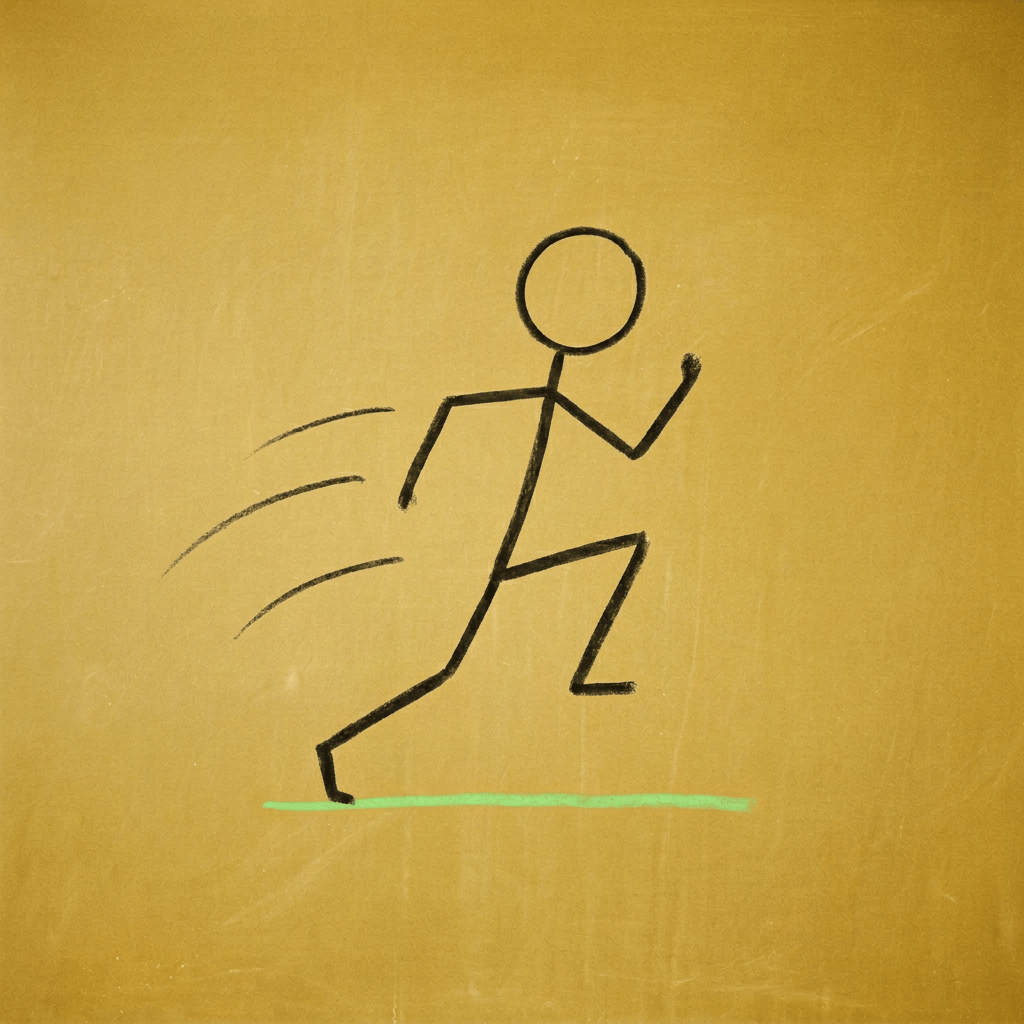
Life-threat (DV): Freeze, Shutdown/Collapse
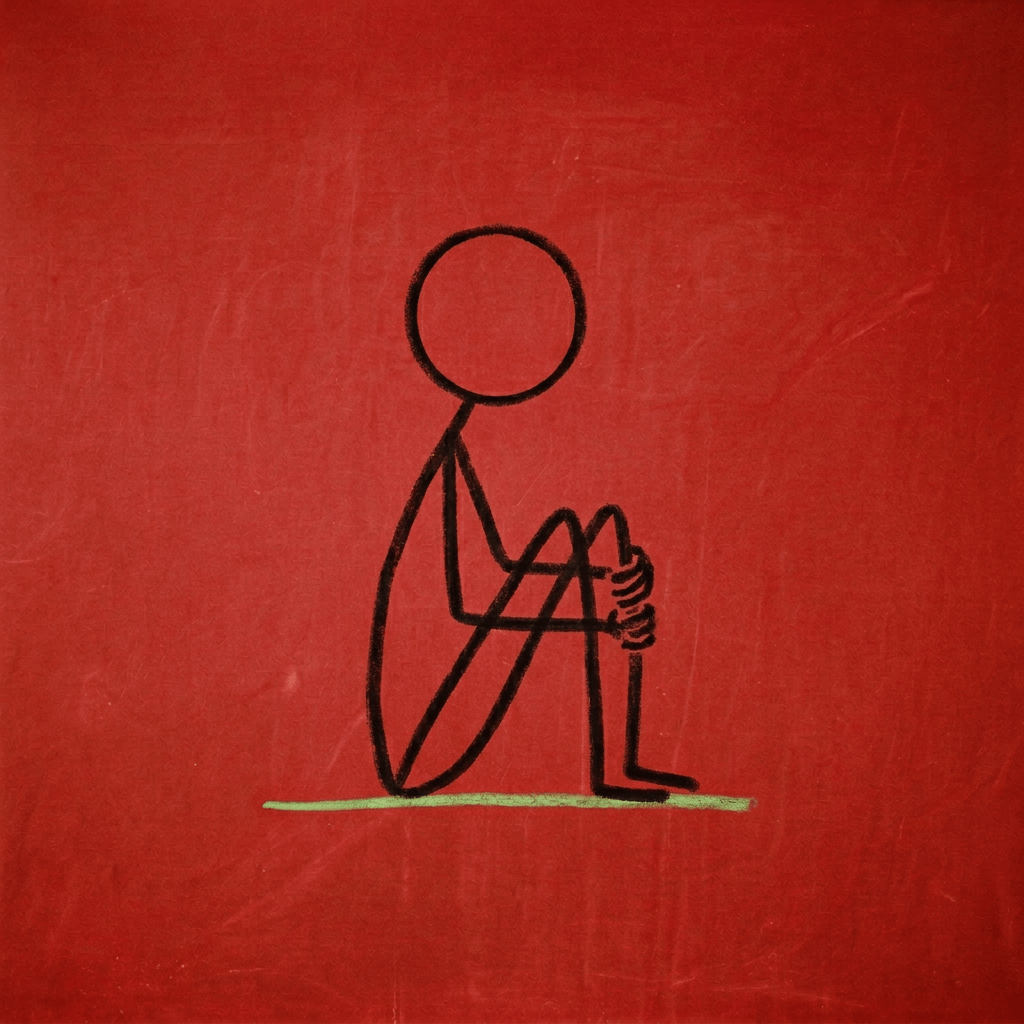
The sequence the states change in must be green to yellow to red, and then from red back to yellow and back to green. Here’s what that would look like:
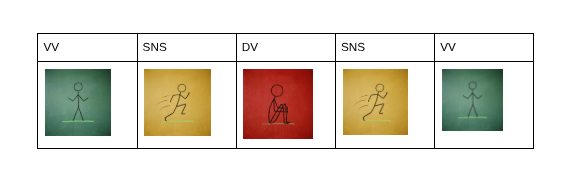
State-Change Sequence These images help us see that a person’s physiological state changes based on their perception of the environment – whether they feel safe or not. If you sense danger, your body prepares to fight or flee. If you sense that any more motion would endanger you, your body floods your system with immobilizing neuro-chemicals to put you into a sudden freeze. Looking at these pictures helps me think about what happens between the pictures…what it would take to go from feeling like you do in green, to feeling like you do in red. And then it helps me to see what it would take to be able to be in a calm state again after being in a defensive mode. And that helped me to be able to envision what it means to be living on the Squiggle of Trauma.
The Squiggle of Trauma is if you get stuck going from red to yellow but can’t get back to green so you just go from red to yellow to red to yellow. Here is a table I made to help see what it means to be stuck going between yellow and red…unable to resolve the threat…unable to return to safety:

The Squiggle of Trauma: Unable to Resolve Threat, Unable to Return to Safety This helped me see that the problem is that you never feel like you are in a safe environment. The fight/flight-freeze cycle can be triggered by physical threats, but I think this table shows the difficulty of our nervous systems being triggered into this cycle by emotional stressors. It can make it feel like you are going from one stressful situation to another without ever really reaching a point of calm. And this type of chronic stress can lead to health problems, which I think is what happened for me.
If that pattern keeps going, it turns into something like this:

Longer times in fight/flight and freeze if pattern continues Here you can see how the person stays in freeze for longer periods of time and then goes into stress mode when they need to be active and then just refreezes. That made me think of the imagery of a storm. It’s like there’s a serious storm going on outside which makes it where you are pretty much in a freeze when you are inside…and then if you need to go outside for some reason, you go into SNS to enable you to go out into the storm for your daily activities.
So while these tables helped me see what the problem is, it also helped me see what the solution is…what we are trying to do when we are trying to get to green. In the article I was talking about in my previous post called “The polyvagal theory: New insights into adaptive reactions of the autonomic nervous system”, Stephen Porges says, “Any stimulus that has the potential for increasing an organism’s experience of safety has the potential of recruiting the evolutionarily more advanced neural circuits that support the prosocial behaviors of the social engagement system.” So when we are stuck in yellow or red, what we need to do is look for any stimuli that will help increase our experience of safety in our environment. If we are able to feel safe again, we can return to green. The Squiggle of Life we are trying to get to is where you mostly just go from green to a little bit of yellow and then easily back into green again after completely discharging the action energy that got cued up when you went into yellow. It would look like this:

The Squiggle of Life: Able to Return to Safety I’m a visual learner and these AI images really helped me, so I kept working with it and will share them with you in several separate posts. I was able to make some that helped me think of stimuli, or resources, we can use to help us feel safe. But the first group of animated pictures I will share with you is about your nervous system being triggered by a physical threat of a tiger and seeing how to resolve that. Hopefully soon I will share in separate posts the other groups of images that are about emotional stressors.
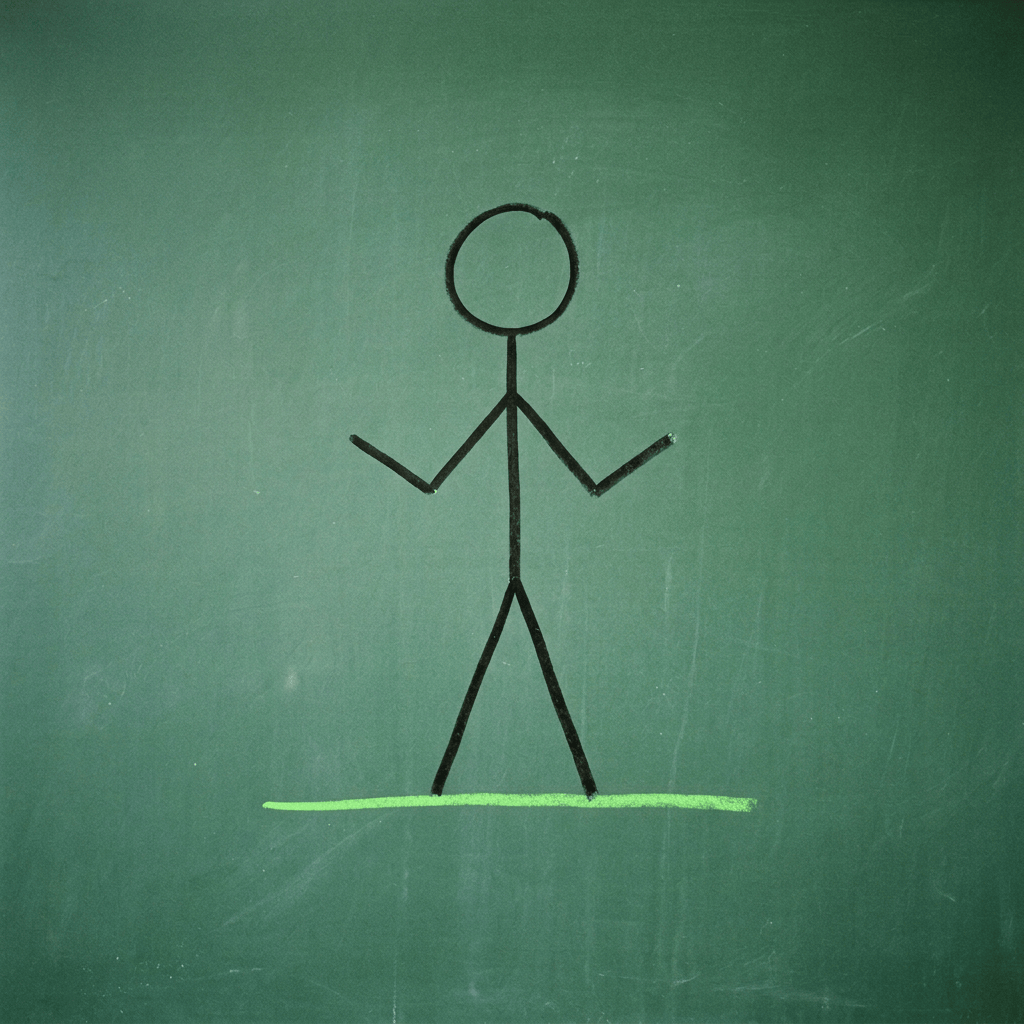
In this picture, the stick figure is calm and feeling safe.
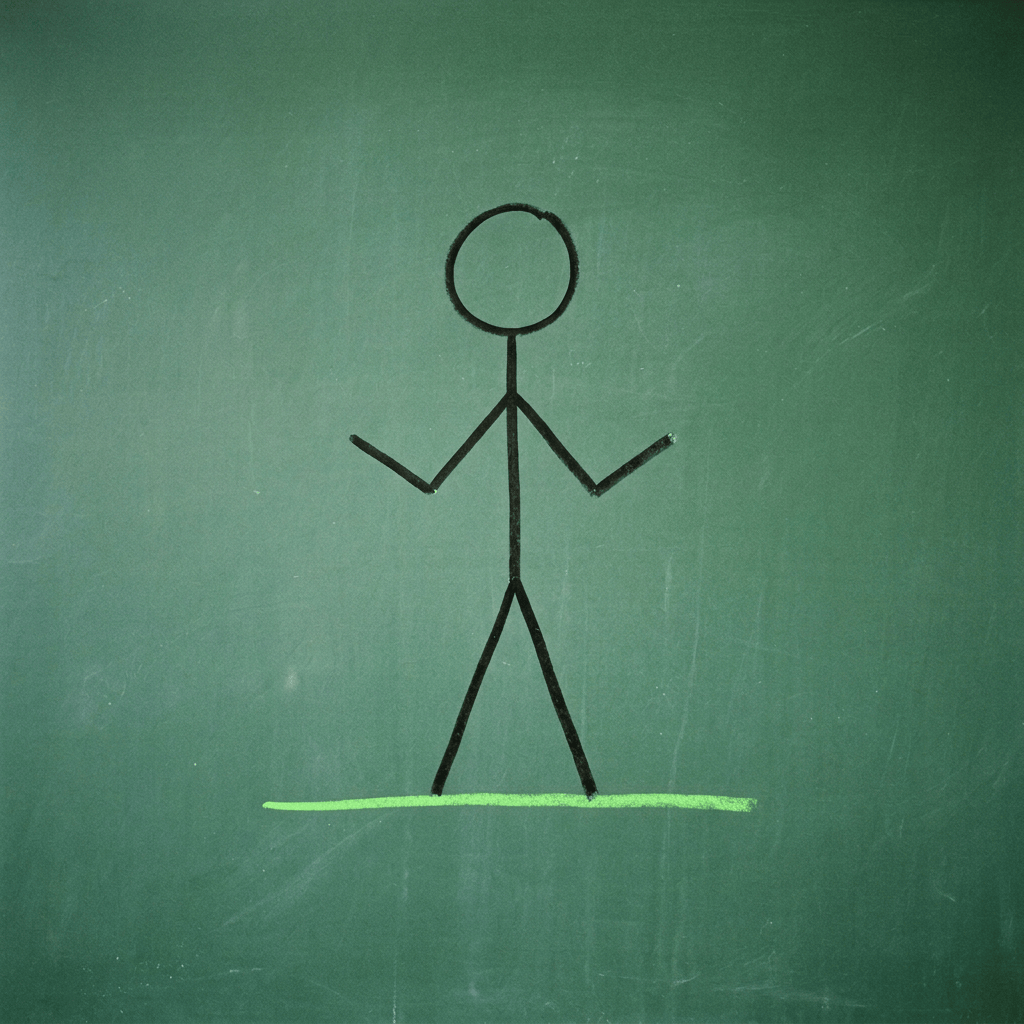
Then he sees a tiger in his environment. The tiger sees him, too, and starts chasing him. So the stick figure quickly changes physiological states to Danger (SNS) and feels a surge of mobilizing chemicals and takes off running.
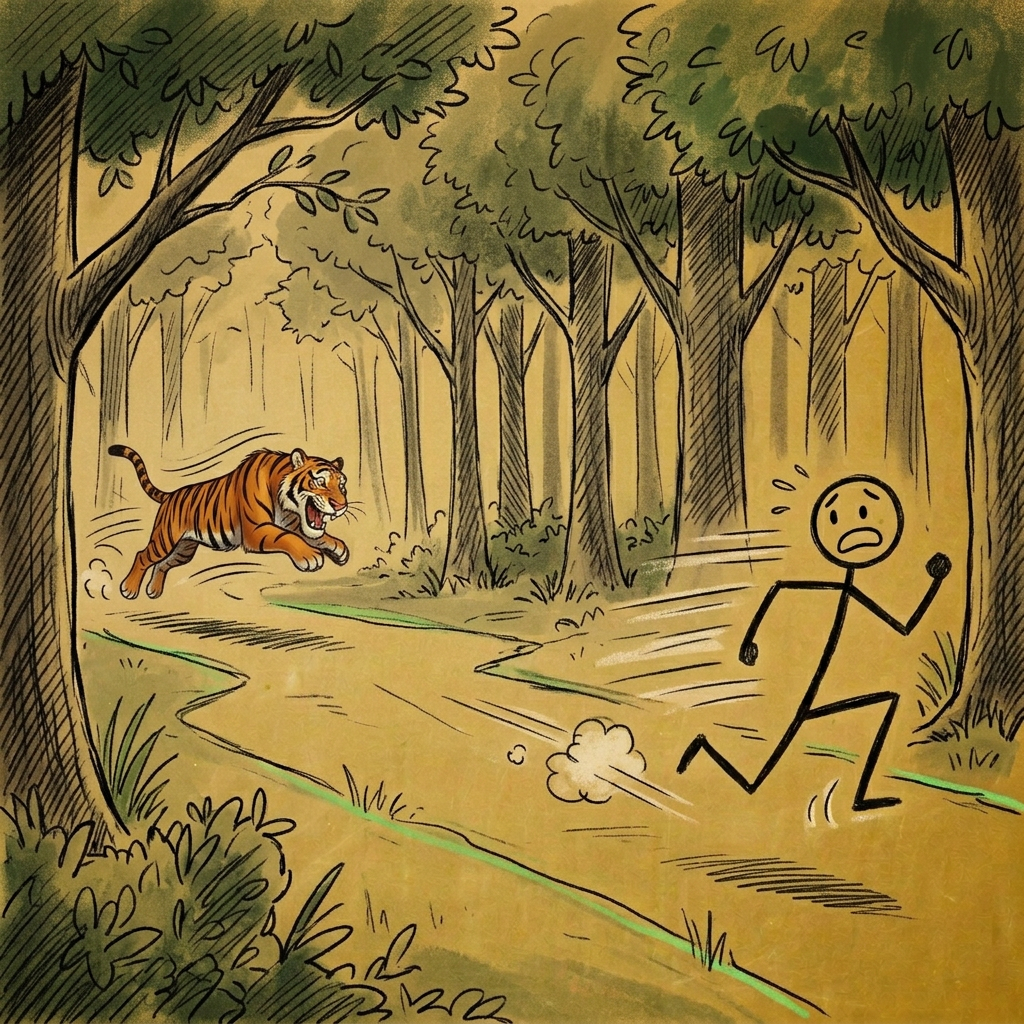
When he sees that the tiger will be able to catch up to him, he hides behind a tree and feels a surge of immobilizing chemicals and becomes undetectable to the tiger. (If a tiger had been as close as in the previous picture, he probably wouldn’t have been able to hide, but I think the picture is still helpful. I couldn’t get it to where the tiger was farther away.)
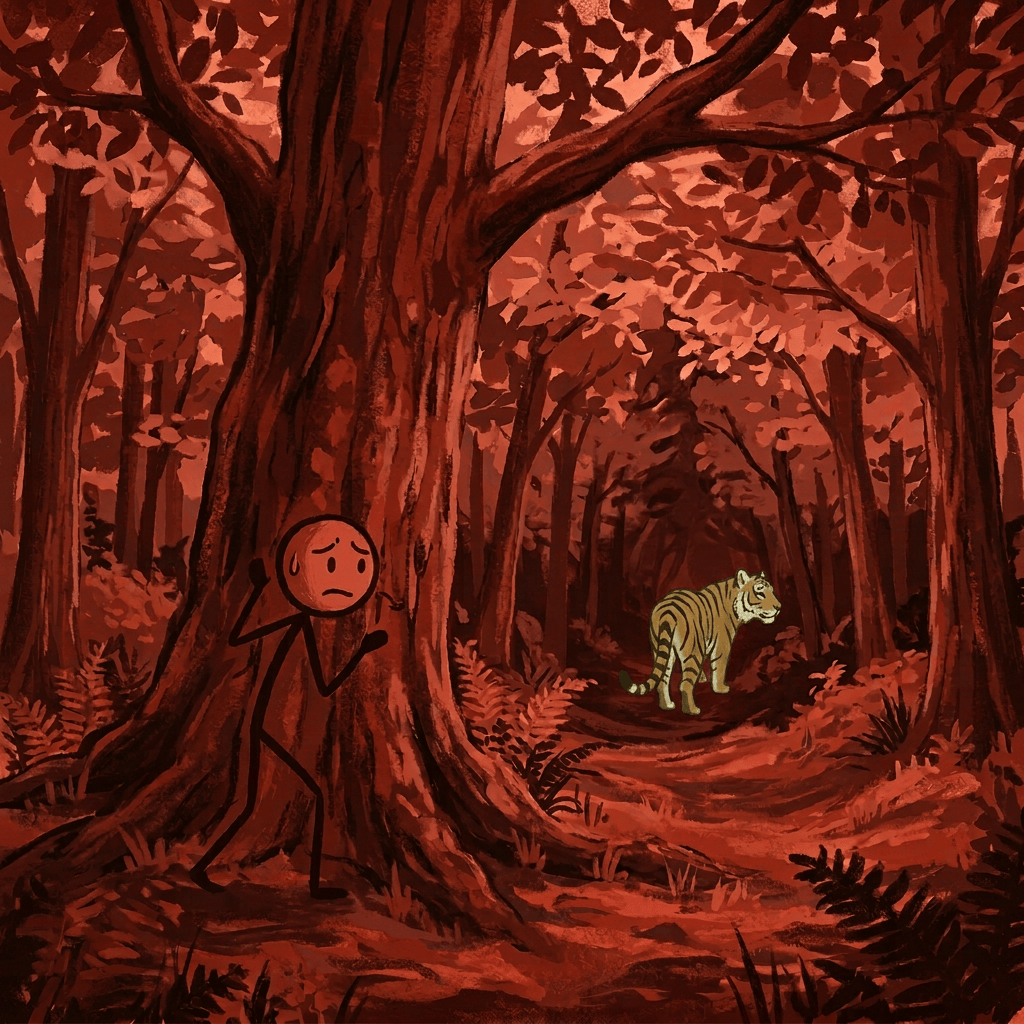
The tiger can’t find him, so the tiger walks off. The stick figure waits to be sure the tiger is completely gone.
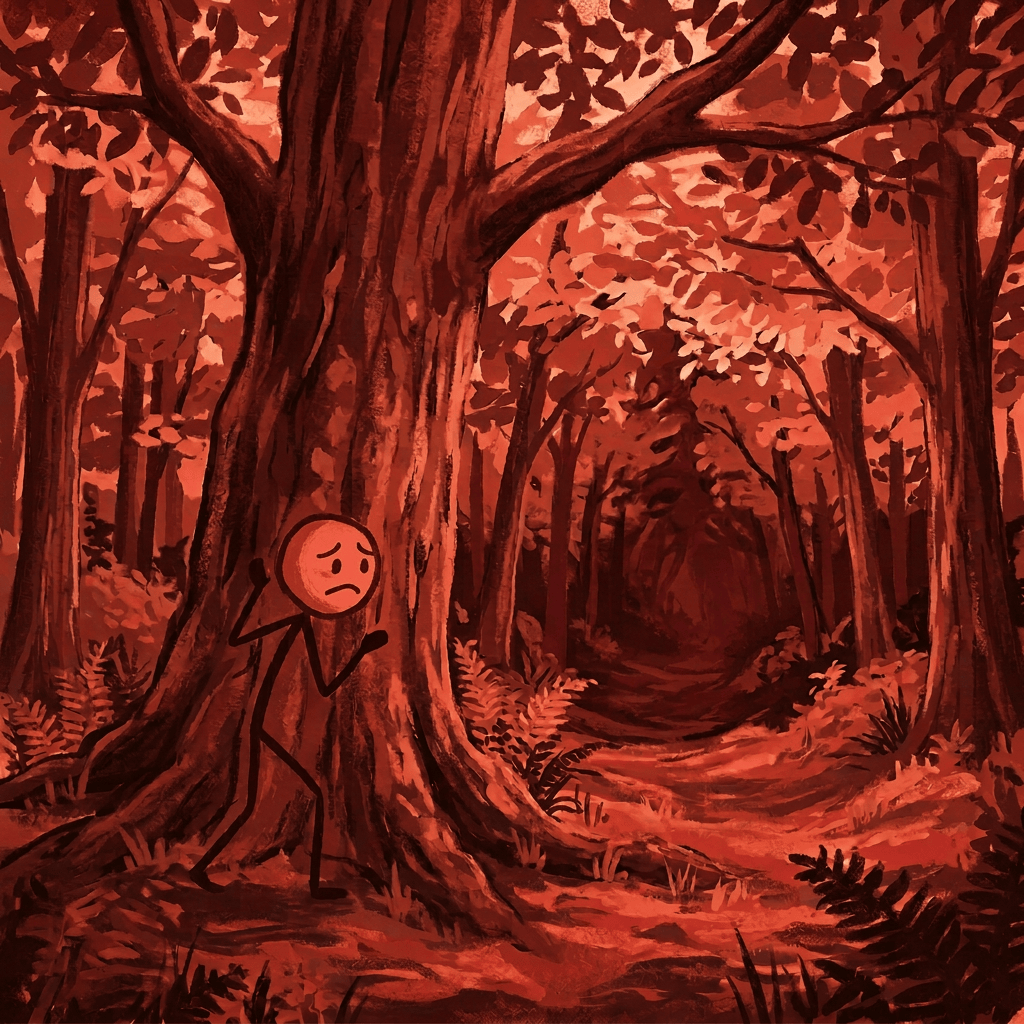
Then he feels a surge of mobilizing energy…he shakes off the compressed SNS energy from when he had to freeze…and then he takes off running to safety. The AI image generator made him smiling because I had typed in that he was relieved to be getting to safety. I couldn’t get it to change it, but I think it works. It’s really important to remember that running to safety will feel good. So he is excited to make a successful escape!

After he has been back in safety for awhile, his heart rate and breathing rate return to normal.
I hope you find these images helpful. They really help me see what is happening when we are changing states — we are reacting to a stressor in our environment. And it helped me see what we are trying to do when we are trying to get from red, through the yellow, to green again — we are looking for safety…we are trying to feel safe again.
I will stop here for today and post sometime soon the pictures of what Fight/Flight-Freeze looks like with emotional stressors.
-
“The Potter and the Clay” by Mrs. Thomas R. Davies; Imagery about the importance of remaining mold-able in God’s hands

Hymnal Page Scan: Great Joy!: a new and favorite collection of hymns and music, for gospel meetings, prayer, temperance, and camp meetings, and Sunday schools page 63 | Hymnary.org
Keyboard Recording:
1 As clay in the hands of the potter,
Am I in Thy hands, oh my God;
If on life’s highway I falter,
And faint ‘neath Thy chast’ning rod;Chorus:
May Thy presence, O Father go with me;
Molding the vessel aright
Till mete for the heavenly Kingdom,
In the beautiful mansions of light.2 If temptations thro’ weakness and blindness,
Cast shadows along my way;
May Thy Spirit within in its wisdom
Prevent me from going astray; [Chorus]The words at the beginning of this hymn that say, “As clay in the hands of the potter, Am I in Thy hands, oh my God” are from Jeremiah 18:6. This hymn also references Isaiah 64:8, which says, “But now, O LORD, You are our Father; we are the clay, and You are the potter.” (Berean Standard Bible) I hope to write more about this soon because I have been reading the study notes about these passages and there is a lot of really interesting information. Some concepts we can start thinking about are that the imagery of God as the potter and us as the clay is a reference to how God formed the first man, Adam, out of the clay of the earth. As God fashioned Adam out of clay, He forms us in our mother’s womb. God is our creator and is sovereign over us. In Jeremiah 18, God tells Jeremiah to go to the house of the potter and observe what happens while the potter is molding a vessel out of clay. Jeremiah 18:4 describes what happens: Jeremiah says, “But the vessel that he was shaping from the clay became flawed in his hand; so he formed it into another vessel, as it seemed best for him to do.” That’s what this hymn is talking about. It’s a prayer to God for help when we have sinned. Let’s look at the words to the 1st verse.
It starts by acknowledging that we are the clay and God is the potter – it’s recognizing that He is our creator and that He is sovereign over us. Then it’s a prayer saying, “If while walking on life’s highway I falter…sin; stray from Your pathway…or if I faint beneath Your chastening rod, May Your presence, O Father, go with me. Molding the vessel aright, until I’m fit for the heavenly Kingdom, in the beautiful mansions of light.” The word “mete” used in the chorus means “suitable, proper, fitting, or well-adapted to a situation or purpose.” (https://www.oed.com/dictionary/meet_adj) So, God forms us in our mother’s wombs like a potter forms a vessel out of clay. Sin causes the vessel to become misshapen. The Berean Standard Bible’s study notes point out that the clay cannot reshape itself. It is completely dependent on the potter to mold it aright. In Isaiah 64, which I hope to post about soon, Isaiah pleads with God for mercy. He cries out to God for help and pleads the covenant relationship between God and Israel in which He is more than just a potter to them, He is their Father. And that’s what the words to this hymn are…they are a prayer to our loving heavenly Father asking Him for mercy…praying for His presence to go with us and to lovingly reshape us instead of casting us away…praying He will continually mold us aright until we are fit for the heavenly kingdom. The second verse is a prayer for help in temptation. It uses imagery for temptations of dark shadows being cast over the pathway we are walking on, which makes it difficult to see where we are going. Then there is prayer for the Holy Spirit within us to guide us with His wisdom and prevent us from going astray while we are struggling to see the pathway. Take time to envision that…envision the dark shadows. Feel the Holy Spirit guiding you with His wisdom until you are once again walking in the daylight.
I was looking up hymns on this topic when I was writing about how to heal from a broken spirit. In one of the study notes that I will try to find, it talked about the importance of the clay remaining moldable in the Potter’s hands rather than becoming hardened against God’s reshaping. It really helped me to meditate about that as I am struggling to accept that I might have more trouble with symptoms from my chronic illnesses as I get older. I have been trying to fit my life into a certain mold…a certain idea or framework I had in my mind – I was going to get all the way better. But meditating about the clay and the Potter has helped to remind me that God has a plan for my life. His kingdom is not of this world. Charles Spurgeon talks in his sermons about how heaven is a reward we have to wait for…and that we have to be prepared, or fitted, for. I have written recently in posts about “Fly Up to the Sunshine” and “Bend Low” about how God works through afflictions and chastening/discipline to make us more and more like Him. And it’s important for us to remain mold-able…shape-able…so that He can shape us into who he wants us to be. As we are learning more about Him, it helps us to see that we are entrusting ourselves not only to a potter, but to our loving heavenly Father. So while we are not able to know exactly how He is going to shape us or exactly what is going to happen, we are able to know who He is shaping us to be like and where He is preparing us to go – He is shaping us to be more and more like Jesus every day which is preparing us for our home in “the beautiful mansions of light” in heaven. Take time to envision that. Envision yourself as clay in the hands of God. See Him lovingly molding you…and feel that sense of confidence that you can trust that what He is working out for you will be for your ultimate good. When I was working with this imagery, one thing I started noticing was that I would start the day by waiting and looking up and seeing what God was going to do that day…how He was going to mold me…instead of just rushing through things. It can help us learn to stop and wait on Him for guidance.
I will stop here for today and I hope to write more about this soon.
Links:
Isaiah 64:8 Commentaries Biblehub.com
Jeremiah 18:6 Commentaries Biblehub.com -
Polyvagal Theory: Images for Fight/Flight, Freeze, and an Overwrought Nervous System
The other day I was drawing a chart to try and get clarity about what it means to go from the Squiggle of Trauma to the Squiggle of Life. I also read this article: “The polyvagal theory: New insights into adaptive reactions of the autonomic nervous system” by Stephen Porges and something clicked with me about what the colors on the Polyvagal Chart are representing. Porges says in the article, “The human nervous system, similar to that of other mammals, evolved not solely to survive in safe environments but also to promote survival in dangerous and life-threatening contexts.” That’s when something clicked for me that I hope I can explain. It helped me see that the human nervous system developed different settings (for heart rate, breathing rate, adrenaline, etc.) for survival in different circumstances. Those circumstances can be put into 3 categories: safe circumstances, dangerous circumstances, and life-threatening circumstances. In safe circumstances, you can have settings that include a normal heart rate and breathing rate. In dangerous circumstances, you need different defensive settings in order to be able to survive — you need a flood of adrenaline and mobilizing chemicals to enable you to move faster and have a narrowed focus…to enable you to fight or flee. Your heart rate and breathing rate need to change because blood flow needs to be increased to the muscles. Then if your nervous system detects that you are not going to be able to resolve the threat by fighting and cannot escape by fleeing, I think it considers that an imminently life-threatening circumstance in which you need to freeze. So it sends a flood of immobilizing chemicals to either hide you from the predator or make you appear lifeless and non-responsive to pain so the predator will leave you alone.
So, putting the word “circumstances” with it helped me see that the 3 physiological states developed to help you survive in 3 categories of experiences – safety, danger, and life-threatening circumstances. Later in the article, Porges said, “Functionally, visceral states color our perception of objects and others.” All of this helped me see more clearly what the colors on the Polyvagal chart are representing. Green is safety. Then if a threat is perceived in your environment you automatically change states to increase heart rate, breathing rate, etc. in order to increase your chances of survival in those circumstances.
I am a visual learner, so I used the WordPress AI image generator to make some images of the different states. Here they are:
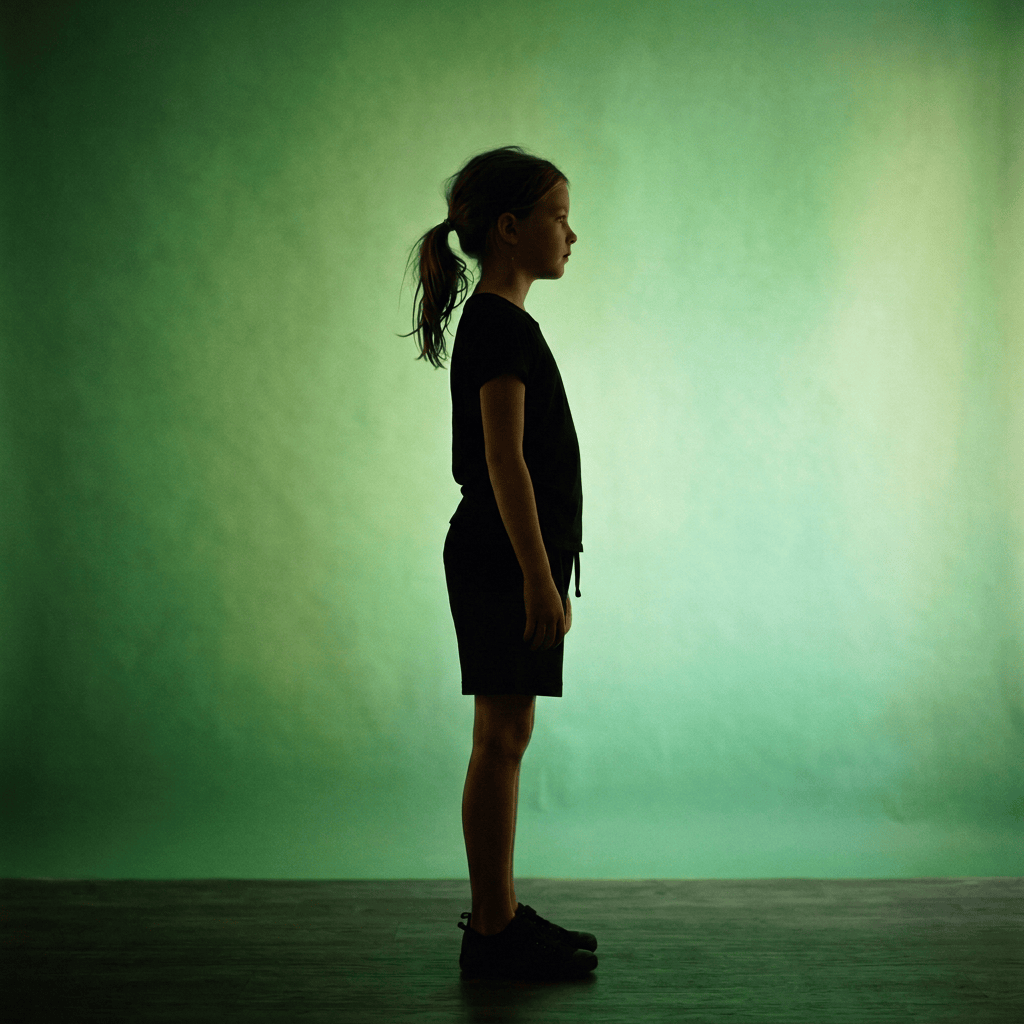
Safety (Ventral Vagal)
Danger (SNS): Fight/Flight

Life-Threat (DV): Freeze

So you can see that when she perceived her environment to be safe (green), she was standing calmly. Then when she perceived something in her environment that was a cue of danger (yellow), she went into fight/flight and started running. When she perceived that she would not be able to escape the threat and that more movement would endanger her (red), she went into a freeze.
I hope I’m thinking of this correctly. I’ll post about it again soon. Right now, it’s really helping me to see more clearly that state-changing is the result of an interaction between your nervous system and the environment. The yellow and red states are not bad…they are actually very helpful because they either flood you with mobilizing neurochemicals that can help you fight or run fast enough to escape or they flood you with immobilizing chemicals that enable you to be still/frozen in a way you couldn’t be in green/vv. The problem is if your system has gotten triggered into yellow or red when it didn’t really need to be…or if the mobilizing energy involved in fight-flight that got compressed when you froze wasn’t ever properly discharged. I tried to make an image for what it would look like for your system to be overwrought after being stuck on the Squiggle of Trauma (only alternating between yellow and red) and here is what the WordPress AI made for that:
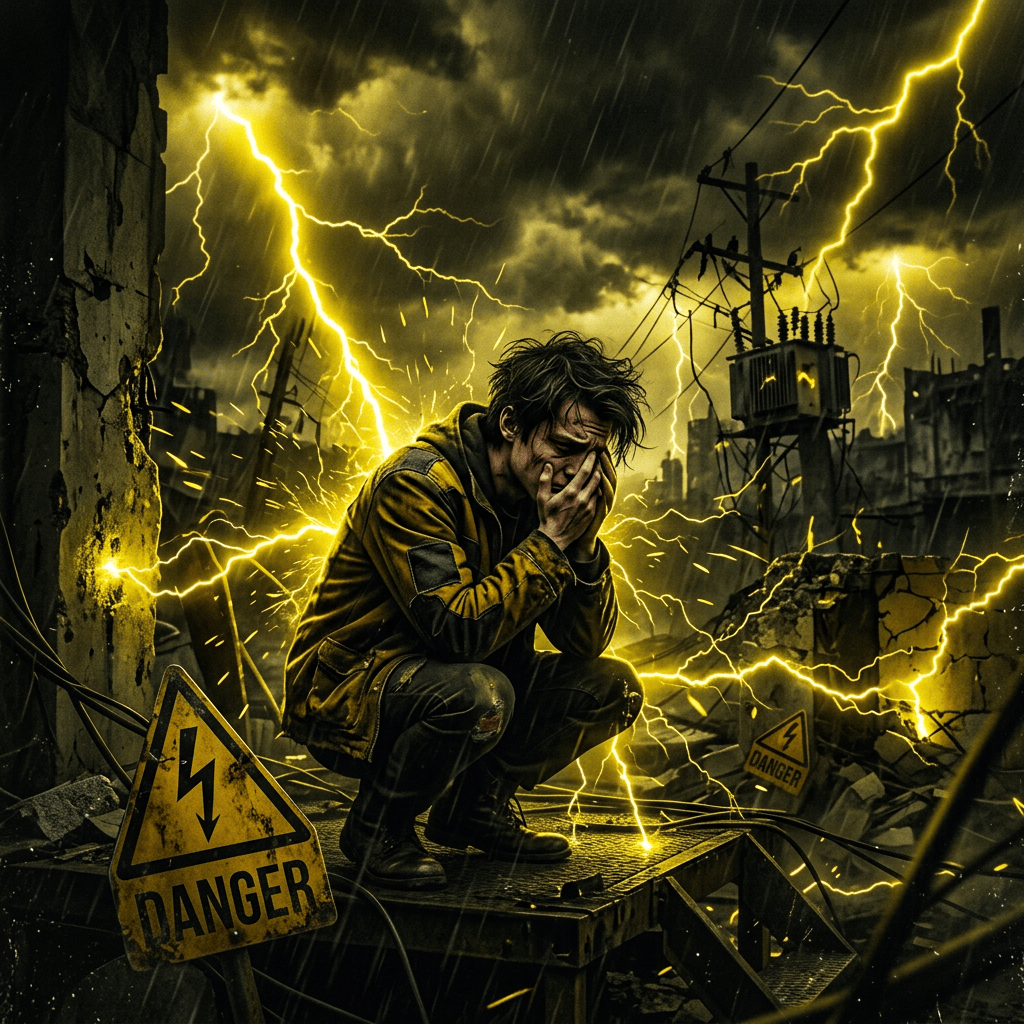
I think this is an extremely helpful picture. It captures what it feels like to have an overwrought nervous system. So again, fight/flight and freeze are not bad. But if your nervous system has gotten stuck on the Squiggle of Trauma, instead of just getting a flood of adrenaline like the girl in the picture with the yellow background, all of this electricity fires off in your system when you are triggered by any threat and you end up in a freeze like the man in this picture.
I’ll stop here for today and post again sometime soon.
-
“The Nearer the Sweeter” by Jessie P. Tompkins

Hymnal Page Scan: Hymns of the Faith p.248 Hymnary.org
Keyboard Recording:
1 The nearer I reach the end of life,
The sweeter is Home to me;
I long for the fragrant flow’rs that grow
On the banks of the Crystal Sea.Chorus:
Home, Home, Heavenly Home,
Fair are my dreams of thee;
The nearer I reach the end of time,
The sweeter thou art to me.2 The nearer the fading of the leaf,
The brighter the colors grow;
I sigh, when the evening shadows fall,
For the light of the morning glow. [Chorus]3 The nearer I reach the banks of bloom,
The fairer the breezes blow;
The nearer I reach the Fount of Love,
Then the sweeter the waters flow. [Chorus]4 The nearer I reach the Morning Land,
The fairer the golden light;
My eyes in the gath’ring mists grown dim,
Then the clearer immortal sight. [Chorus]I have been writing on here about this Polyvagal Chart and how I am having trouble going through the deactivation process. I’ve also been reading books about the unconscious mind and how it communicates through symbols. And it clicked with my mind that the arc on the Polyvagal chart reminds me of something else. In other words, the stress I am feeling when I am looking at the Polyvagal chart might actually be related to another chart I have in my mind that has to do with aging. When my parents’ generation was turning 40 years old, they used to say that that person was now “over the hill.” You would be going uphill until you were 40, and then after 40 you were “over the hill”, which meant that all that was left was a downward decline towards the end of life. People would say it as a joke…but I think it’s how we actually think of the aging process. So I have been struggling with that feeling since I turned 40 a few years ago…that feeling of going downhill. Here is a drawing of the chart I was seeing in my mind of what it means to be “Over the Hill”:
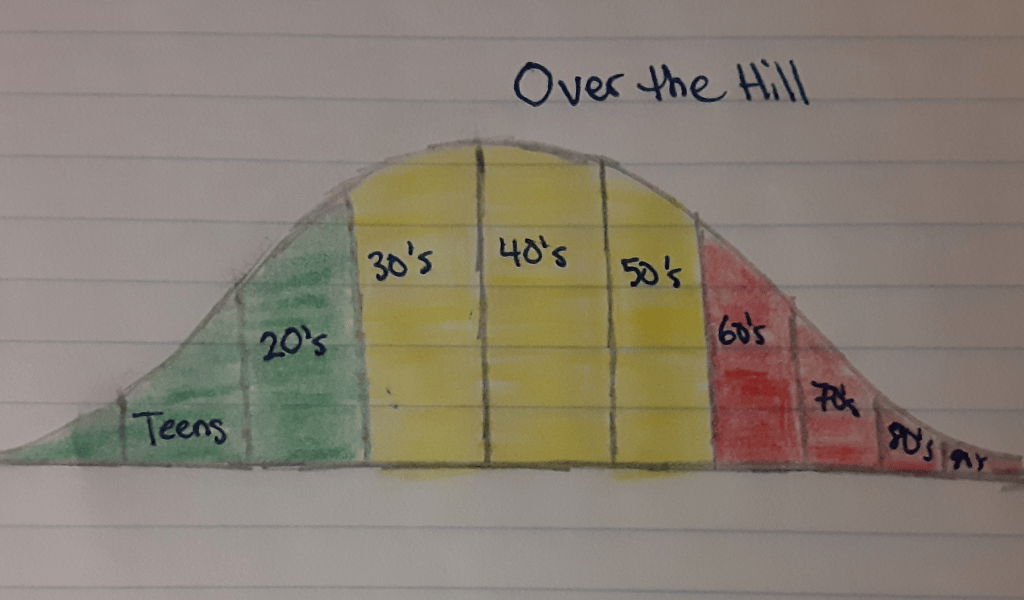
Notice how Birth-30 years old is green, 30-60 year old is yellow, and 60-100 years old is red. I thought that was interesting. I think that’s my mind’s way of communicating that the ages that are green felt safe, the ages in the yellow feel dangerous, and I can’t even really think about being the ages in the red. I would be too worried about my health. We have learned that the mind moves towards safety, so it’s trying to go back to a time when I felt safer when I was younger, but it can’t really do that. So I’m trying to find ways to bring a feeling of safety into the other ages.
I redrew the chart to look like this where all the ages are safe:
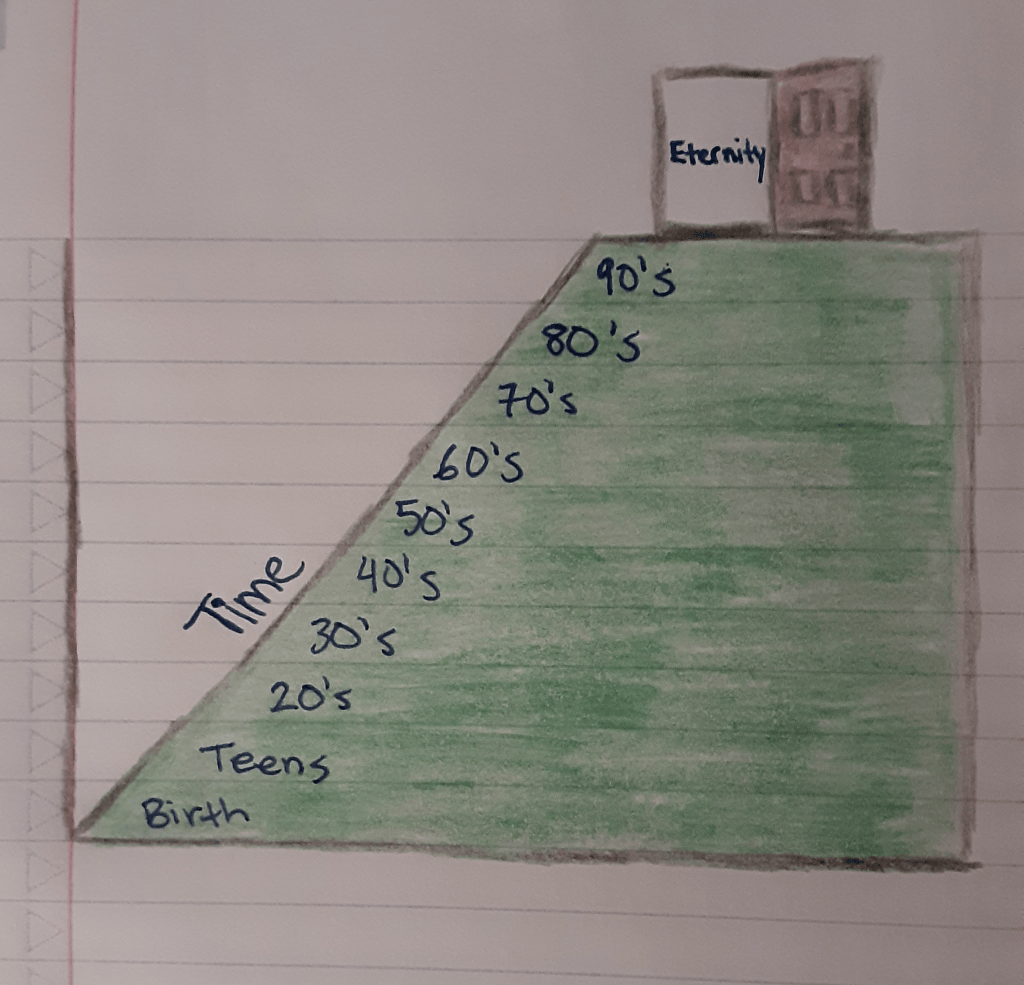
And when I did that I saw that now it looks like a mountain. We can use this to envision all the years of life as part of an upward climb to heaven. There is no downward slope.
I recently started watching YouTube videos of relaxing nature walks and scenic drives where it makes you feel like you are walking or that you are in the car when you watch them. Some of the drives are through mountain ranges and we can use them with the imagery of the mountain in the chart about aging. I found this video that is of a drive on a road that went up into the Alps: Klausen Pass 4K HDR A Scenic Swiss Alps Adventure. There’s also this one of mountains in Austria: The Most Beautiful Mountain Road in Austria Epic Grossglockner Summer Drive. The mountains were so majestic and the scenic views were so amazing that it felt heavenly…it made me think of heaven. And it got me thinking about how at the end of this life, when we are going to meet Jesus face to face, it might feel something like driving up that mountain knowing that He is waiting at the top of it for us. And that made me think of this hymn “The Nearer the Sweeter.” The farther and farther we drive up the mountain, the sweeter and sweeter heaven becomes to us.
The chorus says, “Home, Home, Heavenly Home, Fair are my dreams of thee; The nearer I reach the end of time, The sweeter thou art to me.” You can sing those words as you are meditating about going up that mountain. During our earthly life, we are bound by time…minutes, days, hours, weeks, months, years. The end of our life on earth will be the “end of time” for us. We will then enter into eternity, which is a different state of being in which time will pass differently. It’s not revealed yet exactly how that will work. But we can spend time meditating on that and wondering what life will be like there. Envision how, as we go through each day on earth, we get one day closer to life in heaven…and think about how heaven gets sweeter and sweeter to you the closer you get to it.
Envision the fragrant flowers that grow there…how beautiful they must be. And when it says in the 3rd verse, “The nearer I reach the banks of bloom (or the banks of the heavenly shore that are blooming with flowers), The fairer the breezes blow” envision some of that heavenly breeze reaching you and bringing with it the fragrance of those heavenly flowers. See the waters that flow along the roadside from the Fount of Love in heaven…and as you get closer and closer to the top of the mountain, the sweeter and sweeter the waters become. You are getting closer to home. Envision the evening shadows talked about in the 2nd verse…and then see the golden light of the Morning Land starting to shine and getting fairer and fairer each day. The mists begin to clear and you wait to catch a glimpse of the heavenly city. Think of the joy you will feel when you see Jesus waiting for you with His arms outstretched to greet you!
And then sing through the chorus again:
“Home, Home, Heavenly Home, Fair are my dreams of thee; The nearer I reach the end of time, The sweeter thou art to me.”As we practice meditating on this, hopefully it will help us find safety in all ages and to start viewing the aging process as an upward journey through time to our eternal home in heaven.
-
“Fly Up to the Sunshine” by G. E. Wright; Notes on Commentaries on Romans 8:28 and Proverbs 3:5-8; Imagery of God’s Providence as complex machinery
Hymnal Page Scan: The Gospel Call p.95 Hymnary.org
Keyboard Recording:
1 When your heart is faint and weary,
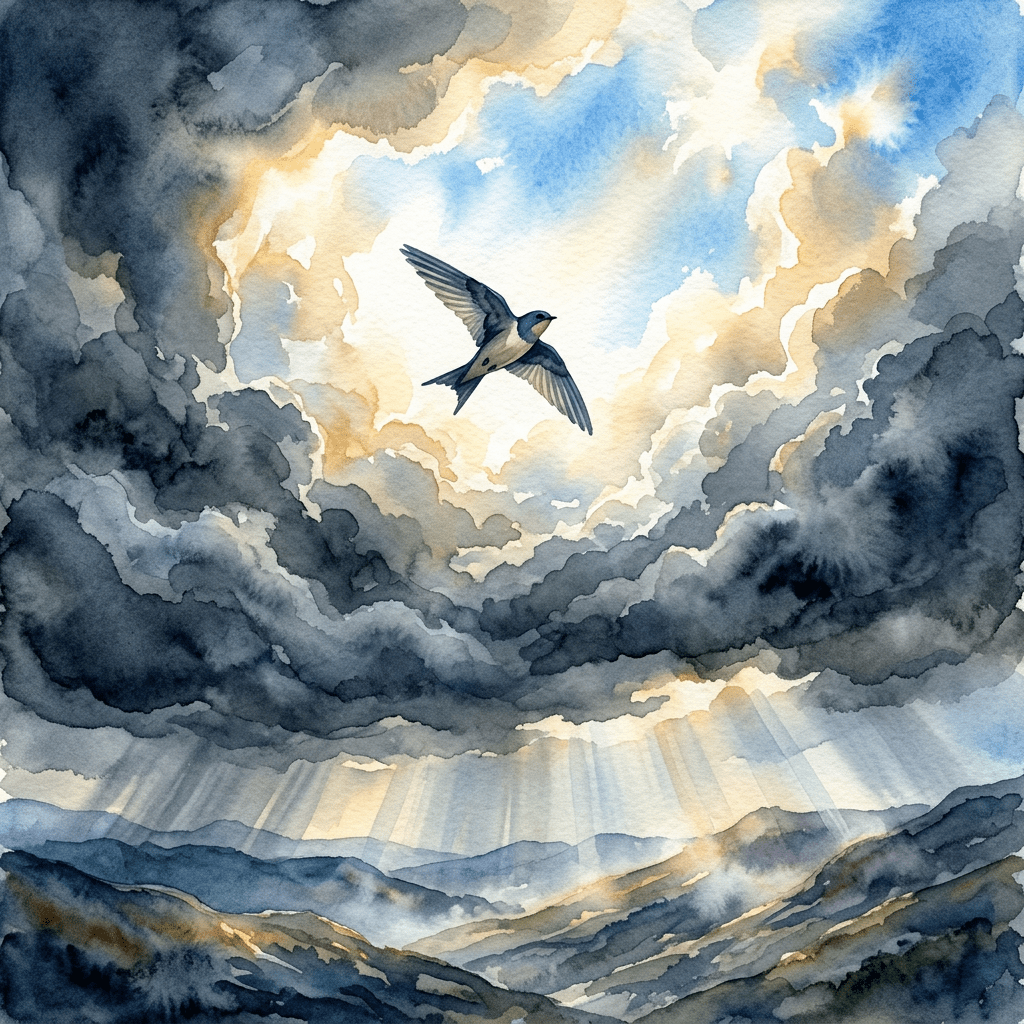
And the clouds obscure the sky,
And dark shades begin to gather o’er your soul;
Let the Savior lift you upward,
With His help He’s always nigh,
For upon Him all your burdens you may roll.Chorus:
Fly up to the sunshine!
Fly up to the sunshine!
Though trials with their mantle would your soul enshroud;
Fly up to the sunshine!
Fly up to the sunshine!
We’re sure the sun is shining just behind the clouds.2 We may conquer in the conflict
If in Jesus we believe:
Ev’ry trial worketh for the good of man;
On faith’s pinions we mount upward,
And the promise thus receive;
That was written in His great redemption plan. [Chorus]3 Then, pour soul, cast down with trouble
Lift to heav’n thy tear-dimmed eye,
With the swiftness of the eagle speed away;
Matters not though storms may gather,
You may safely through them fly,
And will reach the sunny land of endless day. [Chorus]I have been writing on here about how I have trouble getting stuck in a SNS/DV (Fight/flight-Freeze) loop. I see now that Fight/flight and Freeze are helpful, defensive states that enable us to respond to threats in our environment. The problem is if you go into them when you don’t need to or if the cycle doesn’t complete.
When you first sense a threat, on this Polyvagal Chart you go from green (VV) to yellow (SNS)…you go into fight/flight. If fighting or fleeing will not resolve the threat, you suddenly go into a freeze state – which is the red (DV). What we can use this hymn “Fly Up Into the Sunshine” for is in learning how to keep any triggering or activation from leading all the way up the chart into a freeze state. I think what you want to have happen in order to live on the Squiggle of Life is to be able to have only some activation take place from green to yellow most of the time that quickly resolves back into green. So maybe something happens where you need to go into the defensive yellow state (fight/flight) with it’s surge of adrenaline for a short amount of time, but then you are quickly able to return to the green state of safety. And then what is making more sense to me now is that we are going to learn how to address stressors/threats without going all the way into a defensive state by using less intense amounts of mobilizing and immobilizing energy. It seems like that as long as your mind/body feels that you have something else you can do…some other action you can take to resolve the threat…it will not sense as much danger or life-threat and keep activating and go into a freeze state. I think it will see the stressor as one that can be addressed while still in VV because, again, the defensive states are not bad…but the problem is if you are triggered into them for a stressor that could have been addressed without going into them. I hope I am thinking of that correctly.
We have been using hymns to learn about what actions we can take to address threats either in a calm state or with less intense energies. The hymn “Bend Low” helped us learn about how stopping and bending low in prayer in the midst of a storm can help us through it more calmly. This hymn we are looking at today talks about flying up into the sunshine. While I was studying about the Polyvagal Theory, I remembered that there are many hymns that use the words fight, flee, fly, run, wait, etc. All of these options are ways to find safety in God. God is a refuge we can flee to. We can in a spiritual sense “flee to God” or “run the race” or “fight the fight of faith” and this will help us remain calm physically. The key is that if we practice these things on a daily basis when we are not experiencing stressors, we will train our minds and develop new thought pathways that will be there for us to use the next time we do experience a stressor. We will have built an inner refuge we can flee to and your mind will remember it is there. So when it senses any danger, your mind will remember, “I can run to my refuge! I can stop and pray! I can look for God’s presence with an eye of faith!”
Let’s look now at the words to this hymn and see how it can help us. The 1st verse starts by saying, “When your heart is faint and weary, and the clouds obscure the sky, and dark shades begin to gather o’er your soul.” So this is how you are feeling. You are tired and your heart is faint. Dark clouds have rolled in and are blocking the sunlight. You now feel surrounded by darkness. This imagery of storm clouds represents how we feel when we are facing stressful circumstances. We start to feel triggered. We start to feel our heart rate increasing. I think the imagery of the clouds and the darkness captures that moment when you are starting to feel hopeless…like there’s nothing you can do. But then the next words offer a solution: “Let the Savior lift you upward, with His help He’s always nigh (near), for upon Him all your burdens you may roll.” Take time to envision that…envision Jesus lifting you up out of your moment of darkness into the bright sunshine with Him. Then see Him lowering His shoulder and reaching out His hands to you and helping you roll your burden off of your shoulders and onto His. Jesus will carry it for you.
The chorus tells us to, “Fly up to the sunshine! Fly up to the sunshine! Though trials with their mantle would your soul enshroud.” A mantle is “a loose, sleeveless cloak” or “something that covers, envelops, or conceals something else.” (dictionary.com). This is a WordPress AI generated image of a mantle:

You can see how the mantle envelops her. So the words to the chorus are saying. “Fly up to the sunshine! Although trials are trying to surround and envelop you with darkness, fly up to the sunshine! We’re sure the sun is shining just behind the clouds. You will see Jesus there lovingly waiting to help you.” Envision yourself basking in the healing warmth of that beautiful sunshine.
I learned at my Somatic Experience appointment this week that if you have been in a SNS/DV loop for a long time, safety might feel unfamiliar to you and you might not be able to stay in it for a long time. So if we spend time basking in the light of God’s love for a few moments…or as long as you feel comfortable…and then keep increasing the amount of time as you are able…we will be building a sense of what it feels like to be safe and become familiar with that. So be sure to take it slowly knowing that your mind will get comfortable with feeling safe over time.
The 2nd verse of this hymn references Romans 8:28 which says, “And we know that God works all things together for the good of those who love Him, who are called according to His purpose.” (Berean Standard Bible) The 2nd verse of this hymn begins with the words, “We may conquer in the conflict if in Jesus we believe: Ev’ry trial worketh for the good of man.” It is important to think about what the word “good” means here. When Paul says that God works all things together for our good, we often think of “good” in terms of physical comfort or earthly material resources. I used to think of this verse this way. But it has a deeper meaning. God has tender regard for our physical well-being. And sometimes the “good” God works out for us includes our temporal good. But here in this verse, the word “good” means our spiritual good. I’ll write more about this verse in just a minute. But I think that looking at Proverbs 3:5-8 first will help us understand Romans 8:28 because it helps us see that we can entrust our lives to God.
We have been learning about our need to acknowledge our total dependence on God for everything. Proverbs 3:5-8 (BSB) says,
“5Trust in the LORD with all your heart,
and lean not on your own understanding;
6in all your ways acknowledge Him,
and He will make your paths straight.
7Be not wise in your own eyes;
fear the LORD and turn away from evil.
8This will bring healing to your bodyb
and refreshmentc to your bones.”
The Pulpit Commentary on these verses says “with all thine heart” implies “entire reliance upon Jehovah.” It says this entire reliance upon God along with the “corresponding idea of the renunciation of reliance on self, is, as Zockler truly remarks, a ‘fundamental principle of all religion’……Without this reliance on or confidence in God, it is impossible to carry out any of the precepts of religion.” It says, “The teacher (the author of Proverbs) points out not only where we are to rely, but also where we are not to rely.” So we are supposed to trust in the Lord, we are not supposed to trust in our own understanding. I think it was when I was reading through John Gill’s book Doctrinal Divinity and the writings of John Calvin that I started to see that the reason we are not supposed to rely on our own understanding is because our understandings are finite/limited and because they are corrupted by sin. God wants us to use our understandings…to use our minds. But He doesn’t want us to “lean,” or rely, on them. The Berean Standard Bible’s notes on these verses say, “‘Lean’ pictures resting your weight on something for support. The verse warns against even partial dependence on anything other than God.” We are supposed to rely entirely on Him. Take time to envision that. See Jesus standing next to you. Practice envisioning yourself leaning entirely on Jesus for support. Notice that if you started leaning on anything else…like a chair or a wall…you wouldn’t be entirely leaning on Jesus. The same thing happens if we put our trust in…or lean on anything else in the world for support.
The BSB also says, “Trusting Him means admitting we never see the whole picture.” And that is the point that is being made here. We only see part of the picture. So even if we spend a large amount of time trying to think things through, we will only ever be able to see part of the picture. God alone sees the entire picture. And, therefore, we must place our trust in Him. We must seek Him for wisdom in everything. We must trust in Him entirely, for He alone knows everything about what is going on…so He alone can guide us to what is the correct step forward.
The BSB says, “Complete reliance on the covenant God belongs at the center of faithful living. The heart encompasses the mind, will, desires, and affections; God calls His people to place their whole selves under His care and authority.” Learning how to do this will be really important for learning how to cast our cares on Jesus, which I hope to write more about soon. First, we must acknowledge our dependence on Him and place our whole selves under His care and authority. We do this remembering that God’s purpose in telling us to place our trust in Him is that He wants to help us. He sees that we are hurting, and He wants us to stop trusting in ourselves and to trust only in Him so that He can help us through whatever is going on. He’s not wanting to restrict us in a bad way. He’s wanting us to follow Him so that He can lead us in the right direction because we cannot see the way forward on our own. Verses 4-8 tell us what will happen when we do trust in God, “He will make your paths straight.” The BSB notes say about this verse, “God’s guidance does not promise an easy life, but it assures His faithful care and purposeful direction (Psalm 23:3).” I thought that phrase “purposeful direction” was really interesting. It helps you think of the difference between wandering in the dark not knowing which direction to go and having God’s purposeful direction guiding you one step at a time. It’s the difference between being lost and almost overwhelmed in a storm and being guided safely through the darkness…up into the sunshine where we can seek God’s face (if we think in terms of this hymn).
Another really important note from the BSB says, “Trust rests not on visible circumstances but on God’s character, His faithfulness, and His revealed word.” So when we are looking for comfort and assurance, we are not going to look around at our outward circumstances. Instead we look to God’s character and place our trust in Him, knowing that He is with us even when our outward circumstances are stressful. That’s what it means to say that although storms are approaching, we will look beyond our outward circumstances and trust that the sun is shining just behind the clouds. God is still here with us. He still loves us.
Now that we have a better understanding of what it means to acknowledge our total dependence on God, we will look again at Romans 8:28. What does it mean that “God works all things together for the good of those who love Him”? The study notes for the Berean Study Bible for this verse explains that the words “all things” mean that “every event falls within God’s providential rule: suffering, weakness, loss, persecution, answered prayer, and seasons of joy.” It says that the verse shows that God is not passive and distant from His children, but rather that “He reigns over His creation and actively sustains, directs, and redeems the lives of His children.” So “all things” includes every type of event we will encounter in life. And the phrase “God works all things together” means that “the sovereign God actively orchestrates every circumstance for the ultimate good of those who love Him, because He has called them into a plan that cannot fail. Whatever enters our lives is lovingly bent toward His perfect purpose and our eternal blessing.” In another note it says, “Ultimately that good is Christ-likeness, eternal glory, and deeper fellowship with Him—benefits that outlast every earthly loss.”
So that’s one of the main points here that is made in the commentaries on this verse – ultimately the good that God is working out for us is Christ-likeness. If we look to God for help, afflictions and trials we encounter can be used to work sinful things out of us and bring us closer to God. This is part of the sanctification process we are going through where we are made less and less sinful over time and more and more like Christ. Barnes’ Notes on this verse say that “for good” means “for our real welfare; for the promotion of true piety, peace, and happiness in our hearts.” He says that it is a source of consolation and support to Christians that all their afflictions and trials are under the direction of the infinitely wise God “who has purposed the salvation of the Christian, and who has so appointed all things that they shall contribute to it.” He says that “work together for good” means that our afflictions and trials “shall cooperate; they shall mutually contribute to our good. They take off our affections from this world; they teach us the truth about our frail, transitory, and lying condition; they lead us to look to God for support, and to heaven for a final home; and they produce a subdued spirit, a humble temper, a patient, tender, and kind disposition.”
Another note from the BSB can help us see why this knowledge – the fact that “we know” with certainty that God will do this for us – is a source of comfort. It says this verse shows us that “God’s purpose cannot be frustrated by human sin, suffering, or hostile powers. Believers may not understand every path He appoints, but they can rest in the certainty that their lives are held within His redemptive plan.” Even if it feels like something is going wrong…even when we see a storm approaching like in the imagery of this hymn…we know that God is going to work all things together for our ultimate good.
So if we look again at the words to the 2nd verse of this hymn, we will see that we may conquer in the spiritual conflict, in the fight of faith, if we remain steadfast in our belief that God is working every trial together for our ultimate good…if we mount upward on faith’s pinions (wings)…fly through the storm on the wings of faith and receive God’s promise that was written in His great redemption plan…trusting in the assurance of our salvation.
There were several quotes from sermons in the Biblical Illustrator Commentary on Romans 8:28 that were very helpful.
John Angell James says that one of the inferences we can make from this subject (of this verse) is “the necessity of faith, to rise to the standard of our privileges, and receive that abundance of consolation which God has provided for us.” We must believe God is there…that He exists…and that He is good. I thought that was really interesting and it reminds us that trials are a test of our faith. We are learning how faith leads to action…if we really believe that Jesus is there and that He loves us and can help us…we will call out to Him and fly to Him. God wants to see us respond to an approaching storm with true and heartfelt faith in His goodness.
Then John Angell James uses some really helpful imagery. He compares the scheme (or grand design) of providence to a complicated piece of machinery. The Christian is standing there looking at it with all its complex parts and cannot understand how it works. God (the manufacturer of the machinery) is standing there holding in His hand the articles the machinery has produced and says to the Christian: “See these apparently contradictory movements; hear this noise and confusion: you cannot tell the design, perhaps, of one of the wheels, much less enter into the combination of the whole; but I can, and here are the results of these various movements.” And He explains to him how He is working everything together for His good – even seemingly contradictory movements. John Angell James: All Things Work Together Biblehub.com
Then Thomas Manton in his sermon says something that goes right along with this when he says that we cannot understand God’s providence until He has done His work and it is completed. So while we are watching the machine work and produce the events of providence, we must remember that we will not see the entire picture until we are in heaven. I’ve mentioned before on here that there is a hymn that I can’t remember the name of that talks about that when we get to heaven, Jesus will sit down with us and go over with us each step of the pathway we traveled to get to heaven and explain to us why things happened the way they did and how God worked it all together for our good. Manton says, “God knoweth what He is a-doing with you, when you know not (Jeremiah 29:11). When we apprehend nothing but ruin, God may be designing to us the choicest mercies (Psalms 31:22).” Thomas Manton: All Things Working Together Biblehub.com
So take time to work with that imagery. Envision a very complex machine to represent God’s providence. To help get an idea of an image for providence, we can look at the Topical Encyclopedia’s definition of providence and spend some time meditating on it. Here it is: “Providence refers to the divine guidance and care that God exercises over His creation. It encompasses God’s sovereign will and His active involvement in the world, ensuring that His purposes are fulfilled. Providence is a central theme in Christian theology, emphasizing God’s omniscience, omnipotence, and benevolence.” Topical Encyclopedia Biblehub.com Spend time thinking about that definition and see what kind of imagery your mind develops of a machine to represent it. Think about how many wheels it would have…how complex it would be…it would have many intricate parts that we would not know what they are or how they work. Envision the wheels and gears of it turning in ways that seem contradictory to our finite minds. We think things are going wrong. But we look to God and He is telling us, “Wait…Wait on Me…trust in My goodness…trust in My timing…keep walking with Me…and one day when you are here with Me in your eternal home I will show you what I was working out for you. Trust Me…Keep walking with Me. Remember that ‘I have loved you with an everlasting love’ (Jer. 31:3) and I will always be here with you…watching over you and caring for you. Take another step on the pathway with Me. Draw closer to Me.”
As I was working with this imagery, I learned to start letting the machine work…don’t try to stop it…but look up and ask for God’s guidance. Say, “What’s the next step? What’s the way forward?” And keep following Him knowing that He will lead you through the storm.
The words to the last verse of this hymn can help us with envisioning this. They say, “Then, pour soul, cast down with trouble lift to heav’n thy tear-dimmed eye, with the swiftness of the eagle speed away”…even though storms are gathering…you may fly safely through them and you will reach the sunny land of endless day.
Practice spending time each day basking in the light of God’s love for you. Then when storm clouds roll in, trust in God’s love…look up to heaven and fly on the wings of faith…trusting that God is still there…the sun is still shining behind the clouds.
Links:
-
“We Bear the Strain of Earthly Care” by Ozora Stearns Davis

Hymnal Page Scan: We Bear the Strain of Earthly Care Hymnary.org
Keyboard Recording:
1 We bear the strain of earthly care,
But bear it not alone;
Beside us walks our Brother Christ
And makes our task His own.2 Through din of market, whirl of wheels,
And thrust of driving trade,
We follow where the Master leads,
Serene and unafraid.3 The common hopes that make us men
Were His in Galilee;
The tasks He gives are those He gave
Beside the restless sea.4 Our brotherhood still rests in Him,
The Brother of us all,
And o’er the centuries still we hear
The Master’s winsome call.We can use this hymn when we are meditating on the imagery of casting our cares on Jesus. The 1st verse talks about how we bear the strain of earthly care, but we don’t bear it alone; our Brother Christ walks beside us and makes our task His own. Jesus is with us every moment of our lives — watching over us as the Good Shepherd. Think of the tender regard a Shepherd would have for his sheep during the day. He would wonder…is the sheep tired? has the sheep eaten? is the sheep thirsty? Jesus has the same regard for us. He knows us by name, and He knows everything we will be experiencing throughout the day…whether we are at home, or at school, or at work, or out at a store. He knows we need earthly resources and He wants to help us through the stresses of this life.
The 2nd verse talks about how we follow Jesus…follow His leading, serene and unafraid…as we go through our daily tasks. We listen for His voice and we follow His guidance.
The 3rd verse is about how we can trust in Jesus to help us because He understands the strain and care of daily labor. Hebrews 2:17-18 (BSB) says, “17For this reason He had to be made like His brothers in every way, so that He might become a merciful and faithful high priest in service to God, in order to make atonementh for the sins of the people. 18Because He Himself suffered when He was tempted, He is able to help those who are being tempted.” And Hebrews 4:14-16 (BSB) says, “14Therefore, since we have a great high priest who has passed through the heavens, Jesus the Son of God, let us hold firmly to what we profess. 15For we do not have a high priest who is unable to sympathize with our weaknesses, but we have one who was tempted in every way that we are, yet was without sin. 16Let us then approach the throne of grace with confidence, so that we may receive mercy and find grace to help us in our time of need.” The next part of the 3rd verse, which says, “The tasks He gives (us) are those He gave beside the restless sea,” reminds us that our daily tasks are much the same as the daily tasks of the people that were here during Jesus’ incarnation and walked with Him in Galilee. We still need to have food, clothing, and shelter and we still experience illness and the stresses involved in earthly life that make getting those things toilsome.
The 4th verse says, “Our brotherhood still rests in Him, The Brother of us all, And o’er the centuries still we hear the Master’s winsome call.” So, in the same way that He led our brothers in Christ through their lives on earth, Jesus will also lead us through our lives and help us with bearing the strain of earthly care.
Our earthly cares include the physical tasks that we have to do. They also include all of our stresses and anxieties about everything in our lives…they include our emotions. I will be writing more soon about what this means. Right now, take time with starting to envision Jesus walking beside you on the pathway. You are carrying a heavy burden on your shoulder. Jesus reaches out His hand to you and says, “Cast your cares on Me.” So you hand them to Him…and entrust them to His care. Then you continue walking with Him on the path throughout your day. What we will be focusing on is finding comfort in the fact that we can trust Him with everything in our lives. He is our loving Shepherd. He already knows our needs and already wants to help us. We are acknowledging that we need Him…we need His help in all things…and we are showing that we trust Him to help us. We trust in His wisdom and His goodness. We surrender our all to Him…and seek His guidance for every step through this life on earth. And Jesus is right there ready to take your burden from you and be the light for your pathway all the way home to heaven.
-
Learning about what the freeze state is and how to get out of it; Polyvagal Chart

(This is an AI generated image that I will explain at the end of this post.)
I had a breakthrough this week about being able to see what the freeze state is and how to get out of it. I have written about how I am stuck in a state of immobility. This is a link to the Polyvagal chart we have talked about: Polyvagal Chart. Immobility is in the red. I get confused about how you are going to have to experience a mobilizing energy (yellow) to get out of it…and how you are going to have to go through the yellow to get back to the green. I have been getting stuck when I am coming out of freeze and bump into some of that yellow energy. It’s too much, so I go back into a freeze like this:
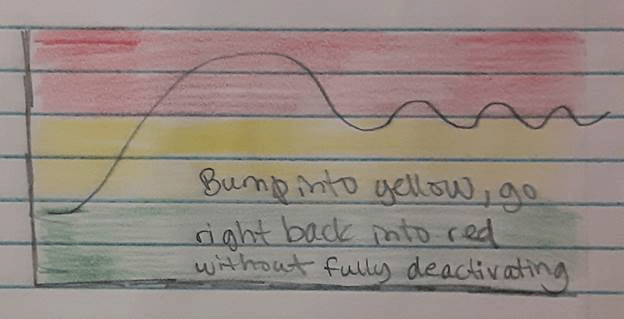
I had been thinking of freeze in terms of the example of a person running from an animal that was chasing them. And then when they realized the animal could catch up to them, they stopped and hid. I was thinking that they would be in distress while they were hiding – so that was correct. But it hadn’t clicked with me yet that it is an involuntary and sudden freeze when it happens to a person, too – and that’s why it’s difficult to regulate. I saw some YouTube videos of the moment when an animal actually goes into freeze, and you can see that it’s not just that they stop moving. There is a process that takes place. They freeze. The animal had been going through its day and then it saw a threat. A large amount of SNS mobilizing energy was cued up. It was ready to fight or flee. But its mind realized that any more movement would endanger it. So the option that would give the animal the best chance of surviving would be to immediately freeze and become undetectable to the predator. Part of that process involves reducing the heart rate and breathing rate so that the predator either will not be able to detect the hiding animal, or it will think the animal it has caught is dead. It also involves making the animal unresponsive to pain so that it won’t cry out or move if it is bitten.
So instead of just stopping and trying not to move, the animal experiences an involuntary reaction that takes over and floods their body with immobilizing neurochemicals and opiates and the animal suddenly stops/freezes. This slows their heart rate. We don’t have conscious control of our heart rate. Our autonomic nervous system controls it. We cannot change our heart rate by thinking about it. We might be able to change it indirectly by thinking about something stressful or something relaxing, but we cannot say or think, “I would like my heartbeat to rapidly reduce immediately” and make that happen like you could say to yourself “I would like to move my arm” and think about it and make your arm move. I think this is why that involuntary reaction takes over. Our mind/body is protecting us. So that’s what clicked with me…that’s what the breakthrough was. I hope I am thinking of it correctly. I see now that the surge of energy that puts me into a freeze is intended to help…it’s an involuntary reaction intended to protect me.
This is what Google AI said about this process when I asked what happens when the freeze state happens:
When the body enters a freeze state, the brain’s fear center triggers a massive surge of chemicals. This flood shuts down movement and action to protect you from harm. [1, 2]
The Brain and Nerve Signals
- The Amygdala senses extreme danger and signals the brain.
- The Sympathetic System starts with a burst of high energy.
- The Parasympathetic System then takes over very fast.
- The Vagus Nerve slows your heart rate and drops your blood pressure. [1, 2]
Key Chemicals and Hormones
- Endorphins flood the body to numb pain.
- Adrenaline stays high or shifts into a heavy, frozen block.
- Acetylcholine changes how your muscles respond.
- Cortisol stays in the blood to manage the severe stress.
Physical Effects on the Body
- Muscles lock up or go totally limp.
- Heart rate drops very low instead of racing.
- Blood flow moves away from your arms and legs.
- Voice and movement stop working as normal. [1, 2, 3, 4, 5]
So freeze floods the body with immobilizing chemicals. I had already been thinking of fight/flight as a surge of mobilizing energy. That had clicked with me. I wrote before about being stuck on the Squiggle of Trauma, the SNS/DV loop. If you are stuck on that, too, then you are used to those mobilizing and immobilizing surges of energy. When I was thinking about how fight/flight gives a surge of mobilizing energy, I remembered a tv show I watched where there was a woman who was in a room and then she realized the door was locked…she had been locked in the bathroom and couldn’t get out. She felt the stress of it…felt the threat to her safety…and she experienced a surge of mobilizing energy. She then had the strength to either break the door open or climb out the window…I can’t remember…I think she went out the window. The surge of energy she had helped her to escape. I think she might have had to go out the window and climb onto a neighboring balcony. She was several floors off the ground. Usually, a person would have a lot of nerves about that. But she was in flight/fight…she had that surge of energy…she didn’t think about what she would normally think about…she just said, “Well, I’ve got to get out of here…” and climbed over to the other balcony. If someone had asked her when she was in the lobby if she would go upstairs and climb on the balconies, she probably would have said no…she would have thought she couldn’t do it. But when she was locked in the bathroom and needed to escape and experienced that mobilizing energy, she went out onto the balcony without the normal hesitation. That’s what these energies do…they put you in an altered state…where you’re not thinking about things the way you normally would. The SNS mobilizing energy gives you that extra surge of strength and narrowed focus (just on making it safely to the other balcony) that helps you just get through it and get to safety.
The thing to note is that she might not have felt the stress of climbing on the balcony in the moment when she was doing it, but she will feel it the next time things get quiet. Everything she would have felt if she had just gone up from the lobby knowing that she was going to climb on the balconies…and everything she would have felt if she had been more aware of what she was doing in the moment…wanting to scream, for example…she will feel all of that later. Or it will start to bubble up. If she can’t process it, it will stay locked away in her system.
I’m wondering if this is where I am getting stuck. Fight/flight/freeze can be triggered by emotional stressors also. And what is clicking with me better now is that the amped up (SNS) energy that got cued up when you sensed a threat gets compressed and frozen rather than discharging if you go into a freeze. It compresses it and waits for a later, safer time to discharge it. But if when you start to relax and things start to get quiet, if what bubbles up (or what starts to unfreeze) is too much for you…too dysregulated…or you don’t have the tools to process it…you go right back into freeze. I’m wondering if that’s what is happening when I start to get out of the red and bump into the yellow.
What I’m starting to see more clearly is that your body is going to want to go through and complete the movements it wasn’t able to act out when you come out of freeze. I posted a video on here before of an impala that was waking up out of immobility and started shaking out that energy. If it was a physical threat, you might have a locked in desire to punch or kick. If it was an emotional threat, you might have the locked in desire to say what you didn’t say or to cry or scream.
If this energy of uncompleted actions has been locked away for a long time, it is important to remember that you are trying to unfreeze a moment that has been frozen in time. It’s so completely frozen and preserved in your mind that it feels like it is still happening. The woman on the balcony did not go into immobility…but if her feelings about it were hitting her later, she might feel like she was on the balcony again because it feels like it is still happening. Or the animal that went into immobility when the predator got too close and is now waking up would be trying to shake off the feelings it had when the predator was standing right there…and the feelings would be so strong that it might seem like the animal is still there. So I think what’s clicking with my mind is that the first step to coming out of a freeze and being able to release the energy would be to realize that the moment you are remembering and trying to process is no longer happening. You are remembering what you felt while you were on the balcony…but you are not on the balcony now. The grounding exercises are supposed to help with that, I think, but I struggle with those.
While I was thinking about this, I was looking at the Polyvagal chart and I realized that when you are coming out of the red (freeze, immobility/shutdown/collapse) you will go into the yellow next…but you are going into the yellow on the downward slope of the arc. You are mobilizing to escape. The animal that had frozen would be mobilizing to run away from the predator to safety. That would feel good. That would not have the same stress with it as it did when the animal was activating in the first place when he saw the predator approaching. So the animal would become aware that the predator was not there anymore, it would feel some relief and then start shaking off that compressed energy and then feel that mobilizing (yellow) energy that would enable it to run to safety. Then it would be able to slow down, rest and recover, and return to ventral vagal (normal heart rate and breathing rate).
It’s helping me to write all of this out. It’s hard for me to keep the information straight in my head. I’m seeing more clearly now that Fight/Flight and Freeze are helpful survival states that you need to have available to you because they give you surges of energy that help you regulate things that you do not have conscious control over – such as how fast your heart is beating or how much blood is going to your muscles. These surges of energy enable you to do things that you could not do in daily living mode (VV). In daily living mode your autonomic nervous system is regulating your heart rate and breathing rate at a normal pace. When your mind senses a threat, your SNS increases your heart rate and breathing rate and makes adjustments to how much blood is being sent to your muscles and what resources are available for digestion so that the resources necessary for escape will be sent to the right areas. Then, if your mind senses that you cannot escape and any more movement would endanger you, your parasympathetic nervous system floods your body with immobilizing neurochemicals that suddenly reduce your heart rate and breathing rate lower than they would be in VV. It also makes adjustments in your muscles and organs that will enable you to not be noticed by the predator.
So these are good functions in and of themselves. They are necessary for your survival…they are defensive, survival states that enable your body to mobilize or immobilize suddenly and intensely in response to a threat. The problem is if these defensive states get triggered when they are not necessary, or if they do not fully complete when they are triggered…if that compressed energy never gets properly discharged.
So what I will be working on is learning how to safely discharge the compressed energy that is already stored and also how to prevent energy from getting locked away like that in the first place. What I have been writing about on here is that we are trying to find what actions we could take to get out of that SNS/DV loop…to get out of the Squiggle of Trauma and get into the Squiggle of Life.
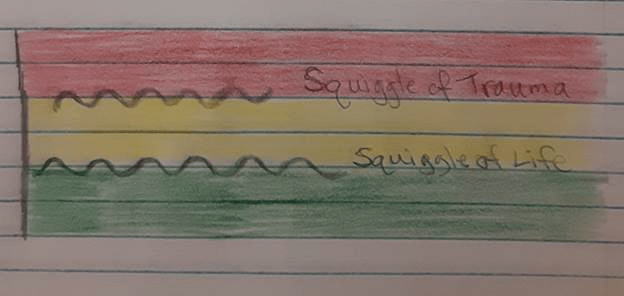
Some of the hymns I have been posting help us learn about how to stop and pray when we start to feel the activation process taking place. Praying is an action…you are crying out to God for help. You are crying out in distress. That helps discharge some of that cued up energy…and when you do pray, you will feel a response from God that can help calm your nervous system because you will sense that your cry for help has been heard. I’ve also been looking up hymns about how we are the clay and God is the potter. I hope to write about that sometime soon because the imagery is helpful. You have gotten into a bracing stance while you were in freeze…and hymns that are prayers for God to mold and shape us into who He wants us to be can help us get out of that bracing. I’ve also been looking up hymns about how Jesus is the sure foundation. There is really helpful imagery with those, too, because if we feel that solid foundation beneath our feet, it can help us to regulate when we are triggered because it gives us a sense of safety. When I was writing this post, God reminded me of 1 Peter 5:7 (BSB) which says, “Cast all your anxiety on Him, because He cares for you.” I found a really pretty hymn about casting all your cares on God and I found a lot of very helpful information in the study notes about this verse that I hope to post about soon. One thing I can share quickly is the imagery of your cares represented by a load of weight an animal, like a donkey or llama, is carrying. The act of “casting” is an intentional act of removing the load from the animal and placing it somewhere else. So instead of the donkey, envision your cares as a load of weight on your shoulders. Envision yourself intentionally removing it and then lifting it up…and casting it onto Jesus’s shoulders for Him to carry for you. There is more to this imagery, but it will help to start thinking about it like that. Even if you can’t physically move around when you are feeling triggered, envisioning a movement of casting that anxiety onto God can help prevent activation from increasing.
So, again, what we are trying to learn about is what we can do to prevent activation from increasing all the way through yellow to red when it doesn’t need to. When we start feeling triggered, we can stop to pray, cry out to God for help, learn how to be still before Him and wait, learn how to let Him mold and shape us. And we can learn to cast our cares on Him. Envisioning moving the weight that you are carrying off your shoulders and casting it up for Jesus to carry can really help.
I wanted to write a little bit about the picture at the top of this post. It is the image that the WordPress AI generated based on my post. I thought it was interesting and could be helpful to use as imagery. It is a close-up of relaxed hands slowly unclenching above a calm lake. The scattered ripples fading into still water suggest releasing the compressed, stored energy and completing unfinished actions. So, the hands are slowly releasing the compressed energy, which creates gentle ripples in the water. As the ripples fade away, the energy dissipates. This reminds me of exercises you can do where you are supposed to envision releasing the charged energy out of your feet into the ground to dissipate like what happens with lightning. I know that’s what happens in nature…lightning going through the ground like that where it dissipates without hurting anyone. But I struggle with thinking of the stored energy as lightning because I already have trouble thinking of the energy as something that could be released safely. It is so dysregulated and so harmful…how could it ever be released without causing harm? And I think of lightning as harmful. So maybe we could try thinking of releasing the energy…just a little bit of it…in waves into the water like in the picture. The key is to just release a little bit of it. That will take the pressure off of the rest of the energy that is stored…like a steam release valve. I tried using the imagery of the picture and it seemed to work. There are 2 hands in the picture. I thought of one of them as being mine and one of them as being Jesus’ hand. He was directing me…showing me how to release the energy into the water so it could dissipate. Then I started thinking of releasing the energy from my hand into His hand…and then He would carry that energy for me. That would go along with the idea of casting our cares upon Him. So sometimes when you work with one image, it can help some and then you might think of another image that helps, too.
This is another AI image that was generated based on the content in this post:
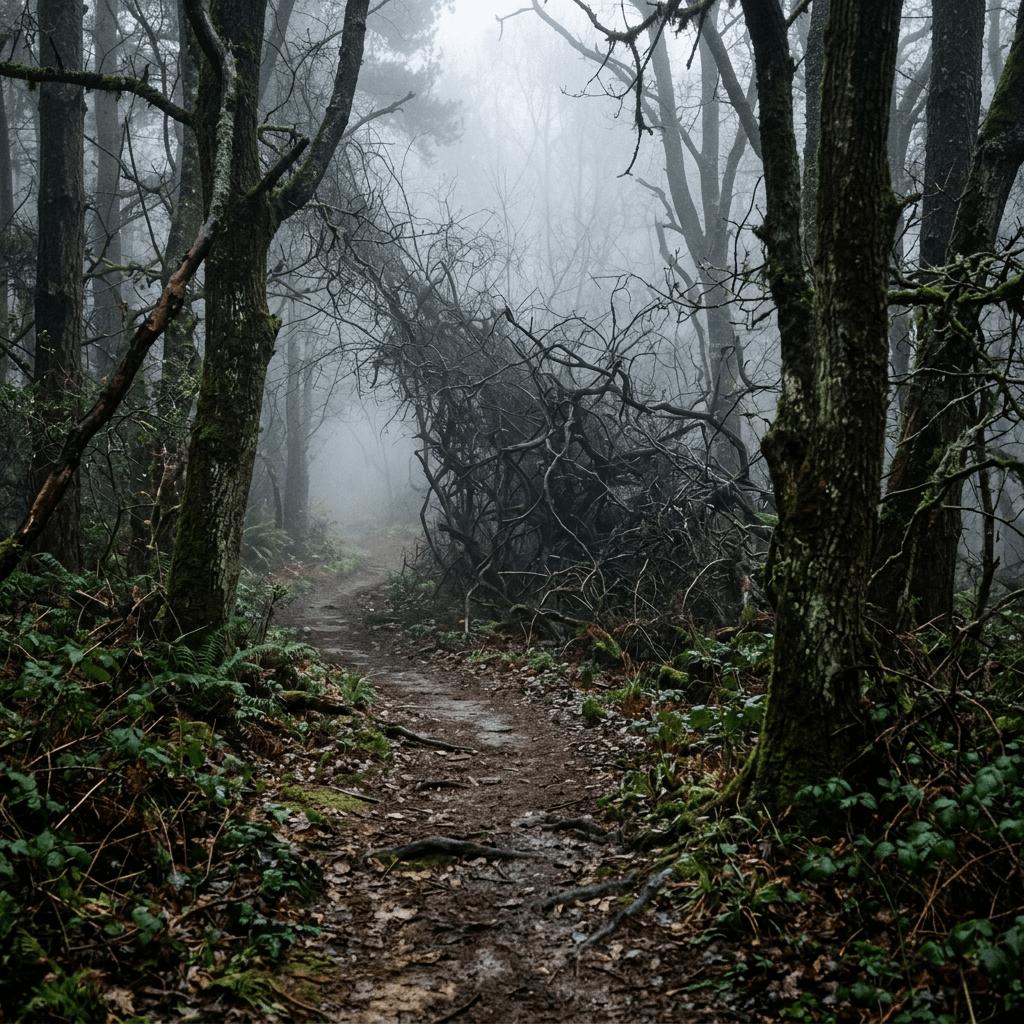
It is a forest that is supposed to represent the freeze state. I thought it really effectively captured what it feels like to have been in immobility for a really long time. This is what you are trying to unfreeze from. This is what it feels like when you start to wake up. New life has not really been able to grow while you have been frozen. So you must wait and try to let things thaw out…wait for rays of sunlight to shine in. They bring a gentle warmth that wakes everything up…revives everything…brings renewal. New little flowers start to spring up. New life energy flows through everything. You start hearing nature sounds again…you see vibrant colors returning all around you. This is what we are hoping will happen. See if you can use this picture to help you envision it.
I will stop here for today and write more about this soon.
-
Children’s Hymn: “Sail, Little Ships” by Lizzie DeArmond

Hymnal Page Scan: Sail, Little Ships Hymnary.org
Keyboard Recording:
1 Sail, little ships on the tossing waves,
Over life’s sea so wide;
Follow your compass, the Bible true,
Ever a faithful guide.Chorus:
Sail, sail, sail little ships,
Fear not the rolling waves beating so high;
Sail, sail, sail little ships,
You’ll gain the harbor of heav’n by and by.2 Sail, little ships, though the clouds hang low,
Hiding the port afar,
Over the shadows still shines above
Jesus, the Morning Star. [Chorus]3 Sail, little ships, let the storm-winds blow,
Christ will your Pilot be;
Onto the heavenly shore he’ll lead,
Safe through eternity. [Chorus]We have talked before about how faith is believing that Jesus is who He says He is and that He will do for us what He has promised to do. I think it was John Owen in one of his writings (I will try to find it) who used the imagery of going on a voyage. When you become a Christian, Jesus becomes the Captain of your ship. You get into the ship with Him and start out on a voyage over an ocean. You can’t see where you are going…you can’t see the destination…all you can see out towards the horizon is water. As we are sailing over the treacherous sea, we are trusting in Jesus to lead the way. We are trusting that He is who He says He is and that He is leading us where He says He is leading us. When we are out on the stormy seas and our faith beings to falter, we must remember to sail on because we know that even though Jesus is leading us through a storm, we can trust His guidance. And we trust that the destination of our voyage is heaven. Jesus is leading us to heaven over the stormy seas. One day, the golden shore will appear on the horizon and our ship will reach the port of heaven where we will live with Jesus forever.
The imagery in this hymn will help us practice following Jesus’s guidance. Envision yourself in a ship sailing on the ocean. You know that you are traveling to heaven but you don’t know the way. You need Jesus to guide you. The 1st verse tells us to sail on little ships on the tossing waves. We will use the Bible as our compass. Envision yourself looking down at a compass that has a needle that always points towards heaven. That’s what the Bible does for us. When we read it, it points us to Jesus. It helps us see the way. Psalm 119:105 (NIV) says, “Your word is a lamp for my feet, a light on my path.”
The Berean Study Bible says about this verse, “Light in the Bible often symbolizes truth, purity, and the presence of God. It dispels darkness, revealing the path ahead……The word of God provides not only immediate guidance but also long-term direction, helping believers navigate life’s complexities……God’s inerrant word functions both as a close-range lamp for each step and a broad-beam light for the whole journey.” And Charles Spurgeon says, “Each man should use the word of God personally, practically, and habitually, that he may see his way and see what lies in it. When darkness settles down upon all around me, the word of the Lord, like a flaming torch, reveals my way.” So, the Bible is a compass with a needle that always points to heaven. And when you read it, it illuminates your pathway over the treacherous seas. Envision a light that shines in the darkness…it illuminates the pathway one step in front of you…and is also a broad- beam light that shines throughout the whole journey home.
The 2nd verse talks about times when the way gets dark, and clouds make it difficult to see the way forward. But we can sail on because Jesus the Morning Star will shine light on us from above, making the way bright. Jesus is our Captain, or Pilot.
The 3rd verse says to sail on and let the storm winds blow, because Jesus our Captain, or Pilot, will guide us safely through all the way to the port of heaven. Envision yourself stepping off the ship safely on the golden shore of heaven.
As you are going through your day, if you start to feel confused or distressed…if the sea starts to get stormy…remember to use your compass and to look to your Captain for help. He will help you navigate the sea of life day by day.
Links: https://biblehub.com/psalms/119-105.htm#google_vignette
-
Children’s Hymn: “A Song of Life” by Margaret C. Brown; Imagery for grounding exercises
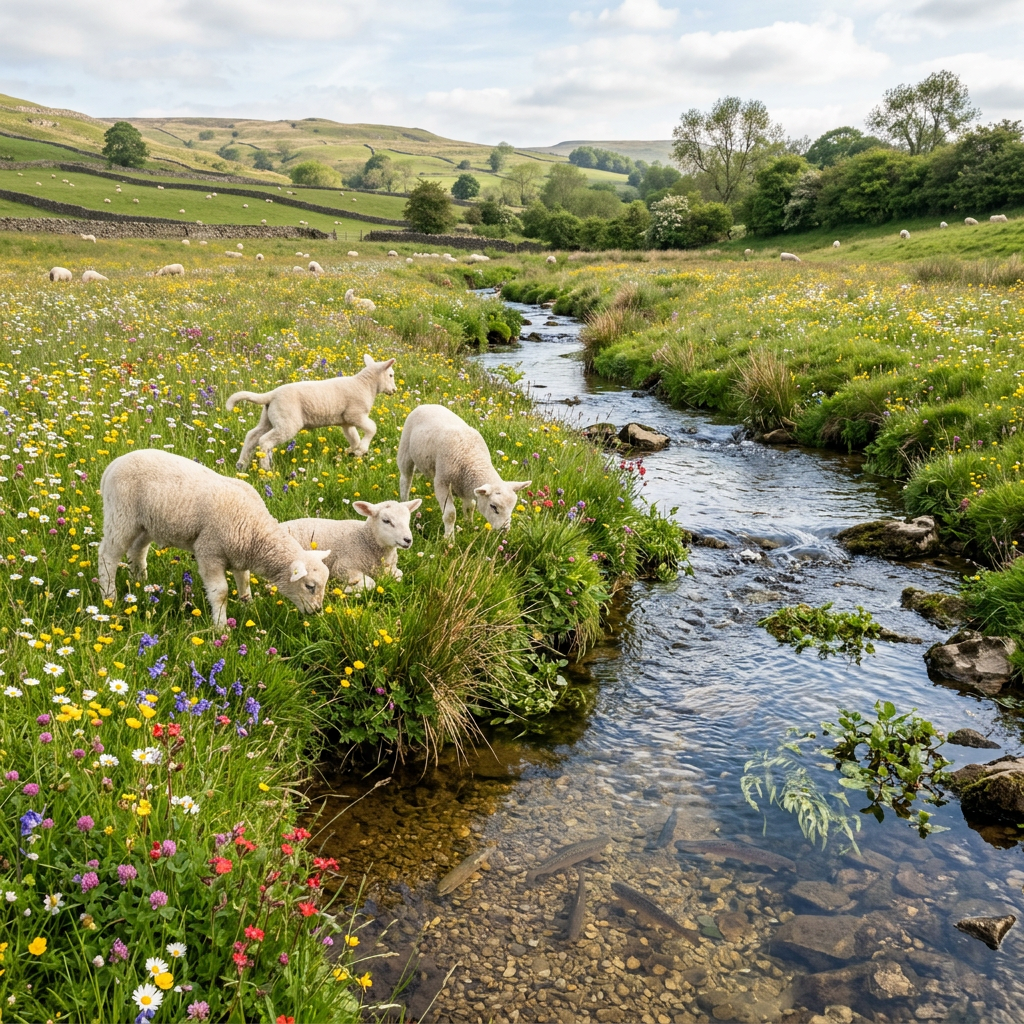
Hymnal Page Scan: A Song of Life Hymnary.org
Keyboard Recording:
1 In the clear, cool water
Little fishes swim,
Darting now in sunshine,
Now in shadows dim;
Under rocks they’re hiding,
Merrily at play:—
God, who made them, loves them,
Cares for them alway;
God, who made them, loves them,
Cares for them alway.2 In the little garden
Seeds begin to grow,
Upward crowd the green leaves,
Down the rootlets go;
Buds and blossoms follow,
Making earth so gay:—
God, who made them, loves them,
Cares for them alway;
God, who made them, loves them,
Cares for them alway.3 On the grassy meadows
See the lambs at play;
Mother sheep is watching,
Never far away;
Bossy calves are cropping
Clovers all the day:—
God, the Life of all life,
Cares for them alway;
God, the Life of all life,
Cares for them alway.4 In the leafy branches
Cozy nests are hung,
Full of baby birdlings,
By the breezes swung;
Hear them sweetly chirping,
Happy all the day:—
God, the Life of all life,
Cares for them alway;
God, the Life of all life,
Cares for them alway.5 In a tiny cradle,
Curtained round with white,
Lies a rosy baby,
Dimples, sweet and bright;
Hear her cooing softly,
Like a gentle dove:—
God, who made the round world,
Gives me light and love;
God, who made the round world,
Gives me light and love.I posted recently about grounding exercises, which are exercises that help you orient yourself to the present moment. I wrote about how I struggle to update to the present moment…parts of my mind are frozen in the past before I got sick. People are often not in the present moment because they are dissociating or distracting themselves from the stress of the present moment. So then, as you start to connect the present moment again, all of the stresses you were pushing aside come flooding into your awareness.
One thing that helps me update to the present moment is focusing on nature. In the grounding exercises, you are supposed to focus on several objects in your environment and focus on what information your 5 senses are picking up on – sights, smells, tastes, touches, sounds. It does help to find objects to focus on. But if you are at home or in a familiar environment, you might have strong emotional associations and memories with the objects. So then you are supposed to try to find new objects to focus on…or something that will help you see the difference between past and present. I was trying this at home and it helped me to expand awareness outside of the house and focus on nature. And interestingly I found a helpful combination of old and new objects…so that I still felt connected to the past, but I also started to feel safely grounded in the present. That way I wasn’t totally disoriented by everything feeling new and unfamiliar…and yet I wasn’t stuck in a past moment where there was not an openness to anything new. The trees outside have been there for years, but the leaves are new. The curb around the outside of the yard and the sidewalks have been there a long time, but the blades of grass and the flowers are new. The sky is familiar…it is still a beautiful blue. And the sun is the same sun. The clouds are familiar shapes, but they are new…they are made of new condensation…and are in different shapes than the last time I looked at the sky. The river is in the same place, but it has new water flowing through it. So you see how I was able to find things that were familiar in nature…which helped me feel like I was somewhere familiar in a good way…and then find things that were new to help the present moment feel safe. It helped me see that I might be in the same place, but I am in a new time now. After focusing on nature, I started feeling more like I could look around at objects inside the house and start feeling the floor beneath my feet and start orienting myself to that environment. I’m not sure if that’s exactly how you are supposed to do the exercises. But it helped to just kind of let my mind find a point to start from where it felt safe.
The reason I find comfort in focusing on nature is because it helps me connect to a sense of God’s presence with me. The attributes of God are displayed in His creation – His wisdom, power, goodness. He created the earth as a habitation for mankind. And He still lovingly governs His creation. When we think about His care for the earth and all of His creatures, it reminds us that He cares for us, too. The words to this hymn are about this.
The 1st verse talks about little fishes swimming in the clear, cool water. Sometimes they are swimming in sunshine…and sometimes in shadows dim…sometimes hiding under rocks…sometimes merrily at play. The God who made them loves them, watches over them, and cares for them wherever they are…in the sunshine or in the shadows dim. He is there with them always.
The 2nd verse talks about a little garden where seeds are beginning to grow. The leaves grow upward, the roots grow downward. Buds and blossoms follow…making the earth beautiful and bright. When God created the world, He provided everything that humans would need…including fruits and vegetables that nourish our bodies…and He made the flowers beautiful to our sight. Genesis 1:31 (NIV) says, “God saw all that he had made, and it was very good. And there was evening, and there was morning—the sixth day.” The Berean Study Bible says “the term ‘very good’ signifies the perfection and harmony of creation before the fall of man. This phrase underscores the inherent goodness of God’s creation.” This inherent goodness reflects His perfect nature. So when we meditate on nature, we are also meditating on the goodness of God. The Berean Study Bible also says that the use of the word “very” foreshadows the restoration of the creation described in Revelation 21:1-4 when God will make all things new. We live in a fallen world now which still reveals the glory of God. But it is just a glimpse of the beauty that we will experience in the new heavens and the new earth described in Revelation. The 2 verse ends by saying about about the garden with seeds and flowers in it – the God who made them loves them and cares for them always.
The 3rd verse talks about a mother sheep watching her lambs playing in grassy meadows. There are also cows eating clover. The 4th verse talks about baby birdlings sweetly chirping in cozy nests. They are happy all the day long. God, the life of all life, cares for them always.
The 5th verse talks about a baby with dimples sweet and bright. She’s in a tiny cradle, curtained round with white. You can hear her cooing softly – God who made the round world, gives her light and love.
As you are singing through this hymn, you can use it as a kind of grounding exercise. Look around in your environment and see if you see any of those things. There are fish in the river close to my house. There are flowers and birds. And if those exact things are not there, what objects in nature could you focus on? Then focus on the fish, flowers, birds, etc. and meditate on God’s loving care for them…and then bring your awareness to God’s care for humans…like how in the hymn the 1st 4 verses are about God’s care for nature and the 5th verse is about God’s care for the little girl in the cradle. At the end of the hymn, say a long with her “God, who made the round world,
Gives me light and love,” and feel yourself resting in His care.While I’ve been writing this and thinking through the words to this hymn, it’s clicked with me what it means when they say that while you’re doing the grounding exercise, you should just let your mind gently experience the present moment…even if it’s just for a few moments…and then let it return to where it’s comfortable…and then let it visit the present moment again for a short time. This way it will be like when you are lifting weights to build muscles…you start with just a few reps. Try not to put any pressure or strain or you mind…like you are trying to make it update to the present. Instead, just let it move into the present moment briefly…and it can stay there longer as it gets comfortable. I was able to start doing that with this hymn. So that is good progress. As you are practicing with letting your mind experience the present moment, remember to focus your awareness on the fact that God is with you at all times in all moments…and keep walking close to Him throughout the day…and you will begin to be able to experience the present moment more easily as it feels safer and safer to do so.
-
Subscribe
Subscribed
Have a WordPress.com account? Log in now.

