The other day I was drawing a chart to try and get clarity about what it means to go from the Squiggle of Trauma to the Squiggle of Life. I also read this article: “The polyvagal theory: New insights into adaptive reactions of the autonomic nervous system” by Stephen Porges and something clicked with me about what the colors on the Polyvagal Chart are representing. Porges says in the article, “The human nervous system, similar to that of other mammals, evolved not solely to survive in safe environments but also to promote survival in dangerous and life-threatening contexts.” That’s when something clicked for me that I hope I can explain. It helped me see that the human nervous system developed different settings (for heart rate, breathing rate, adrenaline, etc.) for survival in different circumstances. Those circumstances can be put into 3 categories: safe circumstances, dangerous circumstances, and life-threatening circumstances. In safe circumstances, you can have settings that include a normal heart rate and breathing rate. In dangerous circumstances, you need different defensive settings in order to be able to survive — you need a flood of adrenaline and mobilizing chemicals to enable you to move faster and have a narrowed focus…to enable you to fight or flee. Your heart rate and breathing rate need to change because blood flow needs to be increased to the muscles. Then if your nervous system detects that you are not going to be able to resolve the threat by fighting and cannot escape by fleeing, I think it considers that an imminently life-threatening circumstance in which you need to freeze. So it sends a flood of immobilizing chemicals to either hide you from the predator or make you appear lifeless and non-responsive to pain so the predator will leave you alone.
So, putting the word “circumstances” with it helped me see that the 3 physiological states developed to help you survive in 3 categories of experiences – safety, danger, and life-threatening circumstances. Later in the article, Porges said, “Functionally, visceral states color our perception of objects and others.” All of this helped me see more clearly what the colors on the Polyvagal chart are representing. Green is safety. Then if a threat is perceived in your environment you automatically change states to increase heart rate, breathing rate, etc. in order to increase your chances of survival in those circumstances.
I am a visual learner, so I used the WordPress AI image generator to make some images of the different states. Here they are:
Safety (Ventral Vagal)

Danger (SNS): Fight/Flight

Life-Threat (DV): Freeze

So you can see that when she perceived her environment to be safe (green), she was standing calmly. Then when she perceived something in her environment that was a cue of danger (yellow), she went into fight/flight and started running. When she perceived that she would not be able to escape the threat and that more movement would endanger her (red), she went into a freeze.
I hope I’m thinking of this correctly. I’ll post about it again soon. Right now, it’s really helping me to see more clearly that state-changing is the result of an interaction between your nervous system and the environment. The yellow and red states are not bad…they are actually very helpful because they either flood you with mobilizing neurochemicals that can help you fight or run fast enough to escape or they flood you with immobilizing chemicals that enable you to be still/frozen in a way you couldn’t be in green/vv. The problem is if your system has gotten triggered into yellow or red when it didn’t really need to be…or if the mobilizing energy involved in fight-flight that got compressed when you froze wasn’t ever properly discharged. I tried to make an image for what it would look like for your system to be overwrought after being stuck on the Squiggle of Trauma (only alternating between yellow and red) and here is what the WordPress AI made for that:
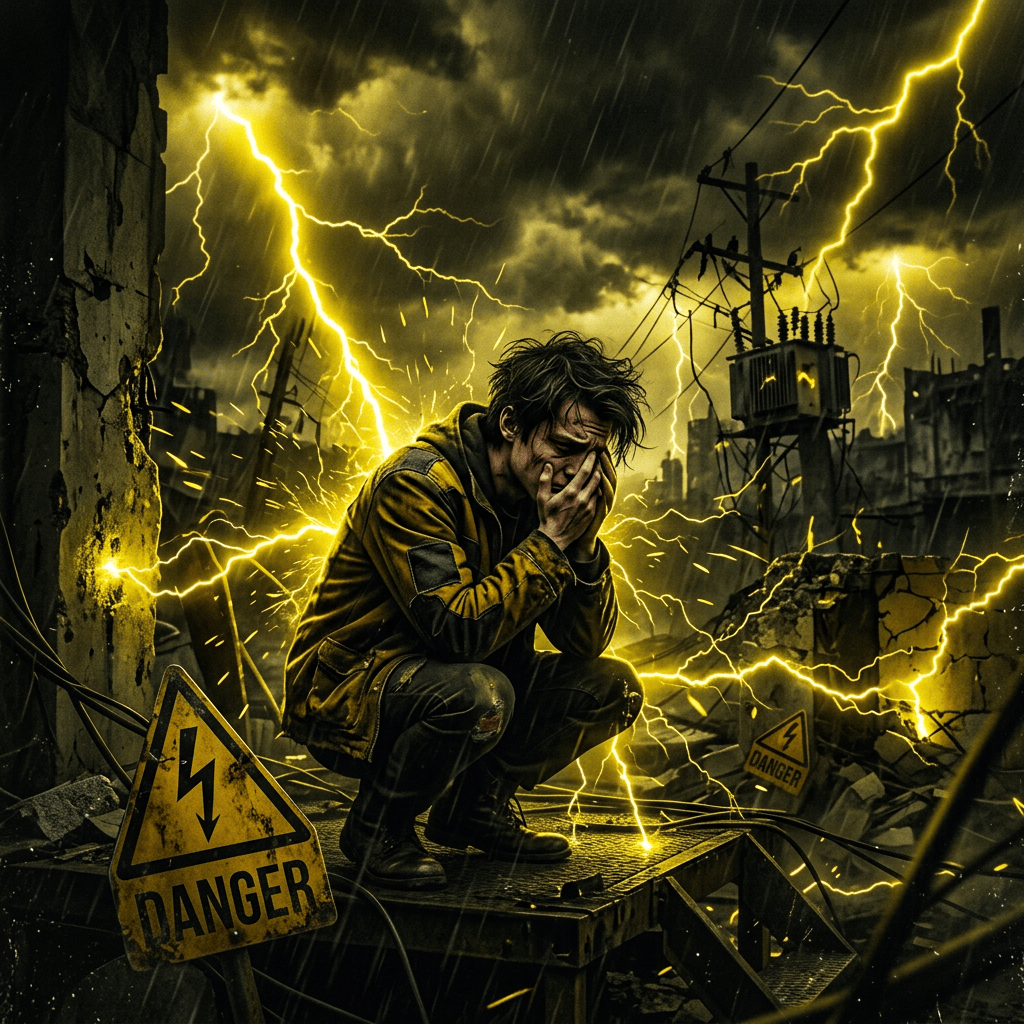
I think this is an extremely helpful picture. It captures what it feels like to have an overwrought nervous system. So again, fight/flight and freeze are not bad. But if your nervous system has gotten stuck on the Squiggle of Trauma, instead of just getting a flood of adrenaline like the girl in the picture with the yellow background, all of this electricity fires off in your system when you are triggered by any threat and you end up in a freeze like the man in this picture.
I’ll stop here for today and post again sometime soon.


Leave a comment