
In today’s post we are going to be looking at a devotional by John Kitto (1804-1854) entitled,”God the Creator.” Here is a link to the full devotional: Daily Bible Illustrations: God the Creator Gen 1:1 p.13 by John Kitto Archive.org.
John Kitto starts his devotional by pointing out that when we open the Bible and read Genesis 1:1, the first role God reveals Himself to us in is as the Creator of the world. Kitto writes throughout his devotional that we need to be thankful for this clear revelation. And he warns us that we need to be careful not to miss the importance of it. Kitto says, “In the fulness of that knowledge which has become our heritage since He, who ‘at sundry times and in divers manners spake in times past unto the fathers by the prophets, hath in these last days spoken unto us by his Son’ (Heb. 1:1), very few of us can appreciate the entire force and importance of this disclosure.” By “in the fullness of that knowledge,” he means that although we are blessed with the fullness of the clear revelation in Genesis 1:1 that God created the heavens and the earth, which has become our heritage by being passed down from generation to generation, still, very few Christians can appreciate the entire force and importance of this disclosure. Sometimes we have heard a doctrine so much and think we are so familiar with it…think that it is an elementary, or basic truth…that we miss the great significance of it. We don’t see the weight of importance it carries. He says that despite not knowing of any other fact which so distinctly shows the full extent of our privileges as this doctrine does – the doctrine that God created the entire universe, including mankind, and, therefore, that we are created by God – “this great ancient secret, has become in our days so common a possession, that we scarcely heed its value, any more than we do that of the air, in which, notwithstanding, our life lies.”
Kitto says that this great doctrine was among the truths that many kings, and priests, and wise men sought after, or groped in the dark after, but were not able to find. He says, “But blessed are our eyes, for they see ; and our ears, for they hear ‘ — not only this, but the more deep and hidden mysteries which even the angels of God, who shouted together for joy on the morning of Creation, desire to look into.” He then points out that many people throughout ancient history (such as philosophers in ancient Greece) tried to answer the question of where the world came from, but they only had hints of the truth in their ideas. He says that after looking at that, we then begin to appreciate the clearness of the revelation the ancient Hebrews received that we read in the first verse of the Bible – that God created the heavens and the earth.
The imagery Kitto is using here is that those who did not have that doctrine that God created the earth were groping around in darkness looking for the answer, but they couldn’t find it. When someone hears the doctrine that God is the Creator, it’s like “the letting in a flood of light to the mind.” And we need to be thankful for that light…that clear revelation. Kitto says, “[The doctrine] is written with a sunbeam in the Old Testament ; and it is well that we should strive, for our profit, to realize (or experience) that vivid impression concerning it, which has perhaps been too much deadened by our familiarity from childhood with the sacred record which sets it forth.” Take time to envision that. See that sunbeam of truth shining out of Genesis 1:1 and illuminating your mind. Has the impression of that truth been deadened by your familiarity with it? Let it make a “vivid impression” like Kitto is talking about. Focus on that sunbeam of truth, and give your mind time to interact with it. Meditate on it. Feel awe regarding it. Let your mind envision what it must have looked like when God created the heavens and the earth…how amazing it was! Feel the weight…the importance of that truth.
Kitto next explains that while we all know that the Hebrew polity (i.e. government, sacrificial system) of the Old Testament was full of shadows that pointed to Christ, another purpose of the Hebrew polity was “to maintain this great doctrine of the creation of the world by one independent and Almighty Being.” And in order to be sure that we never forget it, the Sabbath day was set apart…one day each week…to commemorate it. Kitto says, “Now, that to which God saw fit to give such prominence under the old law, must not be altogether forgotten by us, or, although acknowledged as a matter of course, excluded practically from our meditations and our devotions. Yet how seldom do we adore God as the Creator — in which capacity he saw fit to present himself so conspicuously to his elder children.”
In the next paragraph, Kitto explains that this doctrine of God as the Creator is not only a part of the Old Testament, but it is also part of the New Testament. He says, “The Creation belongs no less to the New Testament than to the Old.” He also says, “The [New Testament] sets [the doctrine of God as Creator] before us in fresh and endearing relations.” It shows us that Jesus Christ is the long awaited Messiah who was prophesied about in the Old Testament. And it tells us that Jesus is the Word made flesh. He is the Redeemer who will save people from their sins. So, the “fresh and endearing relations” Kitto was talking about are shown in the revelation that our Creator is also our Redeemer. The Gospel connects Creation with Redemption.
Kitto says, “[The New Testament] shows to us, that He by whom the world was made, was no other than He who, in a later age, came down in sorrow and in suffering to redeem that world from its pollutions, and to repair the ruin which sin had caused in his own fair work.”
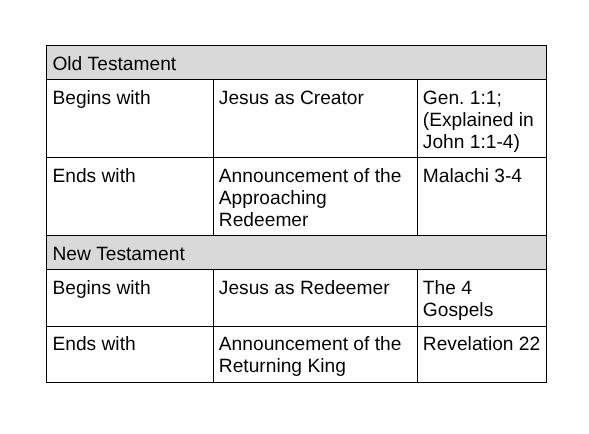
Kitto closes his devotional by showing how the New Testament – the Gospel – connects creation and redemption. He shows us that the Old Testament and New Testament both begin and end with references to Christ. In the beginning of the Old Testament, we recognize Jesus in the Creator. The Apostle John helps explain this to us in John 1:1-4 (BSB) where he says, “1In the beginning was the Word, and the Word was with God, and the Word was God. 2He was with God in the beginning. 3Through Him all things were made, and without Him nothing was made that has been made.” So that’s how the Old Testament begins. It closes with an announcement of Jesus’ approach as our Redeemer in Malachi 3-4. Malachi 3:1 (BSB) says, “1“Behold, I will send My messenger, who will prepare the way before Me.a Then the Lord whom you seek will suddenly come to His temple—the Messenger of the covenant, in whom you delight—see, He is coming,” says the LORD of Hosts.” The New Testament begins in Matthew, Mark, Luke, and John with the birth of Jesus, who has come as the Saviour of the world. John 1:9 (BSB) says, “9The true Light, who gives light to everyone, was coming into the world.” And John 1:14 (BSB) says, “14The Word became flesh and made His dwelling among us.b We have seen His glory, the glory of the one and only Sonc from the Father, full of grace and truth.” At the close of the New Testament, Jesus’ Second Coming is announced. Kitto says, “ and happy are they who can from the heart hail that announcement in the words of the Evangelist — ‘Even so, come Lord Jesus, come quickly’.” (Rev. 22:20)
He who created us, is the one who came to save us. Let your mind and heart feel the awe of that as you spend time meditating today.
Summary
The first role that God reveals Himself to us in is as the Creator of the world.
We are so familiar with the doctrine that God created the heavens and the earth that we often miss the importance of it.
We need to be thankful for the clear revelation of this doctrine in the Bible.
Because God placed such importance on the doctrine of His role as Creator, we need to treat it with importance and spend time meditating on it.
The Creation belongs no less to the New Testament than to the Old. The Gospel connects creation and redemption — the Creator and the Redeemer. They are one – our Creator is also our Redeemer.
Kitto shows us how the Old Testament and New Testament both begin and end with references to Jesus:
Meditation Imagery
The doctrine of God as creator “written with a sunbeam” in Genesis 1:1. When someone finds that revelation, it is like “the letting in a flood of light to the mind.” Spend time letting the light of this truth illuminate your mind – the truth that God created the heavens and the earth.


Leave a Reply