-
“If Thou But Trust in God to Guide Thee” by Georg Neumark; Translated by Catherine Winkworth

Hymnal Page Scan: Psalms and Hymns to the Living God page 467 | Hymnary.org
Keyboard Recording:
1 If thou but trust in God to guide thee,
And hope in Him through all thy ways,
He’ll give thee strength whate’er betide thee,
And bear thee through the evil days;
Who trusts in God’s unchanging love
Builds on the Rock that naught can move.2 What can these anxious cares avail thee,
These never-ceasing moans and sighs?
What can it help, if thou bewail thee
O’er each dark moment as it flies?
Our cross and trials do but press
The heavier for our bitterness.3 Only be still and wait His leisure
In cheerful hope, with heart content
To take whate’er thy Father’s pleasure
And all-discerning love hath sent;
Nor doubt our inmost wants are known
To Him who chose us for His own.4 All are alike before the Highest;
Tis easy to our God, we know,
To raise thee up, though low thou liest,
To make the rich man poor and low;
True wonders still by Him are wrought
Who setteth up and brings to naught.5 Sing, pray, and keep His ways unswerving;
In all thy labor faithful be,
And trust His word; though undeserving
Thou yet shall find it true for thee:
God never will forsake in need
The soul that trusts in Him indeed. -
“There’s A Heavenly Race” by Lizzie DeArmond

Hymnal Page Scan: Sunday School Voices: a collection of sacred songs page 66 | Hymnary.org
Keyboard Recording:
1 There’s a heav’nly race
That our feet must run,—
Let us onward press
Till the goal is won;
Tho’ the hosts of sin
Rise on ev’ry hand,
We will forward go
To the promised land.Refrain:
There’s a crown of victory,
Crown of victory,
Waiting for us thro’ his boundless grace;
There’s a crown of victory,
Crown of victory,
When we shall see him face to face.2 There’s a heav’nly race!
We must cast away
Ev’ry hind’ring weight,
Lest our feet should stray;
Jesus call us on,—
Hear his sweet voice sound,—
“Christian, follow me
To the higher ground.” [Refrain]3 There’s a heav’nly race!
We must win the prize
Ere the sunlight fades
In the glowing skies;
Let us watch and pray,
Tho’ the road be long;
God will tune our lips
To the victor’s song. [Refrain] -
Different Types of Fear: Reverential Awe of God, Terror/Dread of Judgment, and Lack of Faith
You might have noticed in my previous post that when G. Campbell Morgan was describing the fight between the forces of good and the forces of evil, he expressed it by saying it was a battle between fear and faith, which meant that fear was something we were not supposed to feel. Then later in his sermon he said that the spirit of the Christian running the heavenly race should be that he is cautious. And he referenced Proverbs 28:14 (KJV) which says, “Happy is the man that feareth alway: but he that hardeneth his heart shall fall into mischief.” So I wanted to write today a little bit about the different types of fear. We can talk about it more over time. But I wanted to share some study notes with you today to give you an idea of the different types of fear. Basically, there is a holy, reverential fear of God that arises from a sense of His goodness and there is a fear/terror of God that arises from a sense of His displeasure at sin. A person feels that dread of punishment if they are not reconciled to God…if they are not saved yet. Christians feel that reverential awe of God and His commands. After a person is saved, there is a type of fear that Christians feel that can indicate a lack of faith in God.
Now, let’s look at some Bible verses:
1) “For God hath not given us the spirit of fear; but of power, and of love, and of a sound mind.” 2 Timothy 1:7 (KJV)
The Berean Study Bible’s note on this verse says, “This phrase, ‘For God has not given us a spirit of fear,’ emphasizes that fear is not from God. In the biblical context, fear often represents a lack of faith or trust in God. The Israelites, for example, displayed fear when they doubted God’s promise to deliver them into the Promised Land (Numbers 13-14). Theologically, fear can be seen as a tool of the enemy, contrasting with the peace and assurance that come from God. The spirit of fear may also refer to timidity or cowardice, which is not in line with the boldness expected of believers. This aligns with the broader biblical narrative that encourages believers to trust in God’s sovereignty and provision, as seen in passages like Isaiah 41:10, which reassures God’s presence and strength.”
“‘Fear’ here pictures timidity, cowardice, or intimidation—feelings that shrink back from obedience…1 John 4:18 [says], ‘There is no fear in love, but perfect love drives out fear.’ …[The spirit of anxiety] is foreign to our new nature in Christ. We resist it rather than accommodate it (Matthew 10:28).”
“God replaces fear with something far stronger. Acts 1:8 promises, ‘You will receive power when the Holy Spirit comes upon you.’ The indwelling Spirit equips ordinary people for extraordinary obedience. This power: strengthens our inner being (Ephesians 3:16), enables bold witness (2 Timothy 1:8), and turns weakness into a platform for divine strength (2 Corinthians 12:9)”
“Summary 2 Timothy 1:7 draws a sharp contrast: God never plants fearful timidity in His people. Instead, He gifts power to act, love to serve, and self-control to stay the course. Rooted in His unchanging character, these qualities equip us to face opposition, fulfill our callings, and reflect Christ with confident hearts.” 2 Timothy 1:7 Berean Study Bible Biblehub.com
So, fear is not from God. God gives us a spirit of power, of love, and of a sound mind. The indwelling Holy Spirit “equips ordinary believers for extraordinary obedience.” God enables us to reflect the character of Christ. And that is what we are supposed to be doing as we fight the fight of faith. Remember, the fight of faith is when we join the army of the faithful and fight in the battle between the forces of good and evil. The result is the triumph of good in our hearts. We go through the sanctification process and become more and more like Christ and reflect His character in our daily lives.
But there is a reverential fear of God that we are supposed to always have.
2) “The fear of the LORD is the beginning of wisdom, and knowledge of the Holy One is understanding.” Proverbs 9:10 (NIV)
The Berean Study Bible’s note on this verse says:
“‘The fear of the LORD is the beginning of wisdom.’ This phrase emphasizes the foundational role that reverence for God plays in acquiring true wisdom. In the biblical context, “fear” refers to a deep respect and awe for God’s power and authority, rather than terror. This concept is rooted in the Hebrew understanding of wisdom, which is not merely intellectual but involves living in accordance with God’s will. The idea that wisdom begins with the fear of the Lord is echoed in other scriptures, such as Job 28:28 and Psalm 111:10, highlighting its centrality in the biblical worldview. Historically, this reverence was integral to the Israelite identity, setting them apart from surrounding nations that worshipped multiple deities. Theologically, this fear is seen as the starting point for a relationship with God, leading to a life of obedience and moral integrity.”
“‘And knowledge of the Holy One is understanding.’ This phrase underscores the importance of knowing God personally and intimately as the path to true understanding. The “Holy One” refers to God, emphasizing His purity, separateness, and perfection. In the cultural context of ancient Israel, knowing God was not just about intellectual assent but involved a relational and experiential knowledge. This is reflected in the Hebrew word “yada,” which implies a deep, personal acquaintance. The connection between knowing God and understanding is also seen in Hosea 4:6, where a lack of knowledge of God leads to destruction. In the New Testament, this concept is fulfilled in Jesus Christ, who is the ultimate revelation of God (John 1:18). Through Christ, believers gain access to the fullness of understanding and wisdom, as seen in Colossians 2:2-3, where all treasures of wisdom and knowledge are hidden in Him. Proverbs 9:10 Berean Study Bible Biblehub.com
3) “Happy is the man that feareth alway: but he that hardeneth his heart shall fall into mischief.” Proverbs 28:14 (KJV)
The Berean Study Bible’s note on this verse says:
“‘Blessed is the man who is always reverent.’ The concept of being “blessed” in biblical terms often refers to a state of spiritual well-being and prosperity that comes from a right relationship with God. The idea of reverence here implies a continual awareness and respect for God’s presence and commandments. This aligns with the biblical principle found in Proverbs 1:7, where the fear of the Lord is described as the beginning of knowledge. Reverence is not merely an emotional response but a lifestyle of obedience and humility before God. In the cultural context of ancient Israel, reverence was demonstrated through adherence to the Law and participation in religious practices. This phrase suggests that a life marked by consistent reverence leads to divine favor and protection.”
The reverent man “maintains a constant attitude of reverence and fear of the Lord. In the Hebrew context, ‘reverent’ implies a deep respect and awe for God’s authority and commandments.” This reverence “aligns our hearts with God’s will and opens us to His guidance and wisdom.”
“‘Always reverent’ means living in continual awe of God—an attitude Proverbs 1:7 calls ‘the fear of the LORD.’ This is not cowering terror but humble awareness of His holiness and authority. Proverbs 14:26 assures, ‘In the fear of the LORD one has strong confidence,’ and Philippians 2:12 urges believers to ‘work out your salvation with fear and trembling’.” Proverbs 28:14 Berean Study Bible Biblehub.com
Matthew Henry says about this verse, “There is a fear which causes happiness. Faith and love will deliver from the fear of eternal misery; but we should always fear offending God, and fear sinning against him.”
He is talking here about how “Perfect love drives out fear,” when he is saying that faith and love will deliver us from the fear of eternal misery…the fear of God’s judgment. We will rejoice in our salvation rather than feeling the paralyzing dread of eternal punishment. So, perfect love drives out the fear of judgment. But we should still always fear offending God by sinning against Him even after we are saved.
In John Gill’s commentary on this verse, he writes that “a fear of wrath and damnation, or a distrust of his grace, a continual calling in question his love, and an awful apprehension of his displeasure and vengeance” always has torment in it and with that kind of fear in him a man can never be happy. So, a man cannot be happy as long as he has that tormenting fear of judgment in his heart. The type of fear that makes a man happy is “ a reverence and godly fear, a filial one, a fear of God and his goodness, which he puts into the hearts of his people; a fear, indeed, of offending him, of sinning against him, by which a man departs from evil, and forsakes it, as well as confesses it” and this reverential fear arises from a sense of God’s goodness rather than from a sense of his displeasure at sin.
So, to summarize, there are different types of fear. There is a tormenting fear, or terror, arising from a sense of God’s displeasure at sin. And there is a reverential fear of God arising from a sense of His goodness. After a person is saved, they can still feel a fear, or timidness, that is the result of a lack of faith.
As you are going through your day, try to maintain a continual awareness and respect for God’s presence and commandments. See yourself running the Christian race…following Jesus as your guide. With an eye of faith, see yourself walking on the path of righteousness with Jesus. See Him continually there with you…walking with you each step of the way. And feel a reverential awe of Him, arising from His goodness and His love for you.
-
Notes on G. Campbell Morgan’s Sermon “The Fight of Faith;” Imagery of 2 Paths; Imagery of your heart being cleansed of sin; “Flee, Follow, Fight”
I have been writing about running the Christian race. I mentioned recently that G. Campbell Morgan uses the phrase “Flee, Follow, Fight” in his sermon “The Fight of Faith.” Here is a link to the full sermon: G. Campbell Morgan The Fight of Faith oChristian.com. Here are my notes on this sermon:
Morgan begins his sermon by saying, “We are accustomed to speak of the Christian life under different figures. Sometimes it is described as a pilgrimage in which, staff in hand and equipped for long and continuous marches, the pilgrim sets his face toward the country where he fain would be. Sometimes it is described as a voyage over seas in which today the blue of the sky is mirrored, and which tomorrow are swept by storm. Sometimes it is described as a race, to run in which the competitor must strip himself, lay aside every weight and set his face toward the goal, perpetually forgetting the things behind. In all these figures of the Christian life there is the suggestion of effort and of difficulty. I know there are those who speak of this Christian life as though it were easy, soft, weak. As a matter of fact, it is indeed, as the text suggests, a fight, fierce and terrible ofttimes, a constant warfare from beginning to end. It is a fight which requires all a man’s grit and force if he hopes to win. It is in that way I desire to represent it to you, my brothers, to whom principally I speak this evening.
The words of the text constitute a part of the final advice of the aged Paul to his young friend and fellow minister, Timothy.”
These are the verses Morgan is preaching about.
11But thou, O man of God, flee these things; and follow after righteousness, godliness, faith, love, patience, meekness. 12Fight the good fight of faith, lay hold on eternal life, whereunto thou art also called, and hast professed a good profession before many witnesses. 1 Timothy 6:11-12 KJV
The King James Version uses the word “follow.” The NIV uses the word “pursue.”
11But you, man of God, flee from all this, and pursue righteousness, godliness, faith, love, endurance and gentleness. 12Fight the good fight of the faith. Take hold of the eternal life to which you were called when you made your good confession in the presence of many witnesses. 1 Timothy 6:11-12 NIV
So you can think of it as following after Jesus…or pursuing Him…pursuing righteousness. We are following the leadership of the Good Shepherd. I think it also helps to think of the word pursue. We are running after Him, pressing on, pursuing Him.
Morgan says, “The text is really a part of a threefold injunction which may be expressed by the three words which indicate it, “Flee,” “Follow,” “Fight.” The first of these three words indicates what Timothy’s attitude should be toward the evils which the apostle had been rebuking. The second affirms the true ambition of his ministry; the third indicates at once the strenuousness of his life, and by its connection with the latter part of the text, “lay hold on the life eternal,” indicates the strength in which he will be able to fight his fight as he follows after righteousness and flees evil things.”
So, Morgan is saying that 1) Timothy’s attitude towards the evils Paul had been rebuking should be to flee from those evils. 2) The true ambition of Timothy’s ministry was to follow after righteousness. 3) Timothy’s life will be a strenuous battle against evil and he will fight by laying hold of eternal life.
In my post Notes on Sermon by G. Campbell Morgan “Christian Citizenship 1: No Abiding City” – Learning to Live by Faith, I wrote about how Morgan says that “faith is not merely intellectual apprehension and conviction of truth; and shows that faith is the assent (approval, or agreement) of the will, and the yielding of the life, to the claim of the truth of which the mind is convinced.” He also said that, “belief in its profoundest sense is not conviction merely, but conduct proceeding out of conviction, and harmonizing with the conviction.” What Morgan is saying is that saving faith is not just intellectual apprehension and conviction of the truth that Jesus is the Son of God, it involves a yielding of our lives to Him. We not only recognize the truth that Jesus is King, we yield our lives to Him as King. We serve Him as our King. We turn away from evil, and follow after righteousness, or pursue righteousness. After we have a sense of conviction that His laws are righteous, we will try to obey them. And righteous conduct will proceed out of us, and harmonize with our conviction. So we will flee evil, follow after righteousness, and fight the fight of faith.
What is the fight? A spiritual battle against spiritual forces. The battle between good and evil.
Morgan says, “Every man who has yielded himself to the King is called upon to fight the battles of the King in his own life and wherever he may be.” He asks, “What, then, is the fight to which men are called who follow Jesus Christ?” He explains that the battle you are fighting in is the battle between good and evil. He gives examples of ways to think about the forces of good and evil. First, he talks about them as a gathering force and a scattering force. And then he talks about them in terms of good having its inspiration from faith and evil having its inspiration from fear.
A Gathering Force and a Scattering Force
Morgan says that there are 2 forces at work in the world:
1) A gathering force – which gathers to the center and
2) A scattering force – which drives from the center.
– “The gathering force brings a man within his own personality into consistent life, and then brings man to man, heals the breaches and the wounds, and makes for a society which is pure, noble, self-sacrificing.”
– “The scattering force breaks a man up within his own personality, and drives men apart, severing man from man, brother from brother, the wide world over.”
In Matthew 12:30 Jesus says, “30Whoever is not with me is against me, and whoever does not gather with me scatters.” The Berean Study Bible says the phrase “He who is not with me is against me” shows the “impossibility of neutrality in spiritual matters.” These words emphasize the “necessity of a clear allegiance to Jesus.” In the next part of this sermon, Morgan is going to be talking about 2 paths. He says you must make a clear choice to turn away from the paths of evil…flee from them, and pursue the paths of righteousness. In Joshua 24:15 (KJV), Joshua says to the Israelites, “Choose you this day whom ye will serve.” We must choose which of the 2 paths we will follow. We must choose to serve Christ as our King. In Matthew 12:30 when Jesus says, “He who does not gather with Me scatters,” the Berean Study Bible says this is a reference to sheep herding. The work of the Lord was to gather in the lost sheep. The work of Satan was to attack and scatter the flock of the Lord. I think this is what Morgan is referencing when he talks about a gathering force (a good force) and a scattering force (an evil force). And that’s what he means when he’s saying that the gathering force brings harmony, unity, wholeness, and healing within the man’s own life (“brings a man within his own personality into consistent life”) and within his community (“and then brings man to man, heals the breaches and the wounds, and makes for a society which is pure, noble, self-sacrificing”). That’s the way God works in people’s lives – He brings harmony, peace, and healing. The scattering force brings chaos, confusion, and harm within a man’s own life (“breaks a man up within his own personality”) and within his community and the world (“and drives men apart, severing man from man, brother from brother, the wide world over”). The Lord brings healing and unity. Satan brings division and discord. If you choose to serve the Lord, you will be participating in His work of gathering in the sheep.
Faith and Fear
Morgan says, “The force of right and the force of evil are in array against each other.” He says that there is a perpetual battle in the world between good and evil. He has already explained good and evil as being a gathering force and a scattering force. Here, he expresses it by saying that the battle is between fear and faith. He says that “at the center of all evil as its inspiration is fear, at the center of all right as its inspiration is faith. If you take the Bible and trace your way through from beginning to end you will find these two principles are forever revealed as in opposition. You find men attempting to combine on the basis of fear, fear of each other, of some ultimate evil; and also men combining on the basis of faith in the unseen and eternal. Faith and fear are in perpetual opposition. All that which drives men to evil courses, and all that which divides man from man is based upon fear. All selfishness expressing itself in harm to other men grows out of the heart’s fear. All self-sacrifice expressing itself in helpfulness to other men grows out of the heart’s strong, firm courage and faith. In the world these two forces stand opposed. Every man is ranged on one side or the other. Every man’s life is either a part of the force which scatters, or a part of the force which gathers. Every man’s effort in every day of his life is a contribution toward the victory of evil at some point, or else it is a contribution toward the victory of good.”
Morgan explains that behind all expenditure of human effort, there is an infinite hunger and craving after God. “The difference between faith and fear is the difference between attempting to satisfy this deep craving and hunger in the right and true way and in the wrong way. The wrong way is the way of evil. The right way is the way of good.” Remember how we talked about that need for God in my notes on MacLaren’s commentary on Isaiah 55 where we worked with the imagery of the fountain that satisfies our thirst? Morgan is saying here that the right way to satisfy that craving is to follow after God…to go to the fountain. The wrong way is to try to satisfy that craving for God by following after the things of the world.
Morgan says that “these two forces are opposed even in a man’s own life. A young man facing life sees before him some goal to which he desires to come; some ambition inspires him, prompts him, drives him. This in itself is not wrong. It is as it should be.” He says the question is, “How are you going to gain your goal? By what way are you traveling toward your mountain height? How do you propose to translate your castle in the air into a solid piece of work squarely set on the earth? That is the question of importance.” He says there are 2 ways the man must choose between: 1) the suggestion that he should take short cuts devoid of principle toward the goal he desires to reach and 2) the suggestion is that he shall find the one highway of stern duty and true principle and tread it at all costs. The battle begins in his heart between the allurements and enticements of the short and easy method – as it appears to be – of evil; and the long, stern, and arduous method – as it appears to be – of good. Morgan says, “In this great city at this hour the two forces are at work. The battle is set in array. Whoever may lead the hosts on the side of evil, the fact remains that through this city there are forces of evil waiting to lure men into ways of evil on the basis of fear, and other forces drawing men into the paths of righteousness on the basis of faith.”
So there are the paths of evil and the paths of righteousness. This makes me think of the hymn “The Two Paths” by Fanny Crosby – Learning to Live by Faith. It says that the first path leads to Jesus, the soul’s dearest friend. The other ends in ruin and darkness. The first path has waymarks. The other has no guide. The first path has trials and crosses that must be endured, but you will be strong with Jesus there to help you. And there is a crown waiting for you at the end of that pathway.
Morgan says, “Whether it be in a profession or in business, here or there, the deepest thing in all your life story will be the contribution you make toward this great battle between evil and good, fear and faith.” He says you are fighting this battle continually. “You are fighting the battle in every hour and every moment of your life, as your life’s force is being exerted on the side of good or of evil, according to whether the underlying inspiration is that of fear, which attempts to save self, or faith, which attempts to glorify God. That is why the apostle charges Timothy to ‘fight the good fight of the faith’.”
I wanted to share with you the Berean Study Bible’s notes on this passage. It says, “Fight the good fight of the faith.
This phrase emphasizes the Christian life as a spiritual battle. The imagery of fighting suggests perseverance and struggle against spiritual adversaries, echoing Paul’s exhortation in Ephesians 6:12, where he describes the battle against spiritual forces. The “good fight” implies a noble and worthy struggle, aligning with the values and teachings of Christ. The use of “faith” indicates that this is not a physical battle but one of maintaining and defending the Christian doctrine and personal belief in Jesus Christ. Historically, the early church faced persecution and false teachings, making this exhortation particularly relevant. The metaphor of a fight also connects to athletic imagery used by Paul in 1 Corinthians 9:24-27, where he speaks of running a race to win an imperishable crown.” 1 Timothy 6:12 Berean Study Bible Biblehub.comWho is the leader of the forces of faith? Jesus Christ Himself.
Morgan says, “In the letter to the Hebrews the writer describes the heroes and heroines of faith through the ages. At last, passing from the eleventh chapter into the twelfth, you read these words which describe the One who is “The Author”–and now allow me to offer you a more literal and immediate translation of the Greek word–“the File-leader of faith.” Hebrews 11 describes the heroes and heroines of the faith. Then Hebrews 12 begins with these verses:
1Therefore, since we are surrounded by so great a cloud of witnesses, let us also lay aside every weight, and sin which clings so closely, and let us run with endurance the race that is set before us, 2looking to Jesus, the founder and perfecter of our faith, who for the joy that was set before him endured the cross, despising the shame, and is seated at the right hand of the throne of God.
3Consider him who endured from sinners such hostility against himself, so that you may not grow weary or fainthearted. (Hebrews 12:1-3 NIV)
The King James Version says “author and finisher of our faith” in verse 2 where the NIV says “founder and perfector of our faith.” And Morgan is saying that “author” means “file-leader.” A file-leader is the soldier at the front of any file, who covers and leads those in rear of him (www.thefreedictionary.com). Morgan says, “The writer of this letter to the Hebrews puts Jesus Christ at the very forefront of the army that fights the good fight of the faith. Although in point of time and in appearance in human life He came long after the men already mentioned, Abraham, Moses, David, and the rest, yet Jesus Christ is the File-leader, the one moving first.”
So take time to envision that. There are 2 pathways: the path of evil and the path of righteousness. The army of the faithful is marching on the path of righteousness. And at the front is Jesus, the file-leader, covering, protecting, and leading those marching behind Him.
Morgan says, “The whole life story of Jesus, on the human side, is the life story of One who lived by faith. He saw the ultimate victory. He believed in the triumph of righteousness. He wrought with God along the mysterious way of human life and by victory gained over all temptation, and testimony borne in His own age, and at last by the infinite revelation and mystery of His passion, fought ‘the good fight of the faith.’ He it is who leads the armies of the faithful.”
What is the 1st step in the fight of faith? Enlisting in Christ’s Army. Crown Christ as your King.
Morgan says, “If a man is to fight this fight of the faith where is he to begin? He must begin with definite and personal submission to the great Leader of the army of the faithful. Every soldier in this fight must be enlisted of his own will and must yield his will to the will of the Commander. ‘He that is not with me is against me; and he that gathereth not with me scattereth.’ The personal application of that is that if a man would gather he must be with the Christ, and that if he is not with the Christ he is therefore scattering. You cannot ‘fight the good fight of the faith’ until you have crowned the Christ. The first thing, then, in Christian warfare is enlistment under the leadership of the One who stands in front of us, the File-leader of faithful souls.”
What is the equipment for the fight? Laying hold on life eternal.
Morgan says, “Then follows a statement of the all-inclusive equipment for the fight. The charge of the apostle here is not that a man shall fight to lay hold on eternal life, but that a man shall lay hold on life eternal in order to fight.” He says it is a common mistake in interpreting this passage to postpone the possession of eternal life to the ages beyond. But eternal life is something for today. The moment we are saved, we have eternal life. And we are to “take hold on this principle of life and in its power fight the fight of the faith.”
Morgan says eternal life can be expressed as “age-abiding life,” or the “life of the ages.” He says, “Eternal life is not a condition to which a man comes after death. Eternal life is that mystic and wonderful life which is in all the ages, past, present, and to come. It is the infinite force at the back of everything.” He says, eternal life is “the life which defies change, the life which abides when all its varied expressions pass away.”
Here is the Berean Study Bible note on this verse: “Take hold of the eternal life. This phrase calls for an active and intentional grasp of the promise of eternal life, which is a central tenet of Christian belief. The concept of eternal life is not just a future promise but a present reality that begins with faith in Jesus Christ, as seen in John 17:3. The imperative “take hold” suggests urgency and determination, reflecting the need for believers to live in a way that reflects their eternal destiny. This aligns with the teachings of Jesus in John 10:28, where He assures believers of eternal life and security in Him. The historical context of the early church, with its emphasis on the hope of resurrection and eternal life, underscores the importance of this exhortation.”
How do you find eternal life? By faith in Jesus.
In John 17:3, Jesus says, “This is life eternal, that they should know Thee the only true God, and Him whom Thou didst send, even Jesus Christ.” And how do you do this? How do you know the only true God and Jesus, whom He has sent? By receiving Christ…by believing in Him. Morgan explains that John 1:11-13 says, “He came unto his own, and they that were his own received him not. But as many as received him, to them gave he the right to become children of God, even to them which believe on his name: which were born”— there is the beginning of eternal life in the soul – “not of blood, nor of the will of the flesh, nor of the will of man, but of God.” When a man sees Jesus Christ and obeys Him, yields to Him, in that moment he has taken hold on eternal life. He has put his own life in all its meaning into immediate connection with the life which abides, the life of the ages, and in that strength he is called on to go forth to this warfare.
What is to be the soldier’s spirit? Perfect confidence, caution, perseverance resulting in victory, and hardness/resilience.
1. Perfect confidence: Morgan says, “First of all, the man who fights after having crowned Christ fights in perfect confidence because he knows His leader and is convinced of the ultimate issue.” He says, “We have seen Christ (by faith) and to have seen Him is to be perfectly assured that He must win. It is impossible once to have looked into the face of the Son of God, to have seen Him in all the radiant beauty of His purity, the matchless majesty of His victory over sin, and believe that at last He can be defeated. If I am in the fight against evil in my own life and in the fight against evil in the world as a soldier of Jesus Christ, I fight in perfect confidence.”
2. Caution: Morgan says, “The man who fights under the direction of Jesus Christ fights not only in confidence but in cautiousness. The great word of one of the Old Testament writers is forever true in his experience, ‘Happy is the man that feareth alway.’ (Proverbs 28:14) There is a foolhardiness which names itself courage, but is not courage……If a man plays with fire he will be burned, notwithstanding his relationship to Jesus Christ. If a man attempts to try his courage by putting himself into a place of temptation he will fall, notwithstanding the fact that he has crowned Christ in his life by some act of submission in the past. The soldier who is to fight the good fight of faith is to ‘flee’ from all evil…There are places to which no man can go who is to fight this fight. The place of peculiar peril is to be avoided. The good soldier of Jesus Christ is the man who fears, and fears always. Not confidence merely, but caution also.”
3. Perseverance: Morgan says, “The good soldier of Jesus Christ is one, moreover, who understands that there must be conflict unto victory. That the victory is possible he believes. Then if it be possible, however stern, however strenuous, however terrible the conflict, he is to press right through until the end…There must be perseverance.”
4. Hardness/Resilience: Morgan says, “The soldier of Jesus Christ is not only a man having confidence and caution, and determined perseverance which issues in victory. He is a man who will endure hardness and so himself become hard, in that sense of the word hard. Hardness is a quality which comes only through enduring hardness. By hardness we mean not that hardness against which we are warned in the New Testament, the hardness of conscience and heart, but the toughness which enables a man to ‘stand… to withstand… and having done all, to stand.’ …It is by fighting on until the victory is won by strong endeavor that man gains the hardness which makes him at last a valiant and victorious soldier of Jesus Christ. All these things are necessary if we are to ‘fight the good fight of the faith’.”
You could also think of hardness in terms of resilience. Morgan is saying that by enduring hardness, you develop a hardness that enables you to endure further trials more easily. I think that is similar to developing resilience. It might help to think of it this way because, as he is saying, he is not talking about developing a hardness of heart, which dulls your responsiveness to God. The type of hardness/resilience he is talking about will enable you to continue on in serving the Lord with joy.
Where is the fight to be fought? First, in secret, in your own heart. Then, in the world around you.
Morgan says, “You will never be able to fight the good fight of the faith in [the city you live in] until you have fought it, and are fighting it, in your own heart and life…There are so many men who desire to have something to do in the general moral uplifting of society who have never yet enlisted to fight against evil in their own hearts and lives. The first battle is the battle within, against wrong in the heart and life. Yet remember, as I have already said, this battle also, first and fundamental, can be fought only under the leadership of Christ.” We must remember that the Christian life is a battle against sin. We must be actively working to mortify/subdue sin in our own hearts. And Jesus will lead us in that fight. Morgan says, “Crown Him. Follow Him. Fight under Him. The severest battles of a man’s life are fought out in secret and in his own individual soul. Temptation to evil in its varied forms comes far more subtly to a man when he is alone than when he is with others.” Then Morgan makes a statement with a lot of imagery in it that we can use. He says, “I begin my fight inside; in the secret recesses of my inner life, in the hall of the imagination, in the chamber of the affections, there the fight must first be fought. ‘He that is slow to anger is better than the mighty; and he that ruleth his spirit than he that taketh a city’.” Take time to envision that…a cleansing light or cleansing water flowing into the secret recesses of your heart…the hall of your imagination…the chamber of your affections. Feel a weight being lifted off of you as Jesus cleanses your heart from sin. Remember how Hebrews 12:2 says, “let us also lay aside every weight, and sin which clings so closely” so that we can run faster in the Christian race? Having the secret recesses of your heart cleansed from sin is a part of that process. See what Jesus shows you. See what He brings to your mind as you spend time with Him. See if He shows you any sins, or weights, that could be laid aside. Feel that healing feeling as His light flows through your heart more easily after it has been cleansed.
Morgan says, “The fiercest battles of the individual life, the longest, the most strenuous, are the battles fought in absolute loneliness.” He uses the life of Jesus as an example. He says, “May I, with all reverence, illustrate what I am thinking from the life story of Jesus? Do not forget that in the will and economy and purpose of God He lived longer in private than in public. Think you there was no significance in that? Three years of public life, and, reckoning from twelve years of age, when He was a boy coming up to the Hebrew confirmation, eighteen years in quietness, hidden away. Where do you suppose, so far as the manhood of Jesus is concerned, the fiercest battles were fought, in the presence of the crowd or in Nazareth? I tell you, in Nazareth. There were battles to be fought in the presence of the crowd.”
Morgan says that it can be easy “to do right when you are in the midst of people who applaud you.” The hardest fight is when you are alone. He says, “When the comrades in the Christian war are not with me, when the soldiers who would oppose me and make me fight are away and I am alone, then the fiercest fight of my life is fought.” But it is very important to win the battle against sin in your own heart. He says, “Unless a man wins there he will never win anywhere.”
How shall we win in our own hearts? By laying hold on eternal life.
This Son of God who is the Leader of the hosts laid down His life in the light and the darkness of the cross – and let no man tell me there is no mystery in the cross. In that infinite hour of His agony He made it possible for me to lay hold on life, and if a man will lay hold on life by crowning Him, he can fight alone and win, he can fight with his comrades in arms and win, and he can fight against opposition and win. The first battle is ever in loneliness. That is the thought I desire more than any other to impress on you.”
What is to be the final issue of this fight to which we are called? The triumph of right in our own lives and in the world.
How are you fighting? Morgan says, “Take the week that is gone. You have spent so much of thought, so much of energy. On which side has it all been exerted? Have you helped, by thinking and speaking and working, the victory of evil? Did you think and speak and work last week so that God Almighty got some help out of you toward the ultimate victory?
I call you in the name of the great Leader of faithful souls to fight the good fight of the faith, and I say to you tonight, you can fight that fight only as you lay hold on eternal life. I say to you finally, eternal life is yours here and now if you are His. It may come silently, gently, so much so that you hardly know the moment of its coming. When you take your life and hand it over to the great Captain of Salvation, you lay hold on eternal life, and in the power of that life you may begin your fight and win in secret and in public, in your own life and in every endeavor for the Kingdom of God.
Godliness is indeed great gain.”
So, there is a lot of imagery we can use from this sermon. Envision the 2 paths before you, which one will you take? Envision the army of the faithful marching on the path of righteousness behind their leader – Jesus. Your first step in the fight of faith…where you begin…is by crowning Jesus as your King and enlisting in His army. See yourself joining that army of the faithful in the Christian race and taking a step onto the path of righteousness. Remember “Flee, Follow, Fight.” Flee from the path of evil, follow Jesus, and fight the fight of faith. Jesus will begin by leading you in fighting the battle against sin in your own heart. Envision that cleansing light purifying your heart and feel the healing that it brings. I wrote in my post Notes on Sermon by G. Campbell Morgan “Christian Citizenship 1: No Abiding City” – Learning to Live by Faith about how Morgan said that those who are born again “find their life centered no longer in self but in God, and are conscious of the passion for holiness without which no man can see the Lord, and feel within them the thrill and throb and driving of this great eternal life.” So lay hold on the eternal life you possess from the moment you are saved. Feel the thrill and throb of this eternal life and let it be your driving force as you run the Christian race in the way of righteousness. The hymn “The Two Paths” is very helpful to use when you are meditating about the Christian race. See yourself carrying your cross, enduring trials, and receiving comfort from Jesus as you press on towards heaven where the crown of victory is waiting for you!
-
“The Two Paths” by Fanny Crosby

Keyboard Recording:
1 Two paths lie before you,
Which one will you take?
For now is the time
When a choice you should make:
The first leads to Jesus,
The soul’s dearest friend,
The other in darkness
And ruin will end.Chorus:
Which one will you take?
Which one will you take?
Two paths lie before you, which one will you take?
Which one will you take?
Which one will you take?
Two paths lie before you, which one will you take?2 Two paths lie before you,
The narrow and wide;
The first has its waymarks,
The other no guide;
Think well e’er the final
Decision you make,
Two paths lie before you,
Which one will you take? [Chorus]3 The first has its trials,
But you shall be strong,
With Jesus your Savior
To help you along;
The first has its crosses
That all must endure,
And yet to the faithful
The crown will be sure. [Chorus]4 Two paths lie before you,
And what will you say?
A question so urgent
Admits no delay;
If you would be happy,
This course you must take,
The good you must follow,
The evil forsake. [Chorus] -
The Christian Race; “Flee, Follow, Fight” — G. Campbell Morgan; Imagery of God as Our Refuge
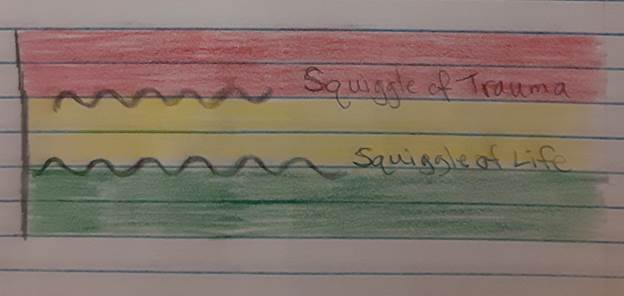
I have been writing on here about the Polyvagal Theory – fight, flight, and freeze – and about how I am trying to get out of immobility….a prolonged freeze state. Today I am going to be writing about running the Christian race – fighting the fight of faith. We have been working with this Polyvagal chart PVChartv10q.pdf, which shows activation and deactivation. I also found a chart at this link recently What is Polyvagal Theory? | Polyvagal Institute. It shows the 3 principle states: Immobilized would be red on the first Polyvagal chart, Mobilized would be yellow, and Relaxed would be green. It also shows that there are blended, hybrid states. We have been learning about the difference in our heart rates and breathing rates when we are mobilizing and immobilizing in safety and when we are mobilizing and immobilizing in the midst of threats. Our defensive responses of fight, flight, and freeze are intended to help us when we are faced with threats like if an animal was threatening us…if we looked out the window and saw a tiger standing there; or if there was a flood or a storm or you saw that something was falling towards you or if you were being physically attacked. But these responses can get triggered by emotional threats, too. And if you have experienced chronic stress, you might never have fully deactivated from the Squiggle of Trauma to be able to live on the Squiggle of Life. The Squiggle of Trauma, which I wrote about in my last post, is when you are stuck in a fight-flight-freeze loop and go back and forth between the red and yellow without ever getting into a relaxed state. If you have been stuck in that loop for a long time, your system will be overwrought. It would be like if someone had been running from a tiger that was chasing them and just had to keep running and running without taking a break – they would be overwrought…exhausted. And if the only time they stopped running was when the tiger was catching up to them so that they had to stop and hide while the tiger was looking around trying to find them…they would not be rested. And once the tiger got far enough away, then they would have to start running again. But the tiger kept chasing…and the person would stay on the Squiggle of Trauma – the fight-flight-freeze loop. So that’s what it feels like to be on the Squiggle of Trauma. On the Squiggle of Life, which alternates between green and yellow, most of the time you are in that relaxed green state on the second Polyvagal chart. If you need to mobilize in safety you feel energetic, active, playful, and motivated. If you need to immobilize in safety you feel blissful, dreamy, tranquil, meditative. If there is a threat…we’ll use the tiger example…you could start running, and then maybe be able to hide where the tiger couldn’t find you. The tiger would run away and it would be safe for you to return to relaxed daily living mode. The threat would be completely resolved in a relatively short amount of time, and life would return to normal. That’s what it feels like to be on the Squiggle of Life. Here is a chart I drew of the 2 Squiggles:
I have been living on the Squiggle of Trauma. I am still learning how to heal from that. If your nervous system has been stuck in that loop of fight, flight, freeze for a long time, it is hard to know how to heal…it’s hard to know what would help. These are invisible injuries to our emotional beings. I did not have the tools or resources to know how to treat those types of injuries when I was growing up, but thankfully I know about them now and am trying to use them. With a visible injury, like after someone has had knee surgery and their knee is really swollen, it might seem like you shouldn’t move it. But they tell you it’s actually very important to move it in certain ways. And they send the person to physical therapy where they will get specific exercises that show them how to move their leg in a way that will not injure them, but will actually help the knee heal. So, if they did not move their knee at all after the surgery, it wouldn’t heal correctly. But if they move it the wrong way, it will injure it. And if they pretended like their leg was not hurt…like they hadn’t had surgery…and just kept walking on it…it wouldn’t heal at all. But that is all we know to do with invisible injuries – pretend they are not there, and keep going like nothing happened. But they don’t heal that way. But, like I said, I didn’t know how to “move” them without making it worse. Thankfully there are techniques that we can use to work with that energy, like titration which takes things in steps. And sometimes the first step is visualizing…working with imagery…just being able to envision yourself moving around…mobilizing without activating that dysregulated energy.
Sometimes it helps to think of what you would do if you saw this happening to someone else instead of yourself. If I saw someone who had been experiencing that fight-flight-freeze loop while running from the tiger and had only been able to alternate between fleeing and freezing, I would make a safe space for them…a refuge. We would walk inside that safe room and I would say, “You’re safe now. Here, sit down. Try to breathe.” And I could talk that person through the deactivation process. And that’s what we’re going to have to do to our own nervous systems, too.
I heard an explanation of the freeze state recently that I thought was interesting. It was in one of Tim Fletcher’s YouTube videos about trauma. He said that for children who are in stressful circumstances that they cannot escape, the freeze state is when they flee into the safety of an internal world. So…if they cannot escape circumstances in their outer world, they flee to an internal world.
Maybe a day or two after I heard that explanation, I was reading a sermon by G. Campbell Morgan called “The Fight of Faith” http://articles.ochristian.com/article14204.shtml and he used the phrase “flee, follow, fight.” This is a very important way to think of things and can help us with getting a new way of processing things. It can help us see our lives in terms of running the Christian race. Martyn Lloyd-Jones preached a very powerful sermon series about spiritual depression that can help us with envisioning what the Christian race will be. He was talking about depression, or discouragement, in your walk with God. He said that spiritual depression stems from wrong expectations of the Christian life. We do not expect it to be a battle. But it is a continual warfare…spiritual warfare against sin and the powers of darkness in the spiritual realm. The imagery we can use for the Christian race is the imagery of that pathway we are walking on with our Good Shepherd…the pathway that leads us home to heaven. What Martyn Lloyd-Jones was talking about is that when Christians envision that pathway, we often try to picture it without any hardships. I think I thought when I was little that once I was saved, then life would get easier. In certain ways it does – you are getting to walk with God. You get to experience His amazing grace. But Jesus has taught us in the scriptures to expect hardships on the pathway to heaven. One thing Martyn Lloyd-Jones emphasizes is that we need to know that we have an enemy: Satan. We also need to know that we have a Savior and a Guide: Jesus. We must call on Jesus for help. We must walk with Him. Here are some verses about this:
8Be alert and of sober mind. Your enemy the devil prowls around like a roaring lion looking for someone to devour. 9Resist him, standing firm in the faith, because you know that the family of believers throughout the world is undergoing the same kind of sufferings.
10And the God of all grace, who called you to his eternal glory in Christ, after you have suffered a little while, will himself restore you and make you strong, firm and steadfast. 11To him be the power for ever and ever. Amen. (1 Peter 5:8-10 NIV)
21When they had preached the gospel to that city and had made many disciples, they returned to Lystra and to Iconium and to Antioch, 22strengthening the souls of the disciples, encouraging them to continue in the faith, and saying that through many tribulations we must enter the kingdom of God. (Acts 14:21-22 ESV)
33“I have told you these things, so that in me you may have peace. In this world you will have trouble. But take heart! I have overcome the world.” (John 16:33 NIV)
I will write more about the Christian race in future posts. Right now, you can start by envisioning that pathway. The pathway leads over hills and through dark valleys…but it leads all the way to heaven. There will always be another step on that pathway until you get home to heaven safely. You will surely reach the goal. The Christian race is not competitive. You are not running against, or competing against, anyone else. You are running home to heaven on the pathway God has laid out specifically for you. And you must keep the faith. You must stay on the pathway and follow Jesus all the way home. There will be trials you must endure trials and tests of your faith. Satan will be trying to draw you away from God. You could envision Satan as a roaring lion…prowling around seeking someone to devour. This will give an image to threats your mind is already picking up on. Your mind scans the visible world, but you also have a sense of the spiritual world…you can see those things with an eye of faith. Now try to use the instructions Morgan gave…when you sense a spiritual threat, you are supposed to flee from it…flee from evil…and run to Jesus for help. Then follow…follow Jesus on that pathway. And fight the fight of faith. Stand firm in the faith. Flee evil, follow Jesus, and fight the fight of faith. I will write more in future posts about putting on the armor of God and fighting with heavenly weapons.
The phrase “flee, follow, fight” makes me think of all of the hymns and Bible verses that talk about God as being our refuge and hiding place – an ever-present help in times of trouble. As Tim Fletcher said, the freeze state is when you flee to an internal world for safety. In certain ways, it can be ok and helpful to have an inner refuge to flee to. Then we can know that we have another option…another way to manage the stress…if we are experiencing a chronic stressor that cannot be resolved. We can work on forming that imagery…building an inner refuge with Jesus there with us…helping us. Here are some hymns you can use in your meditation time as you begin to work with this idea of an inner refuge. The hymn “Jesus, the Ark of Safety” by Rev. J. P. Daugherty – Learning to Live by Faith talks about fleeing to Christ the Ark for safety. “Hide Thou Me” by Fanny Crosby – Learning to Live by Faith asks God, the Rock of Ages, to hide us in Him. “Close, Close to Thee” by Fanny Crosby – Learning to Live by Faith talks about fleeing to the cross and fleeing to Christ for strength. One hymn that you have probably heard before that would be really helpful to listen to is “A Mighty Fortress Is Our God” by Martin Luther; Translated by Frederic Henry Hedge – Learning to Live by Faith. It talks about how God is a mighty fortress of refuge for us. We need that refuge because “still our ancient foe (Satan) does seek to work us woe; his craft and power are great, and armed with cruel hate, on earth is not his equal.” The second verse talks about how we cannot fight Satan in our own strength. We must call on Jesus for help. And with Jesus helping us…protecting us…we will not fear.
To summarize what we have been talking about in this post…I am still learning about how to go through the deactivation process. Fight, flight, and freeze are helpful defensive responses that we will always need to use at times. But if you have been stuck on the Squiggle of Trauma in a fight-flight-freeze loop, your system will be overwrought like the person that was running from the tiger and only stopped when they were hiding. Spend some time visualizing what it would be like for that person to have a safe refuge to go to where they could sit down, rest, and recover. If we can learn how to do that, then our systems will have time to heal and repair before having to face another threat…so we will not already be exhausted when we go into the yellow or red. And we will develop resilience if we are able to activate and deactivate quickly and without as much stress. So…instead of always only running or freezing and hiding, envision times of having to run or hide and then times of resting and recovering…and then feeling restored and refreshed before having to face another threat. You can also spend time starting to visualize the Christian race. Envision that pathway leading to heaven. It leads through much tribulation. Remember the instructions G. Campbell Morgan gave us, “Flee, follow, fight” and practice visualizing fleeing to Jesus for safety. See God as your refuge, your fortress, your hiding place. You are safe in His care. He will lead you all the way home to heaven.
-
“A Mighty Fortress Is Our God” by Martin Luther; Translated by Frederic Henry Hedge

Hymnal Page Scan: Psalms and Hymns to the Living God page 455 | Hymnary.org
Keyboard Recording:
1 A mighty fortress is our God,
a bulwark never failing;
our helper he, amid the flood
of mortal ills prevailing.
For still our ancient foe
does seek to work us woe;
his craft and power are great,
and armed with cruel hate,
on earth is not his equal.2 Did we in our own strength confide,
our striving would be losing,
were not the right Man on our side,
the Man of God’s own choosing.
You ask who that may be?
Christ Jesus, it is he;
Lord Sabaoth his name,
from age to age the same;
and he must win the battle.3 And though this world, with devils filled,
should threaten to undo us,
we will not fear, for God has willed
his truth to triumph through us.
The prince of darkness grim,
we tremble not for him;
his rage we can endure,
for lo! his doom is sure;
one little word shall fell him.4 That Word above all earthly powers
no thanks to them abideth;
the Spirit and the gifts are ours
through him who with us sideth.
Let goods and kindred go,
this mortal life also;
the body they may kill:
God’s truth abideth still;
his kingdom is forever! -
Polyvagal Theory: Asking God to turn the bitter waters sweet; Imagery of driving a stick shift and stalling while changing gears; Imagery from the Cliff Hanger game on the Price is Right
I have been writing on here about how I am trying to get out of a freeze state…out of immobility. Here is a link to the Polyvagal Chart I have been talking about: PVChartv10q.pdf. I am struggling to go through the deactivation process, which is the downward arc going from red to green on the chart. I think one thing I need to do is release stored action energy, which is the energy of an uncompleted threat response. I had written in a recent post about the imagery of how there is a balloon filled with toxic energy and you are trying to let the air out of the balloon slowly rather than all at once – that’s the process of titration…taking things in steps. If you have had energy stored like that over time, it becomes harmful to you. The difficulty is that anything can trigger that stored energy, but you can’t regulate it. So it’s similar to if the energy in the balloon was flammable and you were walking into a room where there was a flame. You feel out of control of the energy…and like anything could cause it to ignite. You could think of it in terms of feeling like the energy in the balloon has electrical currents and you are walking close to water. But thankfully there are ways to work with that energy. While I’ve been working with the energy in this balloon, God reminded me of a passage in Exodus when God turned the bitter waters into sweet waters. This was during the time the Israelites were wandering in the wilderness after the Exodus from Egypt. Here is the passage:
The Waters of Marah and Elim
22Then Moses led Israel from the Red Sea and they went into the Desert of Shur. For three days they traveled in the desert without finding water. 23When they came to Marah, they could not drink its water because it was bitter. (That is why the place is called Marah. f ) 24So the people grumbled against Moses, saying, “What are we to drink?”
25Then Moses cried out to the Lord, and the Lord showed him a piece of wood. He threw it into the water, and the water became fit to drink.
There the Lord issued a ruling and instruction for them and put them to the test. 26He said, “If you listen carefully to the Lord your God and do what is right in his eyes, if you pay attention to his commands and keep all his decrees, I will not bring on you any of the diseases I brought on the Egyptians, for I am the Lord, who heals you.”
27Then they came to Elim, where there were twelve springs and seventy palm trees, and they camped there near the water.
(Exodus 15:22-27)
I have been praying for God to turn the bitter waters sweet. Part of what happens if I start to release that stored action energy…an uncompleted response…is that I have to accept that I wasn’t able to change something. You had energy cued up to take an action to prevent something from happening and when you realized you were not going to be able to take that action, the energy got compressed and locked away. So you are frozen in time before that moment happened. So the challenge is…can I accept life the way that it has happened…without dissociating or pretending things happened differently? That is what I am asking God for help about. And it’s very important to remember to call on Him. He is waiting to hear from us. He is waiting to help. See how Moses cried out to the Lord when they were in distress. Look in Exodus 15:25 where it says, “Then Moses cried out to the Lord, and the Lord showed him a piece of wood. He threw it into the water, and the water became fit to drink.” Moses cried out to God, and God answered and made the bitter waters sweet.
I found this hymn called “Bitter Waters” by John Newton – Learning to Live by Faith that I thought was very interesting. In it, John Newton writes that the cross is the tree, or piece of wood, that turns the bitter waters sweet. Verses 5-7 say:
5 The cross on which the Savior died,
And conquered for His saints;
This is the tree, by faith applied,
Which sweetens all complaints.6 Thousands have found the blest effect,
Nor longer mourn their lot;
While on His sorrows they reflect,
Their own are all forgot.7 When they, by faith, behold the cross,
Tho’ many griefs they meet;
They draw again from every loss,
And find the bitter sweet.This is very powerful imagery we can use in our meditation time as we continue to pray for God to transform these stored energies and help us release them…and help us accept things the way that they have happened.
Last week, I was talking to my acupuncturist about deactivating and she said it made her think of learning to drive a stick shift in a car…and how people stall when they are having trouble shifting gears. That really resonated with me. I think I am having trouble shifting gears. I’m stalling when I am shifting between states and when I am trying to deactivate. If you look at the Polyvagal chart, you will see that in order to get from the red to the green again, you have to go through the yellow. So it can be very difficult to get out of the red/freeze state because when you touch into some of that yellow energy it can feel like too much, and then you go right back into red again. And you get stuck in a fight/flight-freeze loop without ever fully deactivating into the green…without ever really getting into a relaxed state again before something else stressful happens. I’m writing about these things as a patient, not a practitioner of these techniques, so I might not be saying things correctly. I drew these charts to try and get things straight in my head. I think this chart shows what I was just talking about:
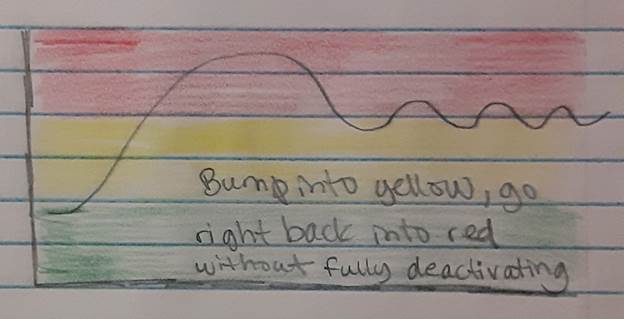
The line that goes back and forth between red and yellow is called the Squiggle of Trauma. What you are trying to do…what the goal is…is to be able to fully deactivate and stay on the Squiggle of Life, which goes between green and yellow. Here is a chart of the 2 Squiggles:
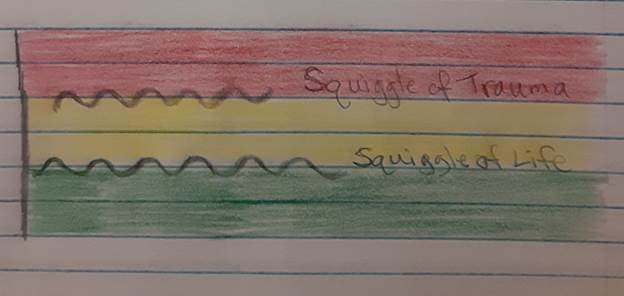
You can see how that if you live on the Squiggle of Trauma, your heart rate and breathing rate will be affected. If you are able to live most of the time on the Squiggle of Life, you will be in a more relaxed state that is conducive to healing.
So, you can have the problem of touching into that yellow energy and going right back into red. I think that something else can happen also when you touch into the yellow. I think what I do sometimes is that when I touch into the yellow and it feels like too much, I try to deactivate too quickly. If you think of deactivating in terms of landing a plane, deactivating too quickly would be like jumping out of the plane when you hit the turbulence of the yellow. It feels like a free-fall…it changes too much too quickly instead of titrating the energy…and then you loop back around into activation. Again, I’m not sure if this is the correct way to say it…but it’s what it feels like. Here is a chart for that:
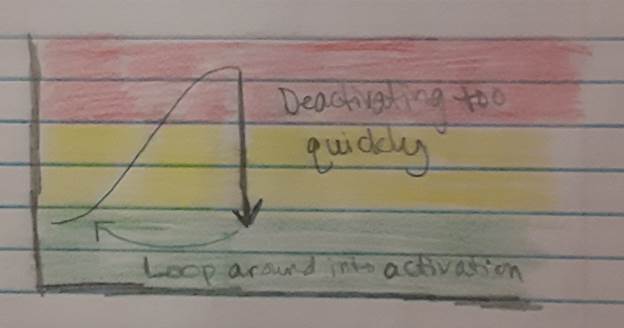
When I drew this chart, it made me think of a game on the Price Is Right called Cliff Hanger. Here is a link to a clip of it: Yodely Guy Gets VERY CLOSE to the EDGE During CLIFF HANGERS – The Price Is Right 1982. The mountain climber moves up the mountain in increments equal to the amount of however many dollars off the price of an item the contestant was in their guess. The climber can go up to 25 steps before going off the cliff. In this clip, the climber stops at 21…the contestant wins…and he doesn’t fall off the cliff. Thinking of this game made me think both about how it feels to go over the cliff and about how it would help to develop stopping points. The freeze state is not bad, and you will have times where you go into it. If I can work on shifting gears more easily, that will help with changing states. But I am trying to break the fight/flight-freeze loop…that’s when you go into freeze when you don’t really need to. So if I can develop stopping points in the activation process, which would mean that I was noticing that I was getting triggered and be able to stop the activation process, I wouldn’t have as much to deactivate from. I’m thinking it would look like this…where if you could stop at earlier points on the activation arc, you would be able to start deactivating sooner:
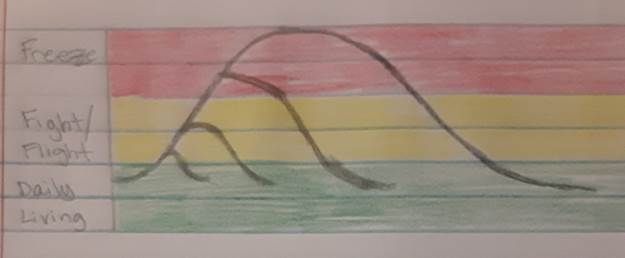
You would have new pathways…new experiences of being able to regulate the energy. And you would only go into freeze when you really needed to. I’m going to keep working with it and hope to see improvements with this flare up soon. I’m going to be trying to learn how to land the plane slowly and gently…how to go through the deactivation process in steps.
-
“Bitter Waters” by John Newton

Hymnal Page Scan: Windsor
Piano Recording:
1 Bitter, indeed, the waters are
Which in this desert flow;
Though to the eye they promise fair,
They taste of sin and woe.2 Of pleasing draughts I once could dream,
But now, awake, I find,
That sin has poisoned every stream,
And left a curse behind.3 But there’s a wonder-working wood,
I’ve heard believers say,
Can make these bitter waters good,
And take the curse away.4 The virtues of this healing tree
Are known and prized by few;
Reveal this secret, Lord, to me,
That I may prize it too.5 The cross on which the Savior died,
And conquered for His saints;
This is the tree, by faith applied,
Which sweetens all complaints.6 Thousands have found the blest effect,
Nor longer mourn their lot;
While on His sorrows they reflect,
Their own are all forgot.7 When they, by faith, behold the cross,
Tho’ many griefs they meet;
They draw again from every loss,
And find the bitter sweet. -
Notes on G. Campbell Morgan’s Commentary on Isaiah 40:12-31; Imagery of Running the Christian Race; Imagery of God infusing strength into us
In this post I will be writing notes about G. Campbell Morgan’s Commentary on Isaiah 40:12-:31. It’s Chapter 22 Part C of his commentary entitled “Prophecies of Peace: Purpose of Peace; Majesty of Jehovah.” Here is the link: The Bible Book of Isaiah – Commentary by Rev. G. Campbell Morgan (Full Text and PDF). Here is the scripture passage:
12 Who has measured the waters in the hollow of his hand,
or with the breadth of his hand marked off the heavens?
Who has held the dust of the earth in a basket,
or weighed the mountains on the scales
and the hills in a balance?
13 Who can fathom the Spirit of the Lord,
or instruct the Lord as his counselor?
14 Whom did the Lord consult to enlighten him,
and who taught him the right way?
Who was it that taught him knowledge,
or showed him the path of understanding?
15 Surely the nations are like a drop in a bucket;
they are regarded as dust on the scales;
he weighs the islands as though they were fine dust.
16 Lebanon is not sufficient for altar fires,
nor its animals enough for burnt offerings.
17 Before him all the nations are as nothing;
they are regarded by him as worthless
and less than nothing.
18 With whom, then, will you compare God?
To what image will you liken him?
19 As for an idol, a metalworker casts it,
and a goldsmith overlays it with gold
and fashions silver chains for it.
20 A person too poor to present such an offering
selects wood that will not rot;
they look for a skilled worker
to set up an idol that will not topple.
21 Do you not know?
Have you not heard?
Has it not been told you from the beginning?
Have you not understood since the earth was founded?
22 He sits enthroned above the circle of the earth,
and its people are like grasshoppers.
He stretches out the heavens like a canopy,
and spreads them out like a tent to live in.
23 He brings princes to naught
and reduces the rulers of this world to nothing.
24 No sooner are they planted,
no sooner are they sown,
no sooner do they take root in the ground,
than he blows on them and they wither,
and a whirlwind sweeps them away like chaff.
25 “To whom will you compare me?
Or who is my equal?” says the Holy One.
26 Lift up your eyes and look to the heavens:
Who created all these?
He who brings out the starry host one by one
and calls forth each of them by name.
Because of his great power and mighty strength,
not one of them is missing.
27 Why do you complain, Jacob?
Why do you say, Israel,
“My way is hidden from the Lord;
my cause is disregarded by my God”?
28 Do you not know?
Have you not heard?
The Lord is the everlasting God,
the Creator of the ends of the earth.
He will not grow tired or weary,
and his understanding no one can fathom.
29 He gives strength to the weary
and increases the power of the weak.
30 Even youths grow tired and weary,
and young men stumble and fall;
31 but those who hope in the Lord
will renew their strength.
They will soar on wings like eagles;
they will run and not grow weary,
they will walk and not be faint.
(Isaiah 40:12-31 NIV)Notes:
The Purpose of Peace
The Majesty of Jehovah
“In elaboration of his declaration of Jehovah as the Mighty One, the prophet [Isaiah] first presented Him in His majesty. This he set forth as to its essential nature; by comparison with false gods; and as demonstrated in different ways.”
Essential
The essential majesty of Jehovah is revealed in His might, His wisdom, and His government.
Might: Morgan says, “The essential majesty of Jehovah is revealed first in His might. This is seen in the perfect adjustment of creation; the measured waters, heaven meted out, the dust comprehended, mountains and hills weighed. Every phrase suggests moreover, the perfect ease with which Jehovah accomplishes these things. The whole creation is seen as known, ordered, and upheld by the might of Jehovah.”
Wisdom: “It is revealed also in the fact of His wisdom.” This is stated in the form of questions that admit of no answer other than “such as recognize the fact that Jehovah acts without instruction and without advice.” The questions in verses 12-13 are basically asking, “Who has done what God has done? Who did He have to seek for advice or instruction?” The answer is that no one has done what God has done. No one can compare to Him in wisdom or in might. Two of God’s attributes are that He is Omniscient (All-Knowing) and Omnipotent (All-Powerful). He contained all the wisdom and power within Himself to be able to create the world and form everything perfectly within it. He did not have to ask anyone for advice or help. He created it all by Himself, without instruction from anyone. Read verses 12-14 again and see how Isaiah is saying that God’s essential majesty is revealed in His might and in His wisdom, which is displayed in His creation of the world.
12 Who has measured the waters in the hollow of his hand,
or with the breadth of his hand marked off the heavens?
Who has held the dust of the earth in a basket,
or weighed the mountains on the scales
and the hills in a balance?
13 Who can fathom the Spirit of the Lord,
or instruct the Lord as his counselor?
14 Whom did the Lord consult to enlighten him,
and who taught him the right way?
Who was it that taught him knowledge,
or showed him the path of understanding?
(Isaiah 40:12-14)Government: This essential might is finally demonstrated by His government of all that which He has created, in unaided wisdom and all-sufficient might. Morgan says, “The things which man ever thinks of as great – the nations, the isles of the sea, the mountains, and the beasts – are characterized by their littleness when placed in comparison with Himself.”
By Comparision
“The whole movement of the prophetic utterances was aimed at recalling the people from their idolatry to the recognition, worship, and service of Jehovah…In view of the essential might, wisdom, and government of God as manifesting His majesty, the inquiry is raised as to who can be likened to Him; or what idea, apart from the truth concerning Himself, can be placed in comparison with Him. To the mind of the prophet the question is enough to reveal the impossibility of comparison.” I think Morgan means that the question in v.18 of, “With whom, then, will you compare God? To what image will you liken him?” is enough to reveal the impossibility of comparison.
“The vision of the majesty of Jehovah in the might and wisdom of His creation, and in the perfect ease of His government, reveals the unutterable folly of any attempt to supplant Him by the feeble work of men who themselves are as nothing when compared with Jehovah.”
Demonstrated
“Finally Isaiah shows that the majesty of Jehovah is demonstrated in creation; in actual government on earth and in the heavens; and in the method of grace with Israel.”
Creation
Isaiah reminds the people of the majesty of Jehovah in creation by alluding to their own sacred writings. In v.28 Isaiah asks the people, “Do you not know? Have you not heard? The Lord is the everlasting God, the Creator of the ends of the earth. He will not grow tired or weary, and his understanding no one can fathom.” To accept these truths about God which they were familiar with from their sacred writings meant that they recognized “the superlative and incomparable majesty of Jehovah.” And when Isaiah asks, “Do you not know? Have you not heard?” it would bring to their minds all of the teachings from their sacred writings…all of the things they had heard about God and His majesty.
Government
“That majesty is seen moreover, in His perfect government. He sits enthroned above the circle of the earth, and in His presence humanity is infinitely small. The whole created order He encompasses as He stretches the heavens around the earth as a curtain, and constitutes them a tent in which He dwells Himself. The figure is one of striking beauty and suggestiveness. By it the prophet calls attention to the earth and the encompassing firmament, like a curtain of gauze, as the Hebrew word suggests; and reminds them that within that curtain, enwrapping the whole earth, is the presence of Jehovah. That is not His final and only dwelling-place. It is but a tent, and suggests His nearness to all the earth and the inhabitants thereof. This God is more than a presence. He is actively reigning, and within that activity the great ones of the earth are completely under His control, and of themselves, as apart from His will, find no stability.
That government moreover, extends to the heavens which like a curtain form His tent of nearness to the affairs of earth. Again challenging men as to whom they will liken God, he bids them gaze beyond the earth, and into the wonders of the heavens, and see that these also have their origin in God; that His government is over them; that by His wisdom they are marshalled as an army; and in His strength they are upheld and sustained.”
This is imagery we can use in our meditation time. The firmament is the visible heavens…the sky. So envision the earth enwrapped by the heavens like a curtain…and then envision God’s presence within that curtain. But, as Morgan said, God is more than just a presence. He is the living God who is actively reigning over His creation.
As Morgan said earlier, “The whole movement of the prophetic utterances was aimed at recalling the people from their idolatry to the recognition, worship, and service of Jehovah.” Here in Isaiah 40, in v.18 Isaiah says, “With whom, then, will you compare God? To what image will you liken him? And in v.25 God says, “To whom will you compare me? Or who is my equal?” says the Holy One.” The answer to this question is that God is the only true God. You will see this stated in many verses throughout the Old Testament…where God is stating that He alone is God and calling His people to return to Him. Here are some examples:
“5I am the Lord, and there is no other; apart from me there is no God. I will strengthen you, though you have not acknowledged me, 6so that from the rising of the sun to the place of its setting people may know there is none besides me. I am the Lord, and there is no other. 7I form the light and create darkness, I bring prosperity and create disaster; I, the Lord, do all these things.” Isaiah 45:5-7
“See now that I am He; there is no God besides Me. I bring death and I give life; I wound and I heal, and there is no one who can deliver from My hand.” Deuteronomy 32:39
“so that all the peoples of the earth may know that the LORD is God. There is no other!” 1 Kings 8:60
“Thus says the LORD, the King and Redeemer of Israel, the LORD of Hosts: ‘I am the first and I am the last, and there is no God but Me’.” Isaiah 44:6
“Do not tremble or fear. Have I not told you and declared it long ago? You are My witnesses! Is there any God but Me? There is no other Rock; I know not one.” Isaiah 44:8
“Yet I am the LORD your God ever since the land of Egypt; you know no God but Me, for there is no Savior besides Me.” Hosea 13:4In these verses that we are studying today, Isaiah 40:12-31, Isaiah is challenging the people…he is saying, “Who can you compare God to? Look at all the works of His hands. Look at His creation, His government of the world, His grace towards His people. Who can compare with Him?” And the answer to those questions is: no one. When you look at the Lord and all of His attributes, no one can compare with His Almighty power, His righteousness, His holiness, His wisdom. And no one can compare to Him in terms of the works of His hands. He alone created the world, without having to ask for advice or direction (v.14), and without having to ask for help. So first look at His Almighty power, and then look at His grace. Morgan says that “the majesty of Jehovah is revealed to men by the grace in which with patience He succours and sustains His failing and fainting people, even more than by the splendour of His government of the universe, or by the awe-inspiring wonder of His creative might and wisdom.”
Grace
“Finally turning to the people in direct address, and appealing to them on the basis of their history, the prophet demonstrated the majesty of God as revealed in His grace. The darkness of the circumstances in the midst of which these words were spoken, and the failure of their vision, had led them to an unbelief which declared that their way was hid from Jehovah, and their Judgment passed away from God. In the light of the truths which the prophet had been re-enforcing as to the nearness and government of God, he inquired as to why they should make such assertions.”
Verse 27 says, “Why do you complain, Jacob? Why do you say, Israel, ‘My way is hidden from the Lord; my cause is disregarded by my God’?” The previous verse talks about how God governs the starry hosts. It says, “Lift up your eyes and look to the heavens: Who created all these? He who brings out the starry host one by one and calls forth each of them by name. Because of his great power and mighty strength, not one of them is missing.” (v.26) Isaiah had reminded them that Jehovah’s presence was there within that curtain of the heavens (the sky) enwrapping the whole earth. And Morgan said, “This God is more than a presence. He is actively reigning”…governing and watching over the stars in the sky. And we are supposed to be comforted by that…because in the same way that He is actively reigning over the creation (nature), He is actively reigning over us. And He shows us grace. He had not forgotten His people.
Calling on God for Strength
So Isaiah has reminded them of God’s Almighty strength. And Morgan says, “Did they not know His inherent strength, that the everlasting One, the Creator, was incapable of fainting or of weariness? This strength moreover, was at the disposal of those in need of it.” And that is the message here. God is calling on His people to look up to Him for help. He longs to give them strength. He longs to be merciful towards them. You are probably familiar with Isaiah 40:30-31, which says,
“28 Do you not know?
Have you not heard?
The Lord is the everlasting God,
the Creator of the ends of the earth.
He will not grow tired or weary,
and his understanding no one can fathom.
29 He gives strength to the weary
and increases the power of the weak.
30 Even youths grow tired and weary,
and young men stumble and fall;
31 but those who hope in the Lord
will renew their strength.
They will soar on wings like eagles;
they will run and not grow weary,
they will walk and not be faint.”So verse 30 is saying that even young people will grow tired and weary; even young people will stumble and fall. But at the end of verse 28 it says, “He (God) will not grow tired or weary, and His understanding no one can fathom.” So people…even young people will grow tired and weary, but God never grows tired. And God’s inherent strength is at our disposal…available to us. Verse 29 says, “He gives strength to the weary and increases the power of the weak.” And, therefore, although people…even young people…will grow tired and weary, those who hope in the Lord and who call on Him for help, will receive strength from Him.
Martyn Lloyd-Jones has a helpful way of saying it. In his sermon series about Spiritual Depression, he says that God infuses strength into us. Here are some definitions of infuse: 1) to cause to be permeated with something (such as a principle or quality) that alters usually for the better; 2) to fill, or pervade; 3) to allow (a liquid) to flow into a patient, vein, etc. That last definition makes me think of getting an IV and feeling something healing flowing into your body…refreshing you. There is also imagery that has to do with the image of God being the fountain from whom our blessings flow. I think faith is pictured as a conduit pipe between us and the fountain…and spiritual graces flow from God to us through that conduit pipe. So take time to envision that. You could use either the imagery of an IV or a conduit pipe. I don’t like needles, so when I think of the IV, I just think of a patch on my arm that light energy flows through from the medicine bag to my arm and throughout my body. Or you could envision a fountain filled with healing energy/water. Envision yourself growing tired and weary. And then feel strength from God flowing into you…being infused into you…reviving and renewing you. I think this verse is talking about strength in terms of spiritual strength rather than physical strength. Remember that in this life we are fighting the fight of faith. It is a spiritual battle. We are running in the Christian race towards the heavenly prize. And God gives us strength so that we will not falter…we will not fall short of the heavenly rest. The book of Hebrews talks about that a lot. I will write more about the Christian race in another post.
Morgan says, “All human strength in itself inevitably fails. Even the youths and the young men, those in the period of life characterized by buoyancy and ability, must inevitably faint and fail and fall. Humanity rightly related to God cannot so fail. The condition of strength is that men should wait upon the Lord. When that condition is fulfilled, even though there is a fainting and a weariness, there is also a renewal of strength. The experience of such renewal the prophet described in words remarkably chosen and arranged so as to reveal the greatness of the strength available to those who wait upon the Lord. Whereas we might be inclined to think that the progress of ability would be from walking to running, and from running to flying, the prophet commences with flight, and then speaks of running, and finally of walking. Herein he recognizes the true and deepest experience of human need. In the day when it is possible to spread the wings and fly, there is less consciousness of the need of help than in the day of running upon the dusty highway; and the hour when man is most conscious of the need of help is that in which he can no longer spread his wings in flight, or hasten along the highway, but must walk patiently and persistently. Yet for all these days there is strength in God. In the day of flight, those who wait upon the Lord mount as eagles, that is, with perfect ease. In the day of running, those who wait upon Him are able to continue without weariness. In the day of walking, they are able to walk without fainting.
The majesty of Jehovah is revealed to men by the grace in which with patience He succours and sustains His failing and fainting people, even more than by the splendour of His government of the universe, or by the awe-inspiring wonder of His creative might and wisdom.“
I have posted a hymn on here called “We Shall Run and Not Be Weary” by Barney Elliott Warren – Learning to Live by Faith that is based on these verses in Isaiah. It would be helpful for you to use during you meditation time with the imagery from this post of God infusing strength into you. I will write more about the Christian race in another post hopefully soon.
-
Subscribe
Subscribed
Have a WordPress.com account? Log in now.

