-
“A Mighty Fortress Is Our God” by Martin Luther; Translated by Frederic Henry Hedge

Hymnal Page Scan: Psalms and Hymns to the Living God page 455 | Hymnary.org
Keyboard Recording:
1 A mighty fortress is our God,
a bulwark never failing;
our helper he, amid the flood
of mortal ills prevailing.
For still our ancient foe
does seek to work us woe;
his craft and power are great,
and armed with cruel hate,
on earth is not his equal.2 Did we in our own strength confide,
our striving would be losing,
were not the right Man on our side,
the Man of God’s own choosing.
You ask who that may be?
Christ Jesus, it is he;
Lord Sabaoth his name,
from age to age the same;
and he must win the battle.3 And though this world, with devils filled,
should threaten to undo us,
we will not fear, for God has willed
his truth to triumph through us.
The prince of darkness grim,
we tremble not for him;
his rage we can endure,
for lo! his doom is sure;
one little word shall fell him.4 That Word above all earthly powers
no thanks to them abideth;
the Spirit and the gifts are ours
through him who with us sideth.
Let goods and kindred go,
this mortal life also;
the body they may kill:
God’s truth abideth still;
his kingdom is forever! -
Polyvagal Theory: Asking God to turn the bitter waters sweet; Imagery of driving a stick shift and stalling while changing gears; Imagery from the Cliff Hanger game on the Price is Right
I have been writing on here about how I am trying to get out of a freeze state…out of immobility. Here is a link to the Polyvagal Chart I have been talking about: PVChartv10q.pdf. I am struggling to go through the deactivation process, which is the downward arc going from red to green on the chart. I think one thing I need to do is release stored action energy, which is the energy of an uncompleted threat response. I had written in a recent post about the imagery of how there is a balloon filled with toxic energy and you are trying to let the air out of the balloon slowly rather than all at once – that’s the process of titration…taking things in steps. If you have had energy stored like that over time, it becomes harmful to you. The difficulty is that anything can trigger that stored energy, but you can’t regulate it. So it’s similar to if the energy in the balloon was flammable and you were walking into a room where there was a flame. You feel out of control of the energy…and like anything could cause it to ignite. You could think of it in terms of feeling like the energy in the balloon has electrical currents and you are walking close to water. But thankfully there are ways to work with that energy. While I’ve been working with the energy in this balloon, God reminded me of a passage in Exodus when God turned the bitter waters into sweet waters. This was during the time the Israelites were wandering in the wilderness after the Exodus from Egypt. Here is the passage:
The Waters of Marah and Elim
22Then Moses led Israel from the Red Sea and they went into the Desert of Shur. For three days they traveled in the desert without finding water. 23When they came to Marah, they could not drink its water because it was bitter. (That is why the place is called Marah. f ) 24So the people grumbled against Moses, saying, “What are we to drink?”
25Then Moses cried out to the Lord, and the Lord showed him a piece of wood. He threw it into the water, and the water became fit to drink.
There the Lord issued a ruling and instruction for them and put them to the test. 26He said, “If you listen carefully to the Lord your God and do what is right in his eyes, if you pay attention to his commands and keep all his decrees, I will not bring on you any of the diseases I brought on the Egyptians, for I am the Lord, who heals you.”
27Then they came to Elim, where there were twelve springs and seventy palm trees, and they camped there near the water.
(Exodus 15:22-27)
I have been praying for God to turn the bitter waters sweet. Part of what happens if I start to release that stored action energy…an uncompleted response…is that I have to accept that I wasn’t able to change something. You had energy cued up to take an action to prevent something from happening and when you realized you were not going to be able to take that action, the energy got compressed and locked away. So you are frozen in time before that moment happened. So the challenge is…can I accept life the way that it has happened…without dissociating or pretending things happened differently? That is what I am asking God for help about. And it’s very important to remember to call on Him. He is waiting to hear from us. He is waiting to help. See how Moses cried out to the Lord when they were in distress. Look in Exodus 15:25 where it says, “Then Moses cried out to the Lord, and the Lord showed him a piece of wood. He threw it into the water, and the water became fit to drink.” Moses cried out to God, and God answered and made the bitter waters sweet.
I found this hymn called “Bitter Waters” by John Newton – Learning to Live by Faith that I thought was very interesting. In it, John Newton writes that the cross is the tree, or piece of wood, that turns the bitter waters sweet. Verses 5-7 say:
5 The cross on which the Savior died,
And conquered for His saints;
This is the tree, by faith applied,
Which sweetens all complaints.6 Thousands have found the blest effect,
Nor longer mourn their lot;
While on His sorrows they reflect,
Their own are all forgot.7 When they, by faith, behold the cross,
Tho’ many griefs they meet;
They draw again from every loss,
And find the bitter sweet.This is very powerful imagery we can use in our meditation time as we continue to pray for God to transform these stored energies and help us release them…and help us accept things the way that they have happened.
Last week, I was talking to my acupuncturist about deactivating and she said it made her think of learning to drive a stick shift in a car…and how people stall when they are having trouble shifting gears. That really resonated with me. I think I am having trouble shifting gears. I’m stalling when I am shifting between states and when I am trying to deactivate. If you look at the Polyvagal chart, you will see that in order to get from the red to the green again, you have to go through the yellow. So it can be very difficult to get out of the red/freeze state because when you touch into some of that yellow energy it can feel like too much, and then you go right back into red again. And you get stuck in a fight/flight-freeze loop without ever fully deactivating into the green…without ever really getting into a relaxed state again before something else stressful happens. I’m writing about these things as a patient, not a practitioner of these techniques, so I might not be saying things correctly. I drew these charts to try and get things straight in my head. I think this chart shows what I was just talking about:
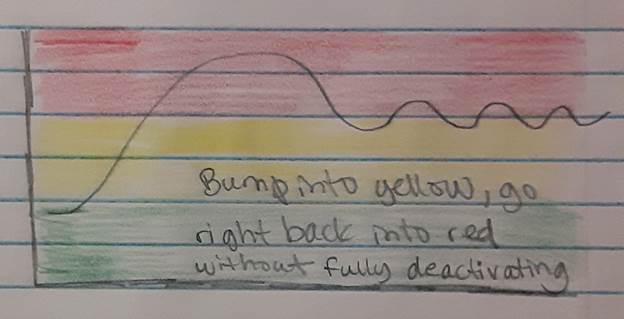
The line that goes back and forth between red and yellow is called the Squiggle of Trauma. What you are trying to do…what the goal is…is to be able to fully deactivate and stay on the Squiggle of Life, which goes between green and yellow. Here is a chart of the 2 Squiggles:
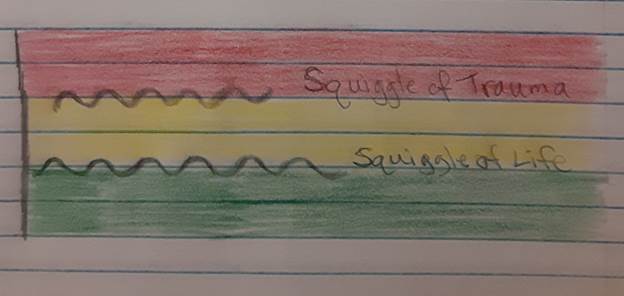
You can see how that if you live on the Squiggle of Trauma, your heart rate and breathing rate will be affected. If you are able to live most of the time on the Squiggle of Life, you will be in a more relaxed state that is conducive to healing.
So, you can have the problem of touching into that yellow energy and going right back into red. I think that something else can happen also when you touch into the yellow. I think what I do sometimes is that when I touch into the yellow and it feels like too much, I try to deactivate too quickly. If you think of deactivating in terms of landing a plane, deactivating too quickly would be like jumping out of the plane when you hit the turbulence of the yellow. It feels like a free-fall…it changes too much too quickly instead of titrating the energy…and then you loop back around into activation. Again, I’m not sure if this is the correct way to say it…but it’s what it feels like. Here is a chart for that:
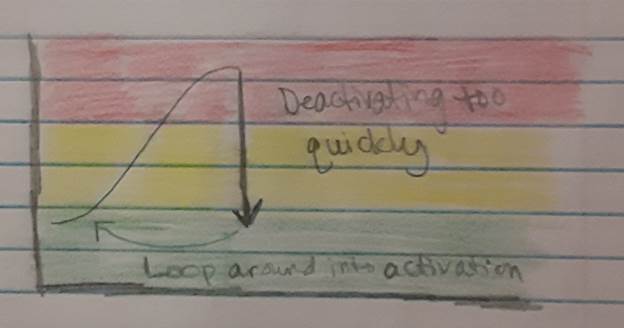
When I drew this chart, it made me think of a game on the Price Is Right called Cliff Hanger. Here is a link to a clip of it: Yodely Guy Gets VERY CLOSE to the EDGE During CLIFF HANGERS – The Price Is Right 1982. The mountain climber moves up the mountain in increments equal to the amount of however many dollars off the price of an item the contestant was in their guess. The climber can go up to 25 steps before going off the cliff. In this clip, the climber stops at 21…the contestant wins…and he doesn’t fall off the cliff. Thinking of this game made me think both about how it feels to go over the cliff and about how it would help to develop stopping points. The freeze state is not bad, and you will have times where you go into it. If I can work on shifting gears more easily, that will help with changing states. But I am trying to break the fight/flight-freeze loop…that’s when you go into freeze when you don’t really need to. So if I can develop stopping points in the activation process, which would mean that I was noticing that I was getting triggered and be able to stop the activation process, I wouldn’t have as much to deactivate from. I’m thinking it would look like this…where if you could stop at earlier points on the activation arc, you would be able to start deactivating sooner:
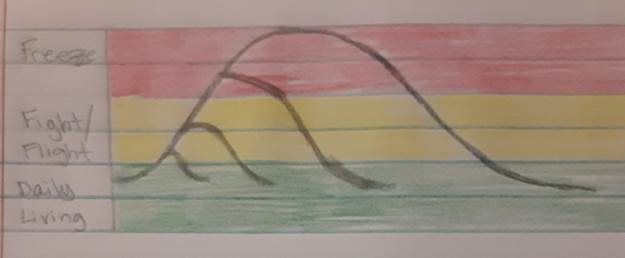
You would have new pathways…new experiences of being able to regulate the energy. And you would only go into freeze when you really needed to. I’m going to keep working with it and hope to see improvements with this flare up soon. I’m going to be trying to learn how to land the plane slowly and gently…how to go through the deactivation process in steps.
-
“Bitter Waters” by John Newton

Hymnal Page Scan: Windsor
Piano Recording:
1 Bitter, indeed, the waters are
Which in this desert flow;
Though to the eye they promise fair,
They taste of sin and woe.2 Of pleasing draughts I once could dream,
But now, awake, I find,
That sin has poisoned every stream,
And left a curse behind.3 But there’s a wonder-working wood,
I’ve heard believers say,
Can make these bitter waters good,
And take the curse away.4 The virtues of this healing tree
Are known and prized by few;
Reveal this secret, Lord, to me,
That I may prize it too.5 The cross on which the Savior died,
And conquered for His saints;
This is the tree, by faith applied,
Which sweetens all complaints.6 Thousands have found the blest effect,
Nor longer mourn their lot;
While on His sorrows they reflect,
Their own are all forgot.7 When they, by faith, behold the cross,
Tho’ many griefs they meet;
They draw again from every loss,
And find the bitter sweet. -
Notes on G. Campbell Morgan’s Commentary on Isaiah 40:12-31; Imagery of Running the Christian Race; Imagery of God infusing strength into us
In this post I will be writing notes about G. Campbell Morgan’s Commentary on Isaiah 40:12-:31. It’s Chapter 22 Part C of his commentary entitled “Prophecies of Peace: Purpose of Peace; Majesty of Jehovah.” Here is the link: The Bible Book of Isaiah – Commentary by Rev. G. Campbell Morgan (Full Text and PDF). Here is the scripture passage:
12 Who has measured the waters in the hollow of his hand,
or with the breadth of his hand marked off the heavens?
Who has held the dust of the earth in a basket,
or weighed the mountains on the scales
and the hills in a balance?
13 Who can fathom the Spirit of the Lord,
or instruct the Lord as his counselor?
14 Whom did the Lord consult to enlighten him,
and who taught him the right way?
Who was it that taught him knowledge,
or showed him the path of understanding?
15 Surely the nations are like a drop in a bucket;
they are regarded as dust on the scales;
he weighs the islands as though they were fine dust.
16 Lebanon is not sufficient for altar fires,
nor its animals enough for burnt offerings.
17 Before him all the nations are as nothing;
they are regarded by him as worthless
and less than nothing.
18 With whom, then, will you compare God?
To what image will you liken him?
19 As for an idol, a metalworker casts it,
and a goldsmith overlays it with gold
and fashions silver chains for it.
20 A person too poor to present such an offering
selects wood that will not rot;
they look for a skilled worker
to set up an idol that will not topple.
21 Do you not know?
Have you not heard?
Has it not been told you from the beginning?
Have you not understood since the earth was founded?
22 He sits enthroned above the circle of the earth,
and its people are like grasshoppers.
He stretches out the heavens like a canopy,
and spreads them out like a tent to live in.
23 He brings princes to naught
and reduces the rulers of this world to nothing.
24 No sooner are they planted,
no sooner are they sown,
no sooner do they take root in the ground,
than he blows on them and they wither,
and a whirlwind sweeps them away like chaff.
25 “To whom will you compare me?
Or who is my equal?” says the Holy One.
26 Lift up your eyes and look to the heavens:
Who created all these?
He who brings out the starry host one by one
and calls forth each of them by name.
Because of his great power and mighty strength,
not one of them is missing.
27 Why do you complain, Jacob?
Why do you say, Israel,
“My way is hidden from the Lord;
my cause is disregarded by my God”?
28 Do you not know?
Have you not heard?
The Lord is the everlasting God,
the Creator of the ends of the earth.
He will not grow tired or weary,
and his understanding no one can fathom.
29 He gives strength to the weary
and increases the power of the weak.
30 Even youths grow tired and weary,
and young men stumble and fall;
31 but those who hope in the Lord
will renew their strength.
They will soar on wings like eagles;
they will run and not grow weary,
they will walk and not be faint.
(Isaiah 40:12-31 NIV)Notes:
The Purpose of Peace
The Majesty of Jehovah
“In elaboration of his declaration of Jehovah as the Mighty One, the prophet [Isaiah] first presented Him in His majesty. This he set forth as to its essential nature; by comparison with false gods; and as demonstrated in different ways.”
Essential
The essential majesty of Jehovah is revealed in His might, His wisdom, and His government.
Might: Morgan says, “The essential majesty of Jehovah is revealed first in His might. This is seen in the perfect adjustment of creation; the measured waters, heaven meted out, the dust comprehended, mountains and hills weighed. Every phrase suggests moreover, the perfect ease with which Jehovah accomplishes these things. The whole creation is seen as known, ordered, and upheld by the might of Jehovah.”
Wisdom: “It is revealed also in the fact of His wisdom.” This is stated in the form of questions that admit of no answer other than “such as recognize the fact that Jehovah acts without instruction and without advice.” The questions in verses 12-13 are basically asking, “Who has done what God has done? Who did He have to seek for advice or instruction?” The answer is that no one has done what God has done. No one can compare to Him in wisdom or in might. Two of God’s attributes are that He is Omniscient (All-Knowing) and Omnipotent (All-Powerful). He contained all the wisdom and power within Himself to be able to create the world and form everything perfectly within it. He did not have to ask anyone for advice or help. He created it all by Himself, without instruction from anyone. Read verses 12-14 again and see how Isaiah is saying that God’s essential majesty is revealed in His might and in His wisdom, which is displayed in His creation of the world.
12 Who has measured the waters in the hollow of his hand,
or with the breadth of his hand marked off the heavens?
Who has held the dust of the earth in a basket,
or weighed the mountains on the scales
and the hills in a balance?
13 Who can fathom the Spirit of the Lord,
or instruct the Lord as his counselor?
14 Whom did the Lord consult to enlighten him,
and who taught him the right way?
Who was it that taught him knowledge,
or showed him the path of understanding?
(Isaiah 40:12-14)Government: This essential might is finally demonstrated by His government of all that which He has created, in unaided wisdom and all-sufficient might. Morgan says, “The things which man ever thinks of as great – the nations, the isles of the sea, the mountains, and the beasts – are characterized by their littleness when placed in comparison with Himself.”
By Comparision
“The whole movement of the prophetic utterances was aimed at recalling the people from their idolatry to the recognition, worship, and service of Jehovah…In view of the essential might, wisdom, and government of God as manifesting His majesty, the inquiry is raised as to who can be likened to Him; or what idea, apart from the truth concerning Himself, can be placed in comparison with Him. To the mind of the prophet the question is enough to reveal the impossibility of comparison.” I think Morgan means that the question in v.18 of, “With whom, then, will you compare God? To what image will you liken him?” is enough to reveal the impossibility of comparison.
“The vision of the majesty of Jehovah in the might and wisdom of His creation, and in the perfect ease of His government, reveals the unutterable folly of any attempt to supplant Him by the feeble work of men who themselves are as nothing when compared with Jehovah.”
Demonstrated
“Finally Isaiah shows that the majesty of Jehovah is demonstrated in creation; in actual government on earth and in the heavens; and in the method of grace with Israel.”
Creation
Isaiah reminds the people of the majesty of Jehovah in creation by alluding to their own sacred writings. In v.28 Isaiah asks the people, “Do you not know? Have you not heard? The Lord is the everlasting God, the Creator of the ends of the earth. He will not grow tired or weary, and his understanding no one can fathom.” To accept these truths about God which they were familiar with from their sacred writings meant that they recognized “the superlative and incomparable majesty of Jehovah.” And when Isaiah asks, “Do you not know? Have you not heard?” it would bring to their minds all of the teachings from their sacred writings…all of the things they had heard about God and His majesty.
Government
“That majesty is seen moreover, in His perfect government. He sits enthroned above the circle of the earth, and in His presence humanity is infinitely small. The whole created order He encompasses as He stretches the heavens around the earth as a curtain, and constitutes them a tent in which He dwells Himself. The figure is one of striking beauty and suggestiveness. By it the prophet calls attention to the earth and the encompassing firmament, like a curtain of gauze, as the Hebrew word suggests; and reminds them that within that curtain, enwrapping the whole earth, is the presence of Jehovah. That is not His final and only dwelling-place. It is but a tent, and suggests His nearness to all the earth and the inhabitants thereof. This God is more than a presence. He is actively reigning, and within that activity the great ones of the earth are completely under His control, and of themselves, as apart from His will, find no stability.
That government moreover, extends to the heavens which like a curtain form His tent of nearness to the affairs of earth. Again challenging men as to whom they will liken God, he bids them gaze beyond the earth, and into the wonders of the heavens, and see that these also have their origin in God; that His government is over them; that by His wisdom they are marshalled as an army; and in His strength they are upheld and sustained.”
This is imagery we can use in our meditation time. The firmament is the visible heavens…the sky. So envision the earth enwrapped by the heavens like a curtain…and then envision God’s presence within that curtain. But, as Morgan said, God is more than just a presence. He is the living God who is actively reigning over His creation.
As Morgan said earlier, “The whole movement of the prophetic utterances was aimed at recalling the people from their idolatry to the recognition, worship, and service of Jehovah.” Here in Isaiah 40, in v.18 Isaiah says, “With whom, then, will you compare God? To what image will you liken him? And in v.25 God says, “To whom will you compare me? Or who is my equal?” says the Holy One.” The answer to this question is that God is the only true God. You will see this stated in many verses throughout the Old Testament…where God is stating that He alone is God and calling His people to return to Him. Here are some examples:
“5I am the Lord, and there is no other; apart from me there is no God. I will strengthen you, though you have not acknowledged me, 6so that from the rising of the sun to the place of its setting people may know there is none besides me. I am the Lord, and there is no other. 7I form the light and create darkness, I bring prosperity and create disaster; I, the Lord, do all these things.” Isaiah 45:5-7
“See now that I am He; there is no God besides Me. I bring death and I give life; I wound and I heal, and there is no one who can deliver from My hand.” Deuteronomy 32:39
“so that all the peoples of the earth may know that the LORD is God. There is no other!” 1 Kings 8:60
“Thus says the LORD, the King and Redeemer of Israel, the LORD of Hosts: ‘I am the first and I am the last, and there is no God but Me’.” Isaiah 44:6
“Do not tremble or fear. Have I not told you and declared it long ago? You are My witnesses! Is there any God but Me? There is no other Rock; I know not one.” Isaiah 44:8
“Yet I am the LORD your God ever since the land of Egypt; you know no God but Me, for there is no Savior besides Me.” Hosea 13:4In these verses that we are studying today, Isaiah 40:12-31, Isaiah is challenging the people…he is saying, “Who can you compare God to? Look at all the works of His hands. Look at His creation, His government of the world, His grace towards His people. Who can compare with Him?” And the answer to those questions is: no one. When you look at the Lord and all of His attributes, no one can compare with His Almighty power, His righteousness, His holiness, His wisdom. And no one can compare to Him in terms of the works of His hands. He alone created the world, without having to ask for advice or direction (v.14), and without having to ask for help. So first look at His Almighty power, and then look at His grace. Morgan says that “the majesty of Jehovah is revealed to men by the grace in which with patience He succours and sustains His failing and fainting people, even more than by the splendour of His government of the universe, or by the awe-inspiring wonder of His creative might and wisdom.”
Grace
“Finally turning to the people in direct address, and appealing to them on the basis of their history, the prophet demonstrated the majesty of God as revealed in His grace. The darkness of the circumstances in the midst of which these words were spoken, and the failure of their vision, had led them to an unbelief which declared that their way was hid from Jehovah, and their Judgment passed away from God. In the light of the truths which the prophet had been re-enforcing as to the nearness and government of God, he inquired as to why they should make such assertions.”
Verse 27 says, “Why do you complain, Jacob? Why do you say, Israel, ‘My way is hidden from the Lord; my cause is disregarded by my God’?” The previous verse talks about how God governs the starry hosts. It says, “Lift up your eyes and look to the heavens: Who created all these? He who brings out the starry host one by one and calls forth each of them by name. Because of his great power and mighty strength, not one of them is missing.” (v.26) Isaiah had reminded them that Jehovah’s presence was there within that curtain of the heavens (the sky) enwrapping the whole earth. And Morgan said, “This God is more than a presence. He is actively reigning”…governing and watching over the stars in the sky. And we are supposed to be comforted by that…because in the same way that He is actively reigning over the creation (nature), He is actively reigning over us. And He shows us grace. He had not forgotten His people.
Calling on God for Strength
So Isaiah has reminded them of God’s Almighty strength. And Morgan says, “Did they not know His inherent strength, that the everlasting One, the Creator, was incapable of fainting or of weariness? This strength moreover, was at the disposal of those in need of it.” And that is the message here. God is calling on His people to look up to Him for help. He longs to give them strength. He longs to be merciful towards them. You are probably familiar with Isaiah 40:30-31, which says,
“28 Do you not know?
Have you not heard?
The Lord is the everlasting God,
the Creator of the ends of the earth.
He will not grow tired or weary,
and his understanding no one can fathom.
29 He gives strength to the weary
and increases the power of the weak.
30 Even youths grow tired and weary,
and young men stumble and fall;
31 but those who hope in the Lord
will renew their strength.
They will soar on wings like eagles;
they will run and not grow weary,
they will walk and not be faint.”So verse 30 is saying that even young people will grow tired and weary; even young people will stumble and fall. But at the end of verse 28 it says, “He (God) will not grow tired or weary, and His understanding no one can fathom.” So people…even young people will grow tired and weary, but God never grows tired. And God’s inherent strength is at our disposal…available to us. Verse 29 says, “He gives strength to the weary and increases the power of the weak.” And, therefore, although people…even young people…will grow tired and weary, those who hope in the Lord and who call on Him for help, will receive strength from Him.
Martyn Lloyd-Jones has a helpful way of saying it. In his sermon series about Spiritual Depression, he says that God infuses strength into us. Here are some definitions of infuse: 1) to cause to be permeated with something (such as a principle or quality) that alters usually for the better; 2) to fill, or pervade; 3) to allow (a liquid) to flow into a patient, vein, etc. That last definition makes me think of getting an IV and feeling something healing flowing into your body…refreshing you. There is also imagery that has to do with the image of God being the fountain from whom our blessings flow. I think faith is pictured as a conduit pipe between us and the fountain…and spiritual graces flow from God to us through that conduit pipe. So take time to envision that. You could use either the imagery of an IV or a conduit pipe. I don’t like needles, so when I think of the IV, I just think of a patch on my arm that light energy flows through from the medicine bag to my arm and throughout my body. Or you could envision a fountain filled with healing energy/water. Envision yourself growing tired and weary. And then feel strength from God flowing into you…being infused into you…reviving and renewing you. I think this verse is talking about strength in terms of spiritual strength rather than physical strength. Remember that in this life we are fighting the fight of faith. It is a spiritual battle. We are running in the Christian race towards the heavenly prize. And God gives us strength so that we will not falter…we will not fall short of the heavenly rest. The book of Hebrews talks about that a lot. I will write more about the Christian race in another post.
Morgan says, “All human strength in itself inevitably fails. Even the youths and the young men, those in the period of life characterized by buoyancy and ability, must inevitably faint and fail and fall. Humanity rightly related to God cannot so fail. The condition of strength is that men should wait upon the Lord. When that condition is fulfilled, even though there is a fainting and a weariness, there is also a renewal of strength. The experience of such renewal the prophet described in words remarkably chosen and arranged so as to reveal the greatness of the strength available to those who wait upon the Lord. Whereas we might be inclined to think that the progress of ability would be from walking to running, and from running to flying, the prophet commences with flight, and then speaks of running, and finally of walking. Herein he recognizes the true and deepest experience of human need. In the day when it is possible to spread the wings and fly, there is less consciousness of the need of help than in the day of running upon the dusty highway; and the hour when man is most conscious of the need of help is that in which he can no longer spread his wings in flight, or hasten along the highway, but must walk patiently and persistently. Yet for all these days there is strength in God. In the day of flight, those who wait upon the Lord mount as eagles, that is, with perfect ease. In the day of running, those who wait upon Him are able to continue without weariness. In the day of walking, they are able to walk without fainting.
The majesty of Jehovah is revealed to men by the grace in which with patience He succours and sustains His failing and fainting people, even more than by the splendour of His government of the universe, or by the awe-inspiring wonder of His creative might and wisdom.“
I have posted a hymn on here called “We Shall Run and Not Be Weary” by Barney Elliott Warren – Learning to Live by Faith that is based on these verses in Isaiah. It would be helpful for you to use during you meditation time with the imagery from this post of God infusing strength into you. I will write more about the Christian race in another post hopefully soon.
-
“Behold the Lamb of God” by Fanny Crosby

Piano Recording:
1 Behold the Lamb of God,
Who takes our sins away!
He stands with open arms and pleads
With dying souls today.Refrain:
Behold the Lamb of God!
Behold the Lamb of God,
That taketh away the sins of the world,
Behold the Lamb of God.2 Behold the Lamb of God,
Whose all-atoning blood
Will cleanse and make them white as snow
Who plunge beneath its flood. [Refrain]3 Behold the Lamb of God!
Despised, reproached, betrayed;
The Father’s well-beloved Son
On Whom our guilt was laid. [Refrain]4 Behold the Lamb of God,
Who died for you and me!
Oh, come and at His hand receive
Salvation full and free. [Refrain]5 Behold the Lamb of God!
From earth’s foundations slain,
That we, if faithful unto death,
With Him might live and reign. [Refrain]6 Behold the Lamb of God,
Whom now by faith we see;
Oh, tell the wonders of His grace.
And shout salvation free. [Refrain] -
“Awake, Awake! O Heart of Mine!” by Fanny Crosby

Hymnal Page Scan: Awake, Awake! O Heart of Mine!
Piano Recording:
1 Awake, awake, O heart of mine,
Sing praise to God above;
Take up the song of endless years,
And shout redeeming love;
Redeemed by him who bore my sins,
When on the cross he died;
Redeemed and purchased with his blood,
Redeemed and sanctified.Chorus:
Awake, awake, O heart of mine,
Sing praise, sing praise to God above;
Take up the song of endless years
And shout redeeming love.2 Redeemed by him, my Lord and King,
Who saves me day by day;
My life and all its ransomed powers
Could ne’er His love repay;
And yet his mercy condescends
My humble gift to own,
And thro’ the riches of his grace,
He brings me near his throne. [Chorus]3 O love, unchanging and sublime!
Not all the hosts above
Can reach the height or sound the depth
Of God’s eternal love;
This wondrous love enfolds the world,
It fills the realms above;
’Tis boundless as eternity,
‘Tis God, and God is love. [Chorus] -
“We Shall Run and Not Be Weary” by Barney Elliott Warren

Hymnal Page Scan: Evening Light Songs page 201 | Hymnary.org
Piano Recording:
1 I now am running in the Christian race,
To gain the promised prize;
Through Jesus’ matchless, saving, keeping grace,
We’ll crown Him in the skies.Refrain:
We shall run and not be weary,
We shall walk and never faint,
We’re trav’ling to our happy home,
We’ll walk and never faint.2 We’ll run and never falter by the way,
For Jesus’ word is true;
He’s promised, if we ever will obey,
To bring us safely through. [Refrain]3 I’ll stand upon His word and prove His pow’r,
The Rock of Ages past;
I know He’ll keep me trusting every hour,
While life on earth shall last. [Refrain]4 The heavy weights of sin are laid aside,
My heart is free and light;
There’s nothing we may fear which can betide,
Our hope is clear and bright. [Refrain]5 When life is o’er and labor here is done,
Can we thus say with Paul?—
“I’ve fought the fight, and there’s a starry crown,
That’s waiting for us all.” [Refrain] -
Notes on Sermon by G. Campbell Morgan “Christian Citizenship 1: No Abiding City”
I read a sermon by G. Campbell Morgan last night called Christian Citizenship 1: No Abiding City | G. Campbell Morgan. There were several quotes from it I wanted to share. Sometimes when I am studying I make an outline of a sermon or I summarize it, and sometimes I just have time to write down quotes from it. I keep them in a notebook and look at them again later. For this sermon, I will share several quotes with you. This is a sermon about Hebrews 13:14, which says, “For we have not here an abiding city.” Here are the quotes:
“The letter to the Hebrews is a letter written in order to warn men against the specific sin of unbelief. It illuminates for us, therefore, as perhaps no other writing in the Bible does, the true meaning of faith. It reveals the fact that faith is not merely intellectual apprehension and conviction of truth; and shows that faith is the assent (approval, or agreement) of the will, and the yielding of the life, to the claim of the truth of which the mind is convinced. It is the letter, if I may say so, which more than any other writing of the Bible gives Biblical force and warrant to the suggestion of the title of Professor James’s essay, “The Will to Believe”; showing forevermore that belief in its profoundest sense is not conviction merely, but conduct proceeding out of conviction, and harmonizing with the conviction. From beginning to end the writer has but one sin in mind, the sin of unbelief; that is, the sin of refusing to yield obedience to the claim of the truth, when the truth has brought conviction to the mind.”
Remember that Spurgeon said the 3 elements of faith are knowledge, belief, and trust. So we hear information…we gain knowledge. Then, as Christians, we hear the information and believe it to be true…in other words, we feel convicted of the truth of it. And then we place our trust in it. Morgan is here saying that our belief and trust in God results in an assent (or agreement) of our will…which leads to us yielding our life to God…and righteous conduct flows out from that. So you could think of it like this: conviction –> behaviors that harmonize with our conviction. (that’s supposed to be an arrow after conviction) He is emphasizing that faith is not only conviction…but a conviction that leads to obedience. That is saving faith…saving belief…recognizing that what God says is true…and then serving Him as your King. Morgan says that sin of unbelief is refusing to yield obedience to the claim of the truth after the mind has been convicted that what God said is true. So again, saving conviction leads to behaviors that harmonize with our conviction. You can spend time working with imagery for that. You could envision your heart being convicted of the truth of God…feel your heart being transformed…and then beginning to follow in Christ’s footsteps on the pathway to heaven.
Here is the next quote: “The first essential element of the Christian character is the death of self — so easily said, so imperfectly understood, so little realized — the death of self; not the destruction of self, but the death of self, so far as self is a separate personality thinking only of itself and making all outside forces minister to its own well-being and advancement. The Lord Christ begins by saying to men, “If any man will come after Me, let him deny himself… and follow Me.” That is the central fact of Christian experience, denial of self.
The result in the economy of grace is holiness of character; purity of motive; holiness and righteousness, the two sides of the one great pure Christly character; holiness, rectitude of character; righteousness, rectitude of conduct springing out of rectitude of character. Add to these two things that one inclusive word which has in it the fire of holiness and the passion of self-denial, the great word love. These are the distinctive elements of Christian character.
What is the result wherever these things are realized? A new refinement; life finding self realization according to the original purpose of God through self denial; life set free from all the vulgarities that spoil, and coming into realization of all the refinement and beauty of character which once had its manifestation in human history in the Person of our Lord Christ, the Man of Nazareth. And not refinement only; but that permanence which defies decay, which realizes that the things of past failure are things of no moment; which enables a man to think of death as transition merely, and to challenge the rider upon the pale horse, ‘O death, where is thy victory? O death, where is thy sting?’”
So here Morgan says that the first essential element of the Christian character is the death of self. I think it is correct to think of self in terms of that self is anything in us that is opposed to God…because when you deny yourself…or empty yourself of self…it results in holiness. You are made more and more like Christ. You might have heard it said that we are supposed to be emptied of ourselves and filled with Christ. That is imagery you can use in your meditation time…envision that process taking place of being refined by God and conformed to character of Christ. I thought it was interesting when Morgan said that holiness is rectitude of character and that righteousness is rectitude of conduct springing out of rectitude of character. So that would be…holy character –> righteous conduct. (that’s supposed to be an arrow, too). You can take time thinking about that imagery. You could envision a light energy as holy character is being formed in the heart…and then envision righteous actions springing from that character. What Morgan is emphasizing is the importance of a change of heart. Saving faith results in a heart of stone being changed into a heart of flesh…and then righteous actions spring out of that heart.
Here is the next quote: “Out of our supreme content and rest in God and in His will, arises the restlessness of perpetual protest against everything that is unlike God.”
I posted a hymn on here recently called “Beside the Still Waters with Jesus” by Fanny Crosby – Learning to Live by Faith. The 3rd verse says, “Beside the still waters with Jesus I walk in the glory of noon; His light is the Daystar of gladness that wakens my heart into tune.” We have been talking about the importance of spending time in God’s presence and how that when you do…you will be transformed by it. God makes you more and more like Him…He brings your heart into tune with His. When that happens…you will find yourself more and more in tune with God…and more and more out of tune with the world around you. That’s what Morgan is talking about when he says that out of our rest in God arises a restlessness towards the world around us. So that would be…rest in God –> restlessness with the world. (that’s supposed to be an arrow).
So to summarize…righteous actions should spring out of a saving faith. Once you are saved, you begin to go through the sanctification process…through which your life will be cleansed and transformed and you will be made more like Christ. As this takes place, you become more in tune with God and you begin to see the world around you differently. Earlier in the sermon Morgan explains that, “The presence and work of our Lord in the world was for the creation of these characteristics, and of this character. I go further, and say that the presence and work of our Lord in the world has resulted in the creation of these characteristics and of this character. Dealing with individual men, He communicates the dynamic force which produces the change; and those who are so converted, turned back again to the Divine ideal for humanity, born again, find their life centered no longer in self but in God, and are conscious of the passion for holiness without which no man can see the Lord, and feel within them the thrill and throb and driving of this great eternal life. Those who partake of these characteristics become men and women who are constrained to say, ‘We have not here an abiding city.’ The men of faith are homeless in this world, having no place where they can perfectly rest; having no place where the surroundings are in harmony with the mysterious and mighty forces of their own life, as created by their contact with this Lord Christ Himself.” He says that in this sermon, “We are looking at the ultimate desire, the ultimate passion, of the men of faith. It is a passion for the establishment of the Divine order, or in figurative language, for the building of the city of God.” He says, “We are not fighting to build heaven. The living Lord passed out of sight saying in infinite tenderness and pity and love and compassion to His fearful followers, “I go to prepare a place for you”; and that He will assuredly do. What then is this pilgrimage, what is this warfare? What is the consuming passion of the men of faith? I answer that inquiry superlatively, that I may state it briefly. He has gone to prepare a place for us beyond; our business is to prepare this place for Him.” Earlier in the sermon Morgan said, “The supreme passion of faith is not the selfish desire to win heaven, but the self-emptying desire and devotion to win the earth for God.”
These are the notes I had time to make after reading the sermon last night. I hope it gives you an idea of what the sermon is about. It’s very interesting if you have time to read it. The hymn “Beyond Our Sight” by D. W. Whittle – Learning to Live by Faith talks about the heavenly city and would be helpful to listen to during your meditation time. We are waiting to go to that heavenly city and we are working to prepare this place, this earth for Jesus.
-
The Polyvagal Theory: Deactivation and Releasing Action Energy
I have been writing on here about the Polyvagal Theory (fight/flight and freeze) and that I am trying to get out of immobility. I posted a video in this post Voice Note: Talking about collapsed immobility, being able to take in new information, calendar imagery, and anger defined as dissonance – Learning to Live by Faith of an impala getting out of immobility. And in a recent post Chakra Crystals; Imagery of absorbing and processing energy – Learning to Live by Faith, I was writing about compressed, stored energy. It’s like having a balloon full of toxic energy stored inside you. Anything can trigger the energy in that balloon, but you can’t regulate that energy. And that reminded me of a quote by Calvin where he said we carry within ourselves many forms of destruction.
I think what’s happening is that those balloons are holding the energy of incomplete, or not completed, threat responses. So in the video of the impala…I don’t think it shows it…but before the impala went into immobility like that, it would have been running as fast as it could. Then when it realized it was going to be caught, it went limp…and all of that running energy got compressed and stored away. The energy is stored away for safety…so that it won’t hurt the impala…and then the impala wakes up not too long after going into immobility…and starts shaking. It shakes that compressed energy off, and then starts running again.
Fight/flight and freeze responses are intended to be used for something like what happened to the impala – another animal was chasing it. But for people, fight/flight and freeze responses can be triggered by emotional threats, not just physical ones…and the energy can be compressed and then never released. So imagine that the impala went into immobility and then stayed immobile for a very long time…you could see how that would be harmful to the impala…and that the longer it stayed in immobility, the harder it would be to recover from it. And for people whose brains process information this way, of going into fight/flight-freeze over and over…even when there might not be a threat…you can see how that action energy (the energy of the uncompleted response) would get stored again and again. So I have been working with titration for the energy in that balloon…working with it a little at a time…trying to let the steam off of it. I am finding that I am experiencing resistance to releasing that action energy. I think it’s that you are used to it being there…so it changes everything…changes the balance of things to release it. Also, because threat response energy (fight/flight-freeze) can be triggered by emotional stressors, energy would get compressed and locked away when I could not process what happened in an event that happened during the day…or couldn’t resolve it. I would just say, “That didn’t happen” and set the energy aside. I had a response to a certain situation that I couldn’t act out, so I just had to pretend it didn’t happen and keep that energy stored away because I couldn’t adjust to what had happened yet…things happened that changed your life in ways you were not ready for is what I’m trying to say. It doesn’t always have to be from a physical threat…it can be from an emotional one, too. So I’m working on learning how to process life exactly how it happened – not amplified or minimized…just exactly how it happened. Can I feel ok once I see that those things did happen? Can I release that energy now and say that I wasn’t able to resolve things the way I had hoped but I will be ok because my life is in God’s hands? That’s what I’m working on.
So again, action energy is the energy of an uncompleted threat response. That impala had all the energy cued up to keep running, but had to go into a freeze…so that action energy got locked away. When the impala woke up, it had to shake it off. My counselor said that it’s energy that’s all dressed up with no place to go. And you have to release that energy safely. I’m still learning about how to do that…how to go through the deactivation process and will write more about it soon. It helped me process my thoughts to write this out. I hope you found it helpful, too. Basically, I think how it works is that you release the uncompleted action energy…and then live off of life energy…new life energy that flows through you. I might not be saying that right. I have been in a fight-flight-freeze loop for a long time…so I am used to letting the adrenaline of that threat response pull me through the day if that makes sense. But if you can release that stored action energy and learn to live off of regulated life energy…not adrenaline…then you can stay in ventral vagal and be in daily-living mode…which has a healthy, regulated energy that goes with it. I’ll stop here for today and post again sometime soon.
-
“Alone with God” by Johnson Oatman Jr.

Hymnal Page Scan: Evening Light Songs page 496 | Hymnary.org
Piano Recording:
1. When storms of life are round me beating,
When rough the path that I have trod,
Within my closet door retreating,
I love to be alone with God.Refrain
Alone with God, the world forbidden,
Alone with God, O blest retreat!
Alone with God, and in Him hidden,
To hold with Him communion sweet.2. What tho’ the clouds have gathered o’er me?
What tho’ I’ve passed beneath the rod?
God’s perfect will there lies before me,
When I am thus alone with God. [Refrain]3. ’Tis there I find new strength for duty,
As o’er the sands of time I plod;
I see the King in all His beauty,
While resting there alone with God. [Refrain]4. And when I see the moment nearing
When I shall sleep beneath the sod,
When time with me is disappearing,
I want to be alone with God. [Refrain]
-
Subscribe
Subscribed
Have a WordPress.com account? Log in now.

