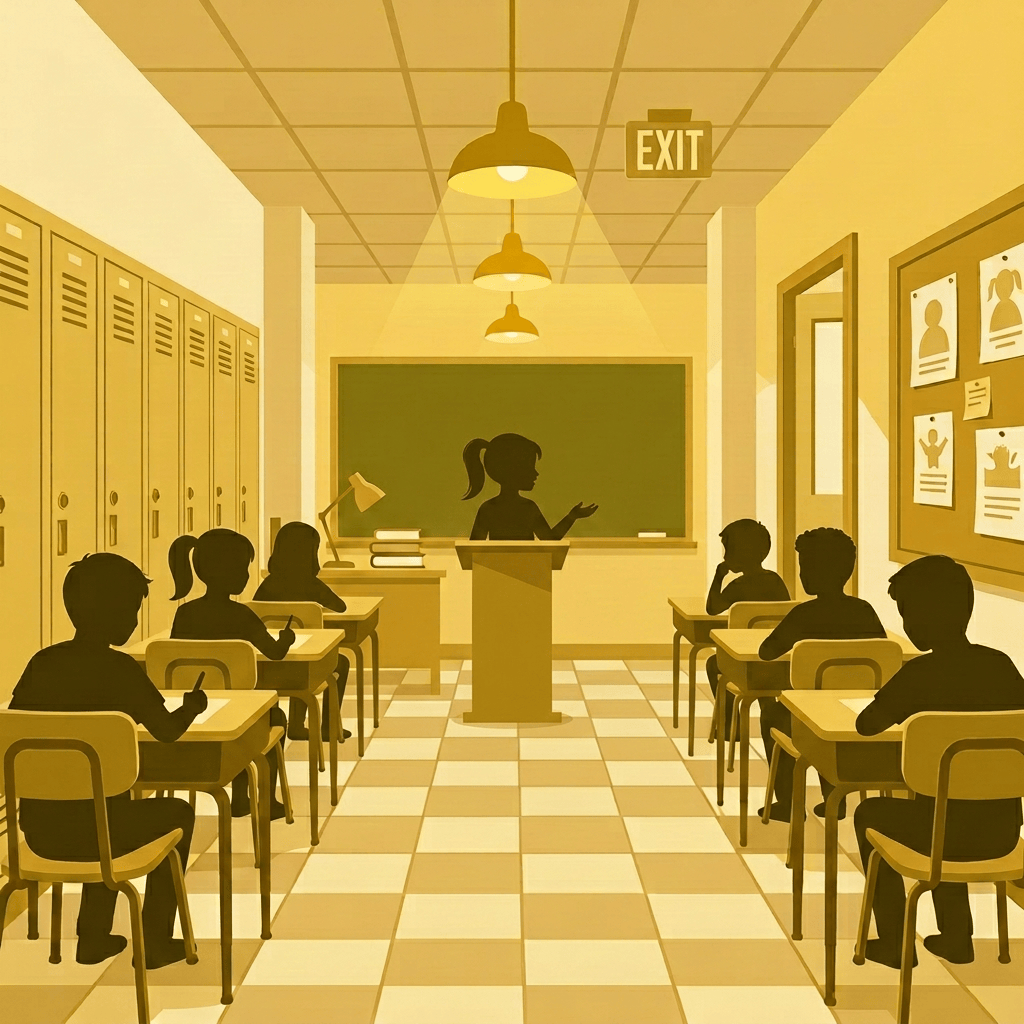
In my previous post, I shared a group of animated AI images that show a girl who is going through a regular day of school. She is living on the Squiggle of Life and is able to resolve the emotional stressors she experienced. One of those stressors was having to give a speech in front of her class. I’m trying to get clarity about why an emotional stressor triggers defensive modes that seem more designed to address physical threats like in the animated AI images I shared with you of a stick figure being chased by a tiger. The flood of mobilizing neuro-chemicals enabled the stick figure to run faster than normal to try to get away from the tiger and the flood of immobilizing neuro-chemicals enabled him to quickly freeze and become undetectable to the tiger. So if there is a physical threat, you resolve the threat by fighting, fleeing, or becoming immobilized if captured in order to be non-reactive (and, therefore, appear to be dead so the predator loses interest) or in order to be undetectable while hiding. But it seems like to me that the way to resolve an emotional threat/stressor is by remaining calm and still…because any added adrenaline will make it harder to stay calm if there is emotional tension.
I asked Google AI about it and here is my summary of the main points of the AI assistant’s answer.
We’ve learned in studying the Polyvagal Theory that our autonomic nervous system acts as a personal surveillance system…always scanning our environments for danger…always assessing what is going on. So when the student stands up in front of the class, her nervous system scans the environment and senses danger because it senses that something high-stakes is going on that could threaten her survival. For humans—and particularly teenagers—social belonging is a biological imperative tied to survival. So if she is noticing looks from her classmates that she perceives indicate that she will be made fun of for the way she is speaking or be ostracized socially…that will signal danger. She could also feel stress if she feels like she is not going to get a good grade on her speech…which would affect her GPA…which affects her future…and her thoughts would start spiraling.
So that explains why she perceives the reaction of her classmates as a social threat. But why does that trigger fight/flight if it is not an imminent life-threat?
The AI assistant said that our nervous systems evolved the ability to respond with speed to all threats. These were the main points of its answer:
1 Triggers instant reaction before fully analyzing
“The amygdala (the brain’s alarm system) acts faster than the thinking part of the brain (prefrontal cortex). It triggers a reaction before you can fully analyze if a situation is a life-or-death crisis or just an awkward social moment. [1, 2]
2 To primitive humans, social rejection equaled death.
“Being rejected or judged by a group meant exile from the tribe, which meant certain death. Because of this, the brain treats social stress and judgment in a classroom the same way it treats a hungry predator.” [1] So, her nervous system can’t tell the difference between a group of classmates and a group of predators.
3 Physical pain and emotional pain use similar pathways in the brain.
Rejection or fear of humiliation activates the exact same survival chemicals—like adrenaline and cortisol—as running from a wild animal.” [1]
4 Default Safety Rule: Safer to react as if it’s a larger threat.
“Evolution favors false positives over false negatives. If your brain mistakes a peer for a predator, you feel unnecessary stress. If your brain mistakes a predator for a peer, you die. The nervous system chooses the safer, louder alarm every time.” [1, 2, 3] So, her nervous system instantly goes into fight/flight before fully analyzing the situation because it has calculated that it would be better for her to mistake a classmate for a tiger than to mistake a tiger for a classmate…which would result in death.
So I think it would be correct to think of it in this way…that when the student got up in front of her class to speak, instead of seeing a room full of peers, her nervous system reacted as if she were in a room full of tigers like in this picture:
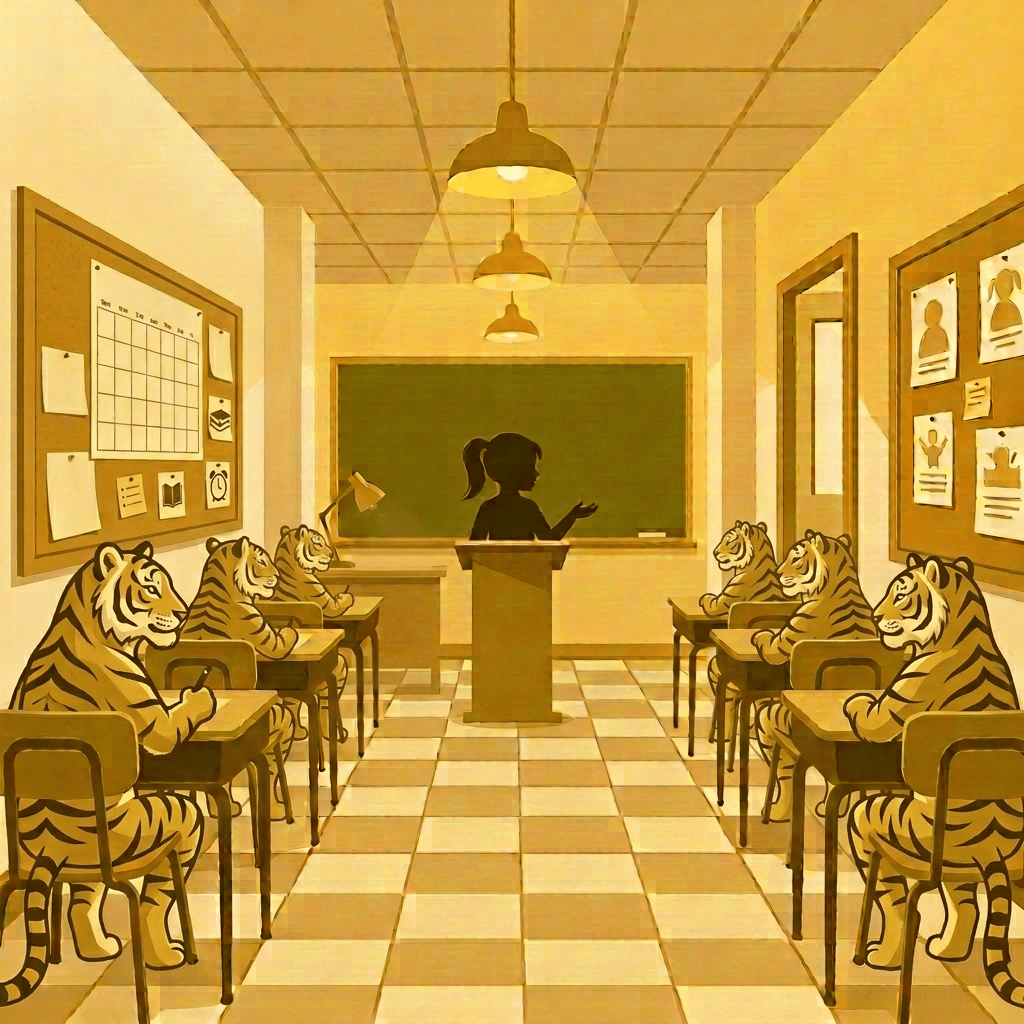
We can see how she would feel a surge of adrenaline in response to seeing the tigers. She would become hyper-focused on their every movement to see if they were looking agitated or like they were going to get out of their desks. The flood of mobilizing chemicals she is experiencing is intended to be used for “extreme, explosive physical action.” So when this is triggered for an emotional threat, it creates a physiological mismatch: her body has produced a massive physical energy for a threat she cannot physically fight or run away from.
Instead of being able to run, she is standing still behind the podium. So all of that survival energy becomes trapped. Left unchecked, this trapped energy will cause the adrenaline rush to backfire, turning what was meant to be a helpful boost of energy into acute physical and mental distress.
She will start to shake. She will have trouble remembering what she was going to say. And as she realizes she is struggling with stress she might panic about how she is doing, which will only increase the stress.
The AI assistant said the adrenaline can be channeled in a way that can provide a helpful boost of energy and focus to the student while she is speaking. She can use the quickened reflexes and maximized vision field to read the reactions of her peers quickly and respond…she can see what they are responding positively to or what they seem to want more of an explanation about…and this can make her speech more engaging and interesting.
The first thing I thought of when I saw the picture with the tigers sitting in the desks was, that if I was that student, I would use very quiet, calming, soothing tone of voice and I wouldn’t make any sudden movements to try to keep the tigers calm. And that made me think of something Stephen Porges said in his article, “The polyvagal theory: New insights into adaptive reactions of the autonomic nervous system.” He said that mammals have a social engagement system…a face-heart connection…that enables social interactions to regulate visceral state. If you watch any videos about the Polyvagal Theory, he talks a lot about how warm facial expressions and soothing tones of voice can be used to calm our nervous systems. So the key here is that she wasn’t standing in front of a room full of tigers. She had more options she could use to try to resolve the treat because it was not an imminent life-threat. She could look for friendly faces in the classroom, or pause and say “I’m feeling really nervous today” and then she would probably hear some encouraging comments before starting the speech, which would increase her ability to keep her voice calm and to be able to speak in a clear and interesting way.
So I think it is correct to say that Ventral Vagal (green) can also be considered as a defensive mode because sometimes – especially with emotional stressors/tension – the best defense is to be able to remain calm and keep your social engagement system online. I will write more about this soon. If we can learn to stay in VV for some threats, that can take the strain off of our nervous systems.
The other thing I noticed when I looked at the picture of the tigers was that I didn’t feel any social threats in response to the tigers. The tigers wouldn’t care what I was wearing or what I looked like. So that helped my mind differentiate between physical threats and social threats – which is hopefully a step towards being able to respond differently. Physical threats trigger predator/prey responses…like when I thought about seeing the tigers sitting in the desks. You are just thinking about that the tiger will see you as prey and might try to chase you. Emotional threats usually trigger a lot of confusion. In those cases, you have to think through all of the social rules and you are thinking about how something you might say (forgetting your words, not making sense) or something you might do (shaking, trembling) might cause you to be a target of comments or might cause you to be ostracized…which to our nervous system signals danger like we were talking about earlier.
Fight/Flight and Freeze are very helpful defensive modes. I think the problem is that our nervous systems are responding to different threats (emotional instead of physical) with the same defensive modes (fight/flight and freeze). While these defensive modes can be helpful in response to emotional threats, going into these modes too frequently is very taxing on our systems. And people often are not able to complete the cycle…which includes properly discharging all of the mobilizing chemicals that got cued up.
I was thinking about the video I posted of an impala in immobility and it was clicking in my mind that that was probably the only time in its life that the impala would go into a state like that. I asked my counselor about it at my Somatic Experiencing appointment this week and she was saying that it’s a rare event for the animal. Sadly, a lot of the time if an animal has been captured, it doesn’t escape. And if it does – like the impala in the video – it’s not going to be going into immobility again on a regular basis.
So, animals bodies are not designed to go into immobility on a regular basis. And our human bodies are not designed to be going into a deep freeze like that very often. Animals might go into fight/flight and less intense freezes more regularly. But animals can actually take off running right away and discharge all of that energy. Humans…especially in regards to emotional threats…end up with that energy staying trapped in their bodies.
To summarize the main points from this post, Physical pain and emotional pain use similar pathways in the brain. So our nervous systems respond to different threats (emotional instead of physical) with the same fight/flight and freeze responses. These responses can be helpful. But the problem is if we are triggered into them too often and if we don’t complete the cycle by discharging the mobilization energy. Also, it’s important to remember that Ventral Vagal can be used as a defensive system.
I will stop here for today and write again soon.


Leave a comment